Argentine · Main Course
Milanesa
Thin beef cutlets pounded flat, breaded and fried, Argentina's most-cooked weeknight dish.
Not the same asWiener schnitzel (A veal cutlet fried in clarified butter or lard and served with lemon and typically potato salad or parsley potatoes; milanesa is beef, fried in a neutral oil, and just as often eaten with a fried egg on top or piled with tomato, ham and cheese.)Cotoletta alla milanese (The Milanese original is a bone-in veal rib fried in clarified butter; Argentine milanesa uses a boneless, lean cut and a plain frying oil.)
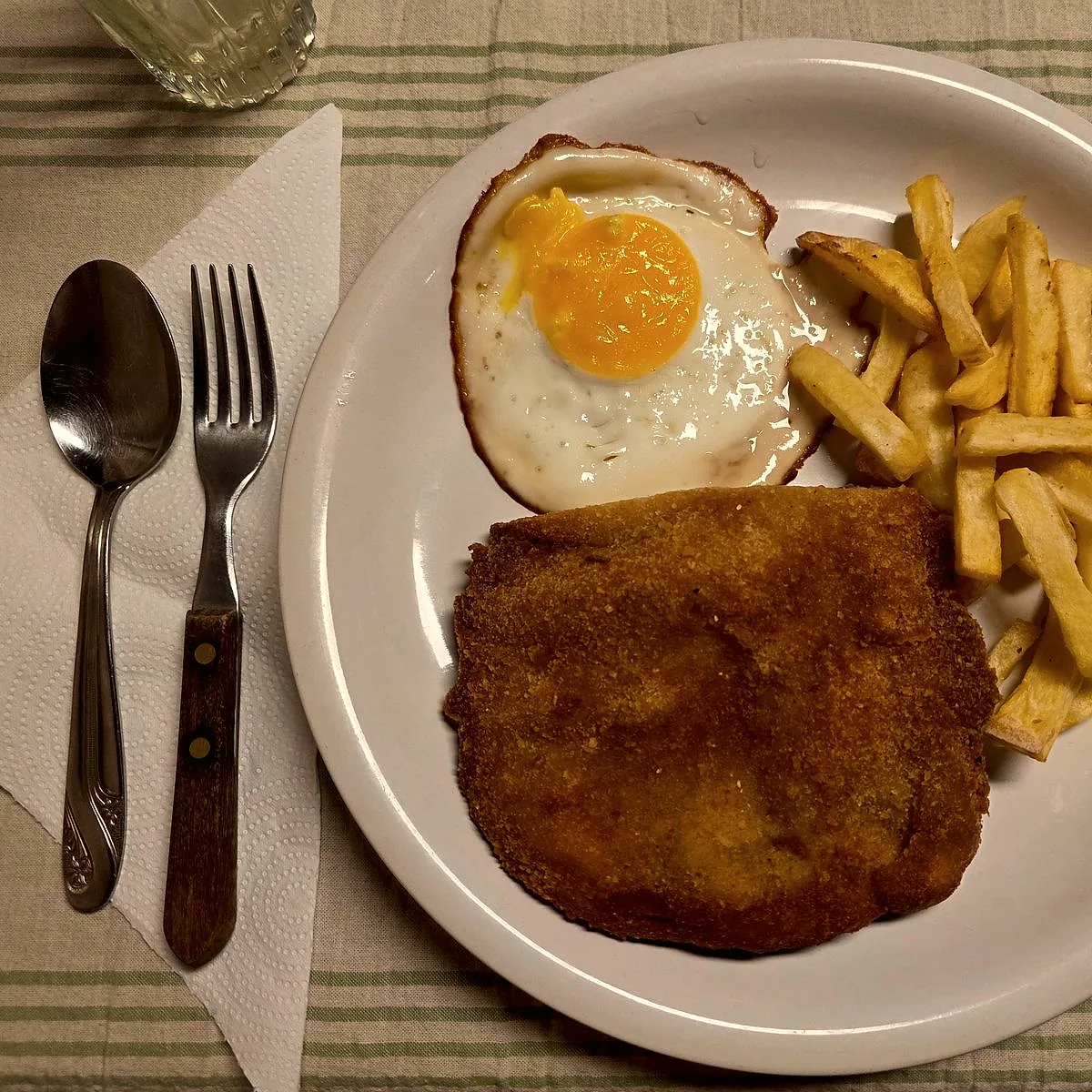

CC BY-SA 3.0. Cropped and colour-adjusted for this site.
Method
Season the 480 g raw beef topside on both sides with the 1 ½ garlic cloves (8 g), 5 g flat-leaf parsley, 6 g fine sea salt and 2 g ground black pepper.
Dip each cutlet in the 2 eggs (100 g), letting the excess drip off, then press it into the 150 g dried breadcrumbs on both sides until fully coated.
Heat the 300 ml vegetable oil in a wide pan until shimmering. Fry the cutlets for 12m in total, turning once, until deep golden and crisp on both sides. Drain briefly on paper before serving.
Common pitfallCrowding the pan or frying at too low a heat lets the crumb soak up oil instead of sealing quickly, giving a soggy, greasy coating rather than a crisp one. The oil needs to be hot enough that the crumb sizzles the instant the cutlet goes in.
Milanesa takes its name, and its basic idea, from Milan's cotoletta alla milanese, a breaded cutlet that in its home city is traditionally cooked bone-in and fried in butter [1][3]. Whether that dish or Vienna's schnitzel came first is its own long-running dispute, tied up in an unverified legend about an Austrian field marshal carrying the recipe home from Italy in the 1850s; no document has been found to support it, and La Nación's own review of the claim warns that cities competing over a dish's birthplace tend "to recreate past realities or invent false accounts" rather than settle the question [3]. That argument belongs to the cotoletta and the schnitzel, not to what happened once the idea reached Argentina.
What happened there was immigration on a scale that reshaped the country's food. Argentina absorbed one of the largest waves of Italian arrivals anywhere outside Italy between 1870 and 1920, and that immigration, combined with the quality and availability of Argentine beef, is what let the Milanese preparation take root in home kitchens rather than stay a restaurant dish [1][3]. Historians of Argentine food more broadly describe this period (Italian and Spanish immigration converging in the same decades) as the point at which received ideas about what counted as national cuisine were actively contested and remade, rather than simply inherited from a colonial Spanish table [2]. The word itself is first documented in the 1914 eighth edition of Francisco Figueredo's El libro de Cocina, not yet as a dish in its own right but as a modifier in recipe titles ("Costillas a la milanesa" and "Escalopes de ternera a la milanesa"), with "milanesa" appearing as a standalone noun only in later cookbooks, including Doña Petrona's influential 1950 edition [3].
The dish that resulted diverged from its Italian source as it settled in. Argentine milanesa is made from a boneless, lean beef cut rather than a bone-in veal rib, pounded thin and fried in a plain oil rather than clarified butter, and it moved from an occasional dish to one of the most frequently cooked meals in the country, eaten plain with lemon, topped with a fried egg, or piled with ham, tomato and cheese as milanesa a la napolitana. Surveys cited by La Nación put average consumption at around three servings per person a week [3], a scale of everyday repetition that says as much about the dish's Argentine afterlife as any single origin story can.
Sources
- Milanesa, WikipediaTraces the dish to the Milanese cotoletta, gives the scale of Italian immigration to Argentina between 1870 and 1920, and records the word's first appearance in a 1914 Buenos Aires cookbook.
- La Cocina Criolla: A History of Food and Race in Twentieth-Century Argentina, Cambridge University PressAcademic account of how the wave of Italian and Spanish immigration around the turn of the twentieth century reshaped ideas of what counted as Argentine food.
- La verdadera historia de la milanesa: dónde nació y por qué la comemos tanto, La NaciónArgentine national newspaper account confirming the bone-in, butter-fried Milanese original, the Figueredo cookbook's exact 1914 recipe titles, and warning against invented city-of-origin claims.