American · Dessert · Breakfast
Glazed Doughnuts
An enriched yeast dough proved twice, fried in deep fat and dipped warm in a thin sugar glaze that sets to a shine.
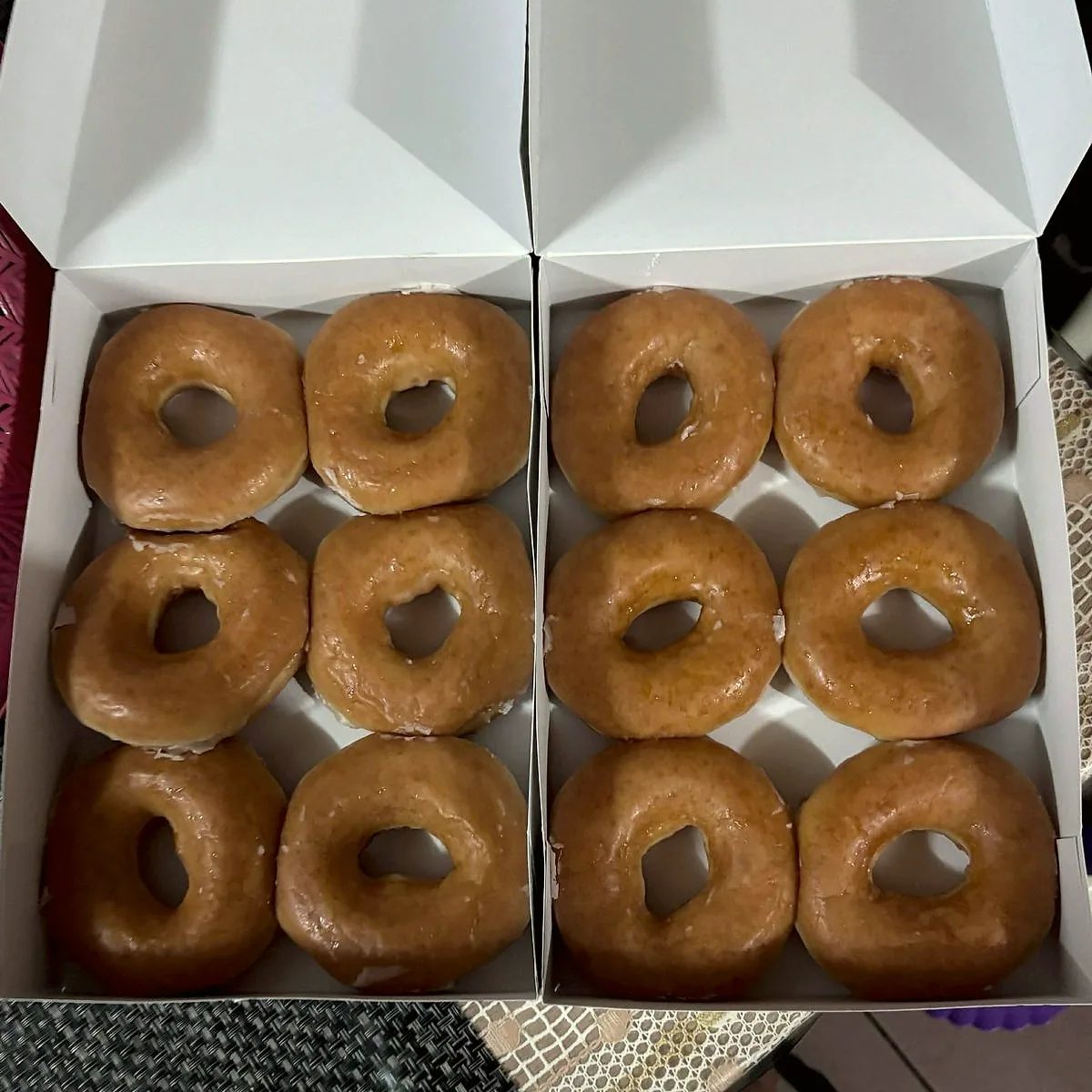

CC BY 4.0. Cropped and colour-adjusted for this site.
The same dish, adapted. Every quantity, time and figure below changes with the version.
Method
Warm the 240 ml milk and stir in the 7 g dried yeast and a little of the 50 g caster sugar; leave it until foaming. Combine the 500 g bread flour, the remaining sugar and the 6 g fine sea salt in a large bowl, then work in the milk mixture, the 1 egg (50 g) and the 50 g unsalted butter to a rough dough. This takes 10m.
Knead the dough for 8m, until it is smooth, elastic and no longer sticks to the sides of the bowl.
Cover the bowl and leave the dough somewhere warm for 1h 15m, until it has roughly doubled.
The long first prove is where the yeast does most of its work and the dough builds the structure that will trap gas during frying; a dough proved too briefly here fries dense no matter how well it is shaped afterwards.
Turn the dough out and roll it to an even thickness. Cut rounds with a doughnut cutter, and cut a hole from the centre of each. Set the rings and holes apart on trays lined with paper, using 12m.
Cover the trays loosely and leave the shaped dough to prove again for 40m, until visibly puffed.
Meanwhile heat the 1.5 L vegetable oil in a deep pan to 180 °C, using 15m to bring it up slowly and settle at temperature.
Fry the doughnuts a few at a time for 10m in total, turning once, until deep golden on both sides. Lift them onto a rack set over paper to drain.
Common pitfallOil that is too hot browns the crust before the centre cooks through, leaving a doughnut that looks done and is not. Oil that is too cool lets the dough soak up far more fat than it should. A thermometer is the only reliable check.
Whisk the 240 g icing sugar with the 45 ml milk and the 4 ml vanilla extract to a thin, pourable glaze. Dip the warm doughnuts in the glaze and set them back on the rack to let it set, over 5m.
Method
Whisk together the 480 g plain flour, the 12 g baking powder, the 2 g bicarbonate of soda, the 2 g ground nutmeg and the 5 g fine sea salt. This takes 3m.
Whisk the 150 g caster sugar into the 45 g unsalted butter, then whisk in the 2 eggs (100 g), the 180 g cultured soured cream and the 8 ml vanilla extract, over 4m, until smooth.
Fold the dry ingredients into the wet ingredients over 3m, stopping as soon as a soft, sticky dough comes together. It will be far too soft to cut yet.
Cover the bowl and refrigerate the dough for 30m, until firm enough to roll.
Common pitfallThis dough is soft and sticky rather than elastic, since it has no gluten development to fall back on for structure. Chilling it firm enough to cut is what makes it workable, and skipping the rest leaves a dough that will not hold a shape.
Roll the chilled dough to an even thickness on a floured surface and cut rounds with a doughnut cutter, cutting a hole from the centre of each. Gather and re-roll the scraps once. This takes 10m.
Meanwhile heat the 1.5 L vegetable oil in a deep pan to 175 °C, using 15m to bring it up slowly and settle at temperature, a little cooler than for a yeasted dough, since this one is denser and cooks through more slowly.
Fry the doughnuts a few at a time for 10m in total, turning once, until deep golden and a skewer through the centre of one comes out clean. Lift them onto a rack set over paper to drain.
Whisk the 240 g icing sugar with the 45 ml milk and the 4 ml vanilla extract to a thin, pourable glaze. Dip the warm doughnuts in the glaze and set them back on the rack to let it set, over 5m.
The doughnut reached America by way of Dutch settlers in New Amsterdam, who brought a yeasted, egg-rich fried dough they called oliekoecken, or oil cakes, studded with dried fruit and dropped by the spoonful into hot fat [1][2]. That dough had no hole in it; the shape most associated with the doughnut today is a later, and far less settled, addition.
The story usually told credits a single sea captain. Elizabeth Gregory, mother of a New England ship's captain, is said to have fried a spiced dough using spices from her son's cargo, sometimes packing nuts into the centre where the dough was slowest to cook through [1]. Her son, Hanson Gregory, later claimed the credit for the hole itself, telling the Boston Post that he had punched it out with the top of a round tin pepper box so the centre would cook evenly [1]. A competing version of his own story has him skewering an unfinished doughnut onto a spoke of his ship's wheel during a storm, the hole appearing by accident rather than design [2].
Neither version has held up especially well under scrutiny. Some historians studying the claim have suggested more mundane motives (economising on ingredients, or easing digestion) behind a hole Gregory dressed up as an inspired accident, and ring-shaped fried pastries already appear in cookbooks from the 1840s, before his claimed date, as well as in fried-dough traditions well outside America entirely [1]. Tori Avey's own account of the ship's-wheel version calls it "probably not true, but a fun story nonetheless" [2], and both pieces treat the captain as the traditional face of an invention that plainly happened by more diffuse means.
Sources
- The History of the Doughnut, Smithsonian MagazineOn Dutch olykoeks reaching New Amsterdam, Elizabeth Gregory's fried dough and her son Hanson Gregory's pepper-tin account of cutting the first hole, and the skepticism historians have raised about it.
- Doughnut Delights: Exploring the History of a Sweet Treat, Tori AveyOn the Oxford Companion to American Food and Drink's description of Dutch oliekoecken, the practical reason usually given for the hole, and the ship's-wheel version of the Gregory story, which the piece itself calls probably apocryphal.