Chinese · Breakfast
Congee
Rice simmered slowly in a large volume of water until it breaks down into a smooth, thick porridge, seasoned only with salt and a little oil.
Also known asJook · GuangdongZhou
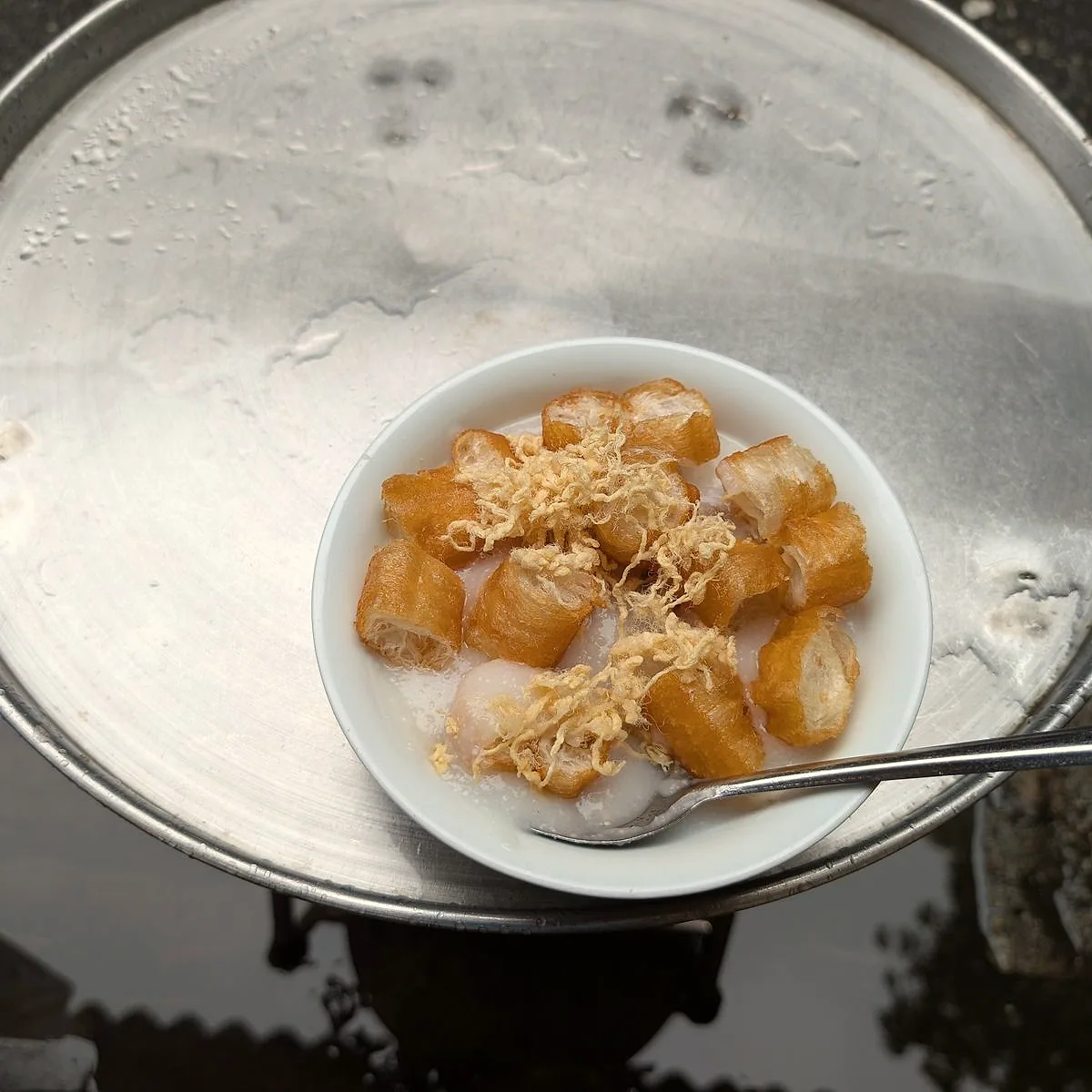

CC BY-SA 4.0. Cropped and colour-adjusted for this site.
The same dish, adapted. Every quantity, time and figure below changes with the version.
Method
Rinse the 200 g rice in several changes of water until it runs mostly clear, then drain.
Put the rice and the 2 L water in a large, heavy pot and bring to the boil, then reduce to the lowest possible simmer. Cook uncovered, stirring occasionally to stop the rice catching on the base, for 1h 15m, until the grains have broken down into a smooth, thick porridge.
A very low, barely-there simmer rather than a rolling boil is what breaks the grains down evenly into the porridge's characteristic smooth, thick consistency, rather than leaving whole grains suspended in a thin liquid.
Stir in the 6 g fine sea salt and 10 ml toasted sesame oil, and finish with the 1 spring onion (15 g).
Method
Rinse the 200 g rice in several changes of water until it runs mostly clear, then drain.
Combine the 200 g pork mince, 10 ml light soy sauce and 8 g cornflour in a bowl and set aside.
Put the rice and the 2 L water in a large, heavy pot and bring to the boil, then reduce to the lowest possible simmer. Cook uncovered, stirring occasionally to stop the rice catching on the base, for 1h 15m, until the grains have broken down into a smooth, thick porridge.
Stir in the 2 century eggs (130 g), 5 g fine sea salt and 1 g ground white pepper, and simmer gently for 5m.
Loosen the marinated pork with your fingers and drop it into the pot in small pieces, stirring gently. Simmer for 4m, until the pork is cooked through and separated into fine strands, then finish with the 10 ml toasted sesame oil, 10 g fresh ginger and 1 spring onion (15 g).
Dropping the marinated pork in loosely, a little at a time, rather than as one mass lets each piece separate into fine strands in the simmering congee instead of clumping into a single dense lump.
Congee's Chinese name, zhou, is attested in writing under the Zhou dynasty, where the Book of Rites lists rice porridge among everyday foods and recommends it particularly for the elderly and the sick [2] [1].
Long before it was an everyday breakfast, congee was treated as medicine. The Han dynasty physician Zhang Zhongjing, later called the father of Chinese clinical medicine, included rice porridge in his medical writing as a way to warm the stomach and help patients recover their strength after illness [2]. It served a more practical role too: a small quantity of rice, stretched with a large volume of water, could feed far more people than the same rice cooked whole, which made congee a standard resort in famine and wartime as well as in the sickroom.
The plain porridge is a base as much as a dish in its own right, and the range of things cooked into or spooned over it reflects that. Century egg and pork is the best-known topped version today, particularly in Cantonese cooking, where it is known as pei dan sau yuk juk.
Sources
- Congee, WikipediaGives the Tamil etymology of the English name, the Chinese term zhou, and the century-egg-and-pork variant's modern popularity.
- One of the Oldest Recorded Recipes of Humanity — Congee, Eats HistoryCovers the Book of Rites reference under the Zhou dynasty and Zhang Zhongjing's use of congee as medicine in the Han dynasty.