Argentine · Main Course
Choripán
A grilled chorizo split and pressed flat, tucked into a crusty roll with a vinegary parsley dressing. Argentina's standard grill-side sandwich.
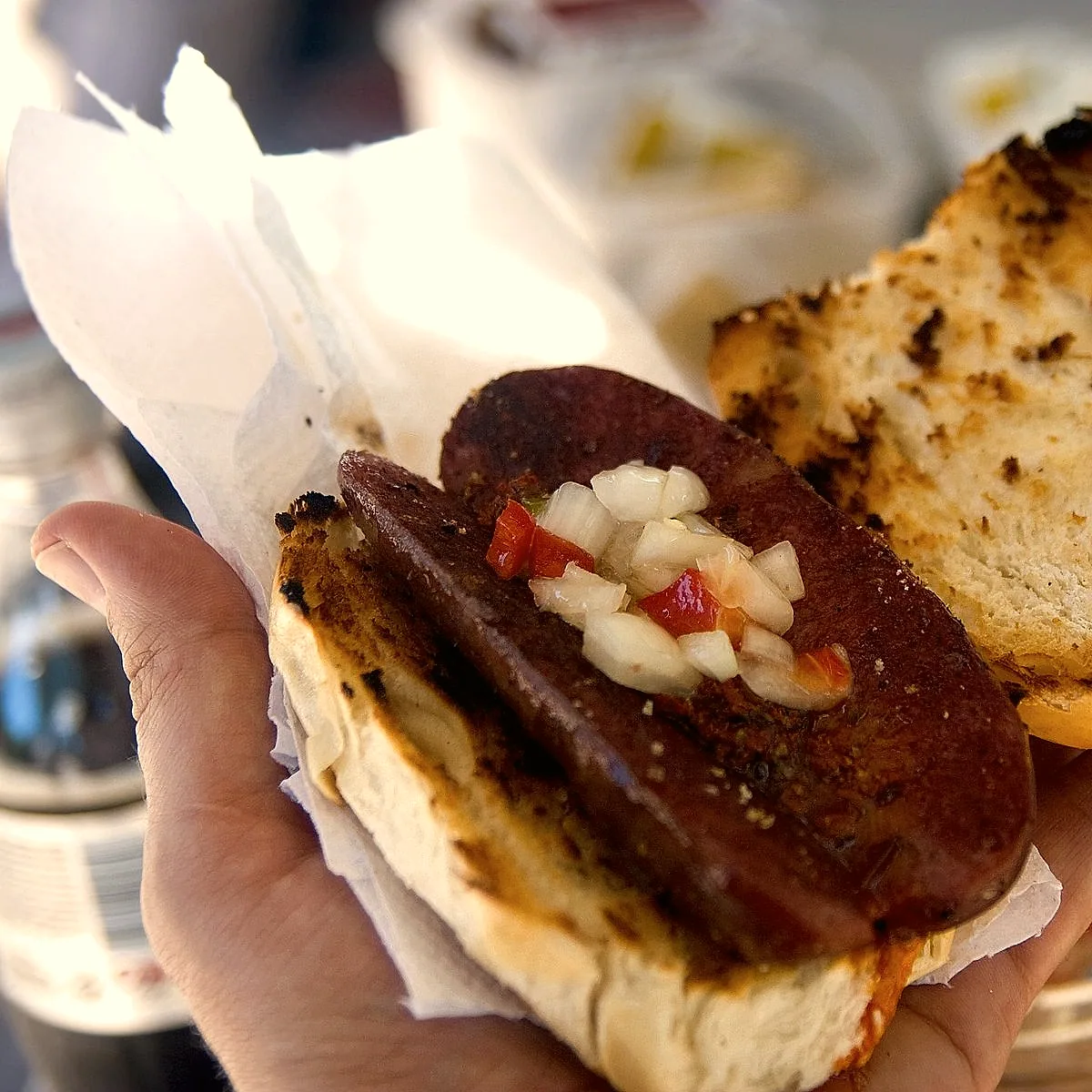

CC BY 2.0. Cropped and colour-adjusted for this site.
Method
While the chorizo grills, combine the 10 g flat-leaf parsley, 1 garlic clove (6 g), 2 g oregano and 1 g chilli flakes in a bowl, then stir in the 20 ml red wine vinegar, 40 ml extra-virgin olive oil and 2 g fine sea salt.
Grill the 400 g raw chorizo split side down first, then turn and cook for 15m in total, until the casing is well coloured and the sausages are cooked through and opened out flat.
Warm the 4 rolls (280 g) briefly on the grill, cut side down. Lay a split chorizo inside each roll and spoon over the dressing.
Choripán's name needs no decoding: chori, for chorizo, and pan, bread. Beyond that, the documented history is thinner than the sandwich's ubiquity suggests. Wikipedia's account of the dish includes a period photograph, dated 1925, of vendors selling something described as choripán on a Buenos Aires street (the earliest visual trace anyone has produced), though the setting most associated with the sandwich today, the grill carts along the city's Costanera riverside, is independently dated only to the early 1960s [1][3]. That gap of several decades between the earliest image and the earliest well-documented everyday setting is itself telling: the sandwich in some form is older than its modern street-food identity. The historian Daniel Balmaceda argues, separately, that the choripán eaten today (the sausage split, grilled and dressed rather than simply pushed whole into bread) was not fixed in that form until it came together at Parque Sarmiento in Córdoba in the 1950s, before spreading outward from there [2]. No source fixes an exact date or a single inventor for either moment, and the two accounts describe different things: an earlier, looser Buenos Aires street food, and a later Córdoba refinement of the sandwich into its now-standard form.
By the end of that decade the dish had reached national and even international notice: Fidel Castro reportedly ate a choripán from a cart on Buenos Aires's Costanera Norte during his visit to Argentina in 1959, a detail that places the sandwich squarely in the capital's street-food scene by the time Balmaceda's Córdoba version was supposedly still spreading [2]. Neither Córdoba nor Buenos Aires has conceded the point to the other. What is not disputed is the role the sandwich plays: it is the food eaten while an asado is still cooking, sold outside football stadiums and at roadside stalls, and treated as everyday food rather than as anything needing an origin story, which may be exactly why so little of one was written down before now.
Sources
- Choripán, WikipediaGives the plain etymology (chorizo plus pan) and includes a photograph of choripán street vendors in Buenos Aires dated to 1925.
- Choripán. Clásico o veggie, el origen se remonta a Córdoba y tiene su propio recorrido, La NaciónArgentine national newspaper account citing the historian Daniel Balmaceda on the sandwich's 1950s consolidation at Córdoba's Parque Sarmiento, and Fidel Castro eating one from a Buenos Aires riverside cart in 1959.
- El choripán: la historia del manjar argentino que nació entre brasas, gauchos y canchas de fútbol, Canal 26Argentine television news account dating the Costanera riverside carts, the setting most associated with the sandwich's Buenos Aires street-food identity, to the early 1960s.