Peruvian · Starter
Ceviche
Cubes of raw white fish firmed by a brief, sharp lime marinade, tossed with red onion and chilli and served cold with boiled sweet potato and corn.
Not the same asTiradito (Thin, sashimi-style slices dressed with a citrus and ají cream and plated without onion, closer to Peruvian-Japanese carpaccio than to ceviche's cubed, onion-tossed style.)
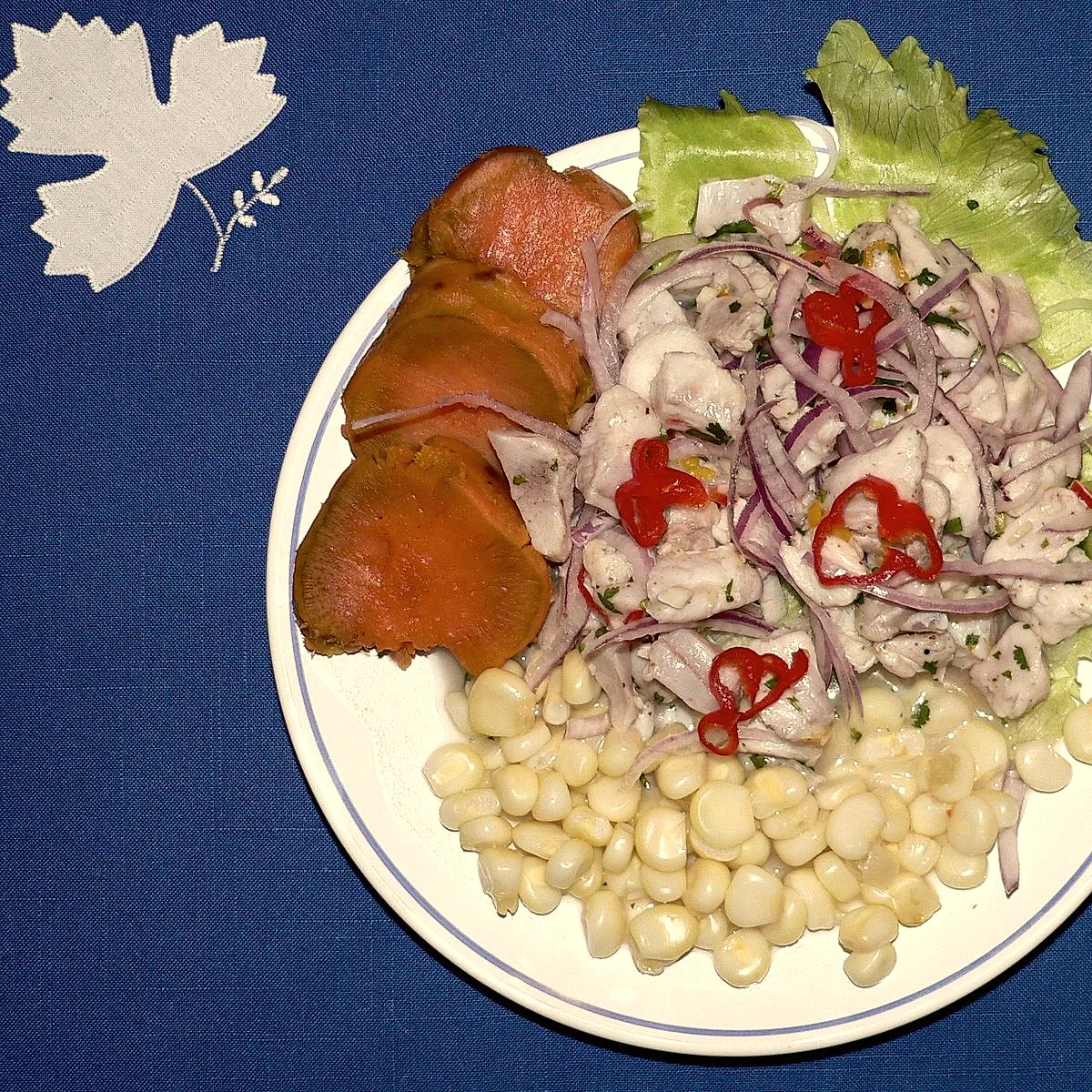

CC BY 3.0. Cropped and colour-adjusted for this site.
The same dish, adapted. Every quantity, time and figure below changes with the version.
Method
Bring a pot of salted water to the boil and cook the 300 g sweet potato and 200 g corn together until the potato is tender to a knife point, about 20m. Drain and set aside to cool.
Cut the 600 g corvina into small, even cubes, discarding any dark bloodline or stray bones as you go. This takes 8m.
Common pitfallCitrus acid does not reliably kill parasites the way cooking does, so the fish needs to have been previously frozen solid; fresh, never-frozen fish is not safe prepared raw this way.
Stir the 200 ml fresh lime juice, 4 ají limos (15 g), 1 ½ garlic cloves (8 g) and 6 g fine sea salt together in a wide, non-reactive bowl. This takes 3m.
Add the fish cubes to the marinade and toss briefly to coat every piece, then leave for 6m, until the flesh has turned opaque and firm at the edges but still looks faintly translucent at the centre.
The lime's acidity denatures the fish's surface proteins the way heat would, firming and whitening the flesh, but it works far more gently than heat and only needs minutes rather than the long marinade older versions of this dish used.
Common pitfallLeft in the lime juice much beyond the given time, the fish turns tough and chalky rather than staying tender, since the acid keeps denaturing the proteins well past the point that reads as "done."
Fold the 100 g red onion and 10 g fresh coriander through the cured fish and its marinade. Line each plate with a 60 g romaine leaf, spoon the fish and its juices on top, and arrange the drained sweet potato and corn alongside. This takes 6m; serve straight away.
Method
Bring a pot of salted water to the boil and cook the 300 g sweet potato and 200 g corn together until the potato is tender to a knife point, about 20m. Drain and set aside to cool.
Bring a small pan of water to the boil with the 2 g fine sea salt and drop in the 200 g shrimp. Cook for 3m, until just pink and opaque, then drain and plunge into iced water to stop the cooking. Drain again and halve each shrimp lengthways.
Common pitfallShrimp left in the hot water any longer than the given time turns rubbery well before the fish beside it is ready, since shrimp firms with heat far faster than the fish firms with acid.
Cut the 400 g corvina into small, even cubes, discarding any dark bloodline or stray bones as you go. This takes 8m.
Stir the 220 ml fresh lime juice, 4 ají limos (15 g), 1 ½ garlic cloves (8 g) and 5 g fine sea salt together in a wide, non-reactive bowl. This takes 3m.
Add the fish cubes to the marinade and toss briefly to coat every piece, then leave for 6m, until the flesh has turned opaque and firm at the edges but still looks faintly translucent at the centre.
Fold the blanched shrimp, 100 g red onion and 10 g fresh coriander through the cured fish and its marinade. Line each plate with a 60 g romaine leaf, spoon the fish, shrimp and their juices on top, and arrange the drained sweet potato and corn alongside. This takes 6m; serve straight away.
Ceviche is Peru's national dish, and in 2023 UNESCO added the practices around preparing and eating it to its list of intangible cultural heritage [2]. Exactly where the underlying technique (raw fish cured in an acid until it firms) began is disputed rather than settled. Archaeological evidence of fish and chilli seeds in human remains on Peru's northern coast points to the pre-Inca Moche, and the food historian Maricel Presilla places the dish's likely birthplace near the fishing town of Huanchaco [1]. Ecuador makes a rival claim resting on the shellfish record of the Valdivia culture, further north and of comparable age [2], and the honest position is that a shared coastal technique predates any single national claim to it.
The citrus marinade now considered essential to the dish is itself a later graft onto that technique: limes and bitter oranges reached the Peruvian coast only after 1492, carried by Spanish and Portuguese traders, and displaced earlier acidic macerations made with native fruit and fermented corn drink [1].
What the citrus does to the fish is a genuine chemical change and a common source of confusion. Its acidity coagulates the muscle protein much as heat does, turning the flesh firm and opaque, but the two processes are not the same thing: acid denaturation is gentler than heat, which is why cured fish stays moist where cooked fish dries out, and unlike heat it does nothing reliable to the parasites raw fish can carry [3].
The brief marinade served today is itself recent. Older Peruvian ceviche sat in citrus for a long stretch; the now-standard version, dressed for minutes rather than hours, followed the arrival of Japanese immigrants whose sashimi tradition favoured showing off freshly cut raw fish, and took hold in Lima's restaurants only within the last several decades [1].
Sources
- Ceviche: the surprising history behind Peru's raw fish dish, National GeographicOn the Moche-era origin near Huanchaco, the arrival of citrus after 1492, and the Japanese-Peruvian shortening of the marinade in the twentieth century.
- Ceviche, WikipediaOn the disputed place of origin between Peru and Ecuador and the 2023 UNESCO recognition.
- Is Ceviche Really Safe? Ask Paul, America's Test KitchenOn the chemistry of acid-firmed fish versus heat-cooked fish, and on what the acid does not do to parasites.