Brazilian · Side
Arroz e Feijão
White rice sautéed in garlic and oil, served beside a pot of simmered black beans. Together they are the pairing eaten daily at most Brazilian tables.
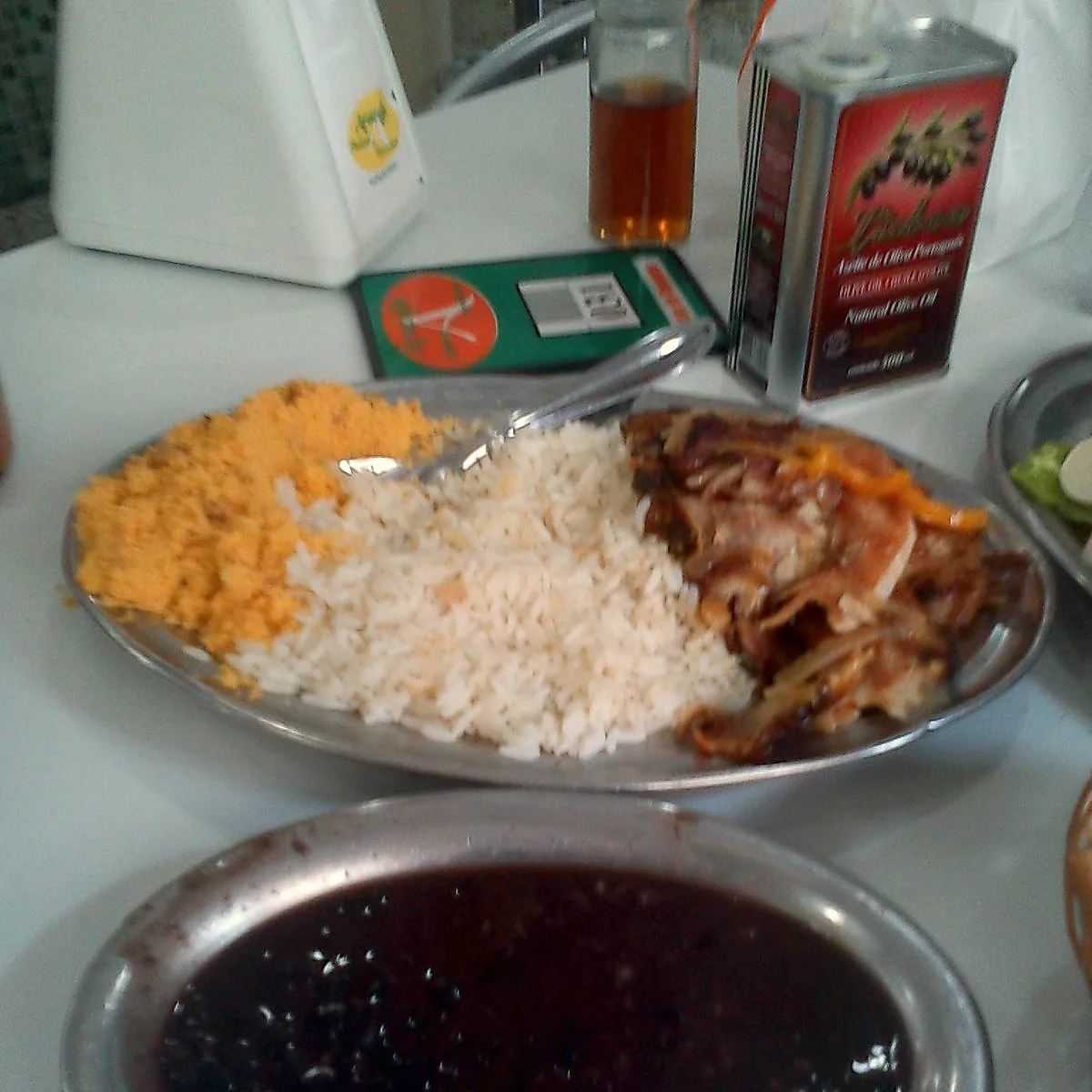
.jpg)
CC BY-SA 2.0. Cropped and colour-adjusted for this site.
Method
Soak the 250 g dried black beans in plenty of cold water for 8h, then drain.
Warm the 15 ml extra-virgin olive oil in a pot and cook the 50 g white onion and 1 ½ garlic cloves (8 g) until soft. Add the drained beans, the 2 ½ bay leaves (0.5 g) and the 900 ml water. Bring to a simmer and cook for 1h, partially covered, until the beans are fully tender and the liquid has thickened slightly. Stir in the 5 g fine sea salt once tender.
While the beans simmer, warm the 15 ml extra-virgin olive oil in a separate pot and cook the 50 g white onion and 1 ½ garlic cloves (8 g) until soft. Add the 250 g rice and stir for a minute to coat the grains in the oil, then pour in the 450 ml water and the 3 g fine sea salt. Bring to a boil, then cover and cook over the lowest heat for 18m, until the water is fully absorbed and the rice is tender. Rest, covered and off the heat, for a few minutes, then fluff with a fork.
Sautéing the rice grains in oil with the onion and garlic before the water goes in coats each grain and lightly toasts it, which is what keeps the cooked rice separate and fluffy rather than starchy and clumped.
Rice and beans arrived in Brazil from opposite directions. Beans were already cultivated by Indigenous peoples across the Americas before Portuguese colonisation, while rice came with the colonists themselves. What made the pairing a national habit rather than a coincidence was price: from the seventeenth into the eighteenth century, beans cost roughly a sixth of what rice did in São Paulo, and their low cost and long storage life made them standard provisions for the tropeiros (mule and cattle drivers who carried goods between Minas Gerais and São Paulo from the seventeenth century onward) and for expeditions travelling into Brazil's interior more generally [1][3]. Rice and beans, cooked together or alongside each other, became the food that stretched furthest for the least money; it was a habit that outlasted the economic conditions that first produced it.
That habit has since become close to universal. A Brazilian restaurant industry estimate puts the number of rice-and-beans meals served daily in the country's bars, restaurants and lunch counters above eighty million, across every region and social class [2]. The pairing is also nutritionally complementary in a way that predates any awareness of amino acids: rice supplies methionine and beans supply lysine, and together they form a more complete protein than either provides alone [2]. The combination is so thoroughly ordinary that the phrase "arroz com feijão" functions in everyday Brazilian Portuguese as an idiom for whatever is plain, standard or unremarkable. It is the linguistic equivalent of calling something bread and butter.
Regional versions branch off from this shared base: feijão tropeiro adds cassava flour, egg and bacon to the beans in Minas Gerais, baião de dois cooks rice and beans together with cheese in the Northeast, and arroz carreteiro folds dried beef through the rice itself in the South. The everyday version (a pot of beans beside a pan of plain sautéed rice) remains the one eaten most often, precisely because it asks the least of a cook and a kitchen.
Sources
- Feijão tropeiro, WikipediaCites food historians including Carlos Alberto Dória on beans as a cheap seventeenth- and eighteenth-century staple, priced at a sixth of rice in São Paulo and carried as provisions by expeditions into Brazil's interior.
- Arroz com feijão: símbolo da comida brasileira no Dia Mundial da Alimentação, Rádio ItatiaiaBrazilian news report citing the Abrasel restaurant association's estimate of over eighty million rice-and-beans meals served daily in Brazil's bars and restaurants.
- Feijão tropeiro: um prato cheio de histórias, Michelin Guide BrasilIndependent account of tropeiro cattle-and-mule drivers carrying dried, non-perishable beans and flour between Minas Gerais and São Paulo from the seventeenth century onward, with no single point of origin for the regional dish this produced.