American · Dessert
Apple Pie
Sliced apples baked in a butter pastry shell under a full top crust, the two sealed together and vented to let their steam escape.
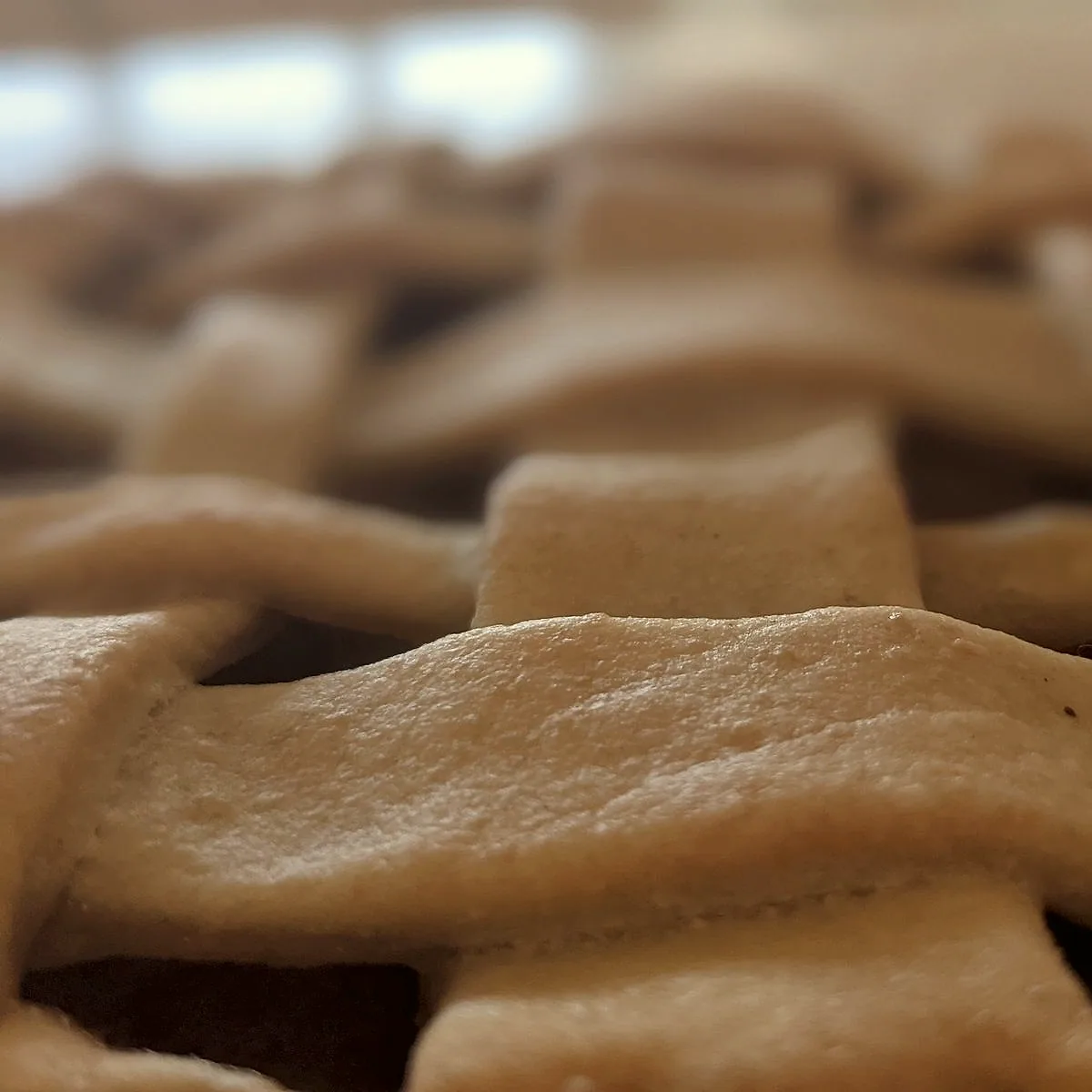

CC BY 4.0. Cropped and colour-adjusted for this site.
The same dish, adapted. Every quantity, time and figure below changes with the version.
Method
Combine the 310 g plain flour, 6 g fine sea salt and 12 g caster sugar in a large bowl. Add the 227 g unsalted butter and rub or cut it into the flour until the largest pieces are the size of small peas. Sprinkle in the 90 ml water a little at a time, turning the mixture with a fork until it holds together when pressed, then divide it into two discs. The whole of 10m should leave streaks of butter still visible rather than a smooth paste.
Wrap both discs and refrigerate them for 1h, until firm but not hard.
Cold butter is what makes a pastry flake rather than crumble; the pieces stay solid until the oven's heat turns their water to steam, and it is that steam pushing between layers of dough that lifts them apart.
Meanwhile toss the 1 kg apple with the 150 g caster sugar, the 50 g light brown sugar, the 3 g ground cinnamon, the 1 g ground nutmeg, the 15 ml freshly squeezed lemon juice, the 25 g cornflour and the 2 g fine sea salt in a large bowl, and leave it to stand while the dough finishes chilling.
Roll one disc of dough into a round wide enough to line a pie dish with an overhang all round, using 8m. Ease it into the dish without stretching it, which only pulls the pastry back as it bakes.
Spoon the apple filling into the lined dish, piling it slightly domed in the centre, and scatter the 20 g unsalted butter over the top. This takes 5m.
Roll the second disc and lay it over the filling. Trim the edges, fold them under and crimp the rim to seal, then cut several slits across the top to let steam escape. Brush the crust with the ½ eggs (25 g) beaten with the 15 ml milk, using the whole of 10m to work carefully round the rim without tearing it.
Rest the assembled pie in the fridge for 20m so the crust firms back up before it meets the oven.
Bake at 220 °C for twenty minutes, then lower the oven to 190 °C and continue for the remainder of 55m, until the crust is deep golden and the filling bubbles up through the vents.
Starting hot and dropping the temperature sets the crust's structure before it can slump, then finishes cooking the apples through without the top burning first.
Leave the pie to cool completely, for 2h, before cutting. The filling keeps setting as it cools, and a warm pie will not hold a slice.
Common pitfallA pie cut while hot runs thin and watery, because the cornflour has not finished setting the juices. Left to cool fully, the same filling slices cleanly.
Method
Combine the 310 g plain flour, 6 g fine sea salt and 12 g caster sugar in a large bowl. Add the 227 g unsalted butter and rub or cut it into the flour until the largest pieces are the size of small peas. Sprinkle in the 90 ml water a little at a time, turning the mixture with a fork until it holds together when pressed, then divide it into two discs. The whole of 10m should leave streaks of butter still visible rather than a smooth paste.
Wrap both discs and refrigerate them for 1h, until firm but not hard.
Meanwhile toss the 1 kg apple with the 150 g caster sugar, the 50 g light brown sugar, the 3 g ground cinnamon, the 1 g ground nutmeg, the 15 ml freshly squeezed lemon juice, the 25 g cornflour and the 2 g fine sea salt in a large bowl, and leave it to stand while the dough finishes chilling.
Roll one disc of dough into a round wide enough to line a pie dish with an overhang all round, using 8m. Ease it into the dish without stretching it, which only pulls the pastry back as it bakes.
Spoon the apple filling into the lined dish, piling it slightly domed in the centre, and scatter the 20 g unsalted butter over the top. This takes 5m.
Roll the second disc and cut it into even strips. Lay half of them across the filling in one direction, evenly spaced, then weave the remaining strips through them at a right angle, lifting alternate strips as each cross strip goes in. Trim the ends, fold the overhang from the bottom crust up and over them to seal, and crimp the rim. Brush the strips with the ½ eggs (25 g) beaten with the 15 ml milk and scatter over the 10 g caster sugar. The weave itself is the slow part of 18m; keep the strips straight rather than rushing them into place.
An open lattice lets far more steam escape than the slit vents of a full top crust, so the filling reduces and thickens rather than staying loose under a sealed lid.
Rest the assembled pie in the fridge for 20m so the crust firms back up before it meets the oven.
Bake at 220 °C for twenty minutes, then lower the oven to 190 °C and continue for the remainder of 55m, until the strips are deep golden and the filling bubbles up between them.
Leave the pie to cool completely, for 2h, before cutting. The filling keeps setting as it cools, and a warm pie will not hold a slice.
Common pitfallA pie cut while hot runs thin and watery, because the cornflour has not finished setting the juices. Left to cool fully, the same filling slices cleanly.
The earliest known written recipe for an apple pie is English, not American, and considerably older than any national claim on the dish: it appears in a collection dated to 1381, calling for figs, raisins, pears and saffron alongside the apples, all held in an unsweetened "coffin" of pastry meant to contain the filling rather than be eaten with it [1]. That recipe's own influences reached further still, drawing on French, Dutch and Ottoman cooking rather than arising in England alone [2].
The apple itself is no more American than the recipe. No apple native to North America is suited to eating or baking (only small, sharp crab apples grew wild there), so colonists arriving at Jamestown in the seventeenth century brought cuttings and seed from Europe to grow the fruit they already knew [1]. Those trees did extraordinarily well: by around 1800, American growers had produced something like fourteen thousand distinct apple varieties, the raw material a pie recipe finally had to work with [1].
The pie's American identity is a later, and more deliberate, construction. Soldiers baking pies from apples scavenged on Civil War-era farms gave the dish a patriotic association it had not had before [2], and in 1902 the New York Times went further, calling apple pie "the American synonym for prosperity" [2]. The phrase that stuck, though, came out of the Second World War: American soldiers, asked by journalists what they were fighting for, answered "mom and apple pie," and the pairing of the two has stood for national comfort ever since [1].
Sources
- Apple Pie Is Not All That American, Smithsonian MagazineOn the 1381 English recipe, the scale of nineteenth-century American apple breeding, and the wartime slogan that fixed the pie's patriotic association.
- How Did Apple Pie Become an Iconic American Dessert?, Mental FlossOn the pie's continental influences, the Civil War-era pies baked from scavenged apples, and the 1902 New York Times line calling it "the American synonym for prosperity."