Peruvian · Main Course
Anticuchos de Corazón
Beef heart, trimmed and cubed, marinated in ají panca and vinegar and grilled hard over charcoal until charred outside and still tender within.
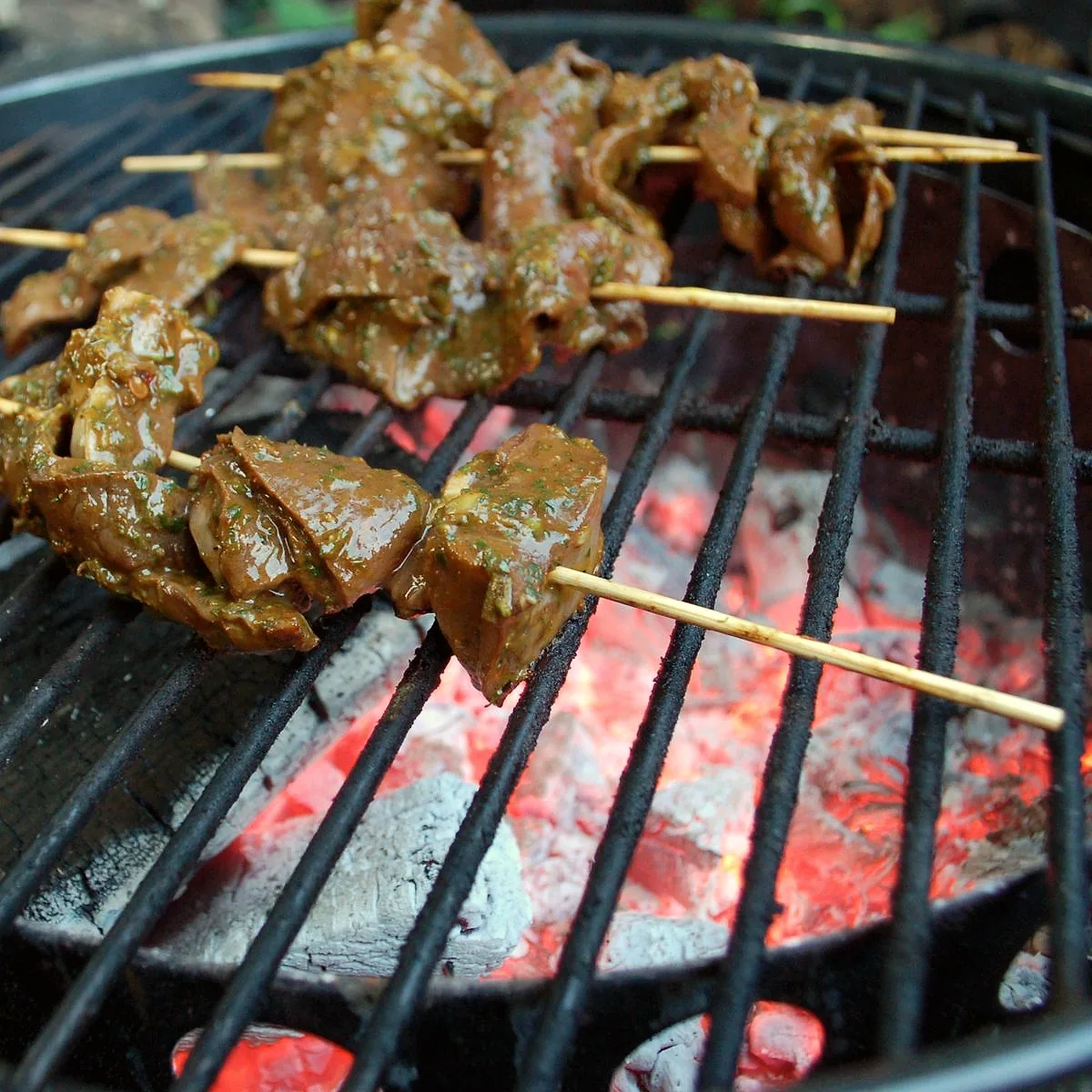

CC BY-SA 2.0. Cropped and colour-adjusted for this site.
Method
Trim the 500 g beef heart of any silverskin, connective tissue and visible fat, then cut the meat into even cubes.
Stir the 40 g ají panca, 2 garlic cloves (10 g), 3 g ground cumin, 30 ml red wine vinegar, 10 ml extra-virgin olive oil, 5 g fine sea salt and 2 g ground black pepper together, coat the cubed heart in the mixture, and leave it to marinate, covered and refrigerated, for 2h.
Thread the marinated cubes tightly onto skewers, leaving as little gap between pieces as the shape of the cubes allows.
Grill the skewers over fierce, direct charcoal heat for 10m, turning often and brushing with the 10 ml extra-virgin olive oil as they cook, until the outside is well charred and the centre is still faintly pink.
Common pitfallBeef heart is lean and dense muscle, not a fatty cut, so it turns dry and tough well past medium. It wants fierce, close heat for a short time rather than the slower approach suited to a fattier cut.
Anticuchos take their name from the Quechua antikuchu, generally read as a combination of anti (the eastern Andean region, Antisuyu) and kuchu, "cut" [1]. That etymology is the basis for the commonly told account that skewered, spiced meat has an Inca-era history in the Andes, prepared originally with llama [1]. Other accounts place the dish's origin later and more specifically, in colonial Lima, with no pre-Hispanic antecedent claimed at all [2]. The two versions are not easily reconciled from the sources available, and what they agree on is the period that matters most for the dish eaten today.
That agreed history is colonial. After the Spanish arrived, beef displaced llama and garlic entered the marinade [1]. Beef heart specifically enters the story through slavery: Spanish colonizers ate the muscle cuts and discarded the organ meats, and enslaved Africans working in and around Lima were given the hearts along with other offal [1][2]. They marinated the heart in vinegar, garlic, cumin and ají peppers and grilled it over open coals, by one account on sugarcane sticks in place of metal skewers [2]. What began as a way of making a discarded cut edible became, over generations, a dish sold from carts on street corners throughout Peru and eaten across every social class rather than remaining what it started as.
Sources
- Anticucho, WikipediaSets out the Quechua etymology and the pre-Columbian llama-meat account, followed by the colonial shift to beef and garlic.
- What Are Anticuchos? Origin, the Marinade & Why Beef Heart, CVCHÉPresents anticuchos as a colonial-era creation rather than a pre-Hispanic one, with no claim of an Inca-era antecedent.