Decoding Nature's Legacy (1833-1902)
Vulcanized Natural Rubber (VNR)
Goodyear's Sticky Path to Success
Eighteen thirty-nine was the year the world discovered how to make a fleeting thing permanent. In January, Louis Daguerre and William Henry Fox Talbot (working independently, an ocean apart, and racing each other into print once each learned the other existed) announced two rival ways of fixing an image of the world onto a plate or a sheet of paper so that it would no longer fade. Before that winter, a picture of a person or a place lived only as long as memory or a painter’s skill kept it alive. After it, for the first time, light itself could be made to leave a permanent mark.
Plate I

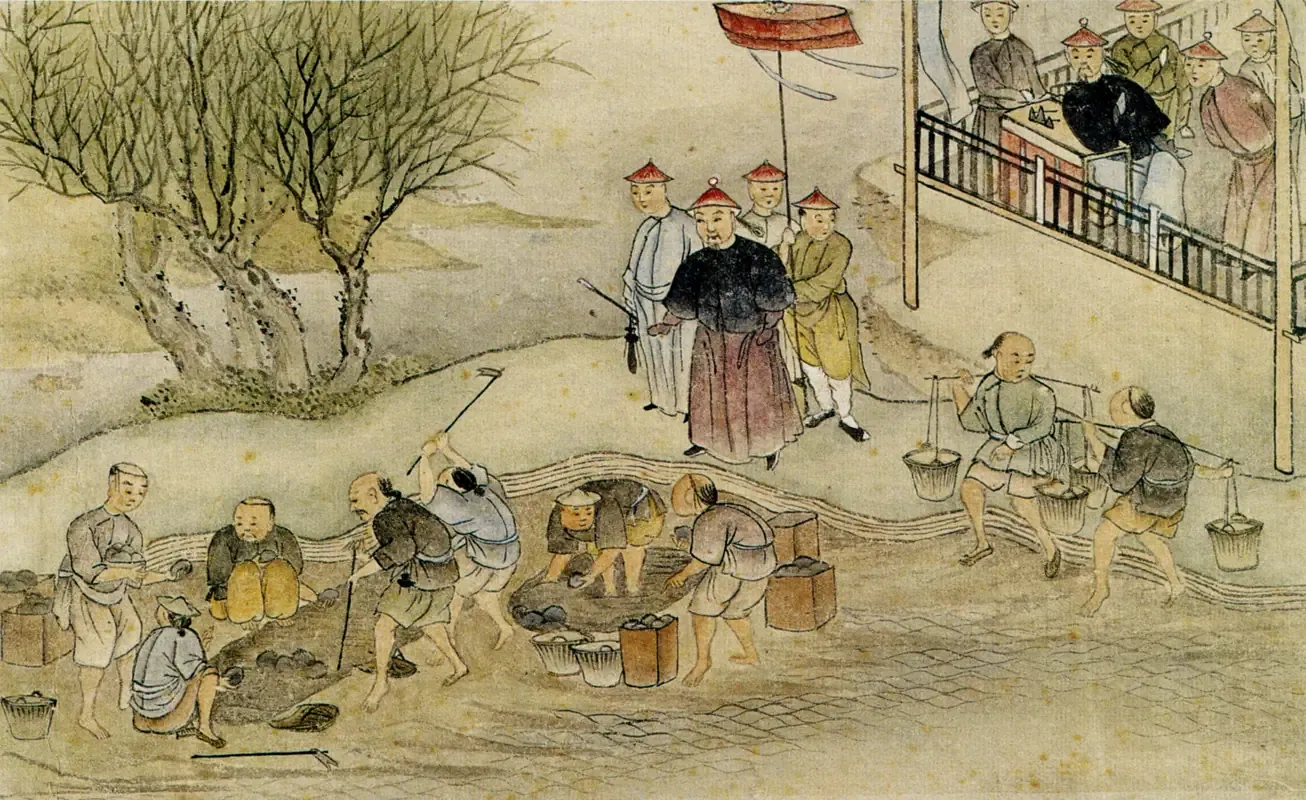
That same year, a different kind of fixing was being forced on the other side of the world, by fire rather than chemistry. In June 1839, the Chinese imperial commissioner Lin Zexu ordered more than a thousand tons of confiscated British opium destroyed at Humen, dissolved in pits of water, salt and lime over three weeks. This was an attempt to permanently purge a corrosive trade from Chinese soil. British warships and Chinese war junks had already traded fire off the coast by the year’s end, the opening moves of what would become the First Opium War.
Plate II

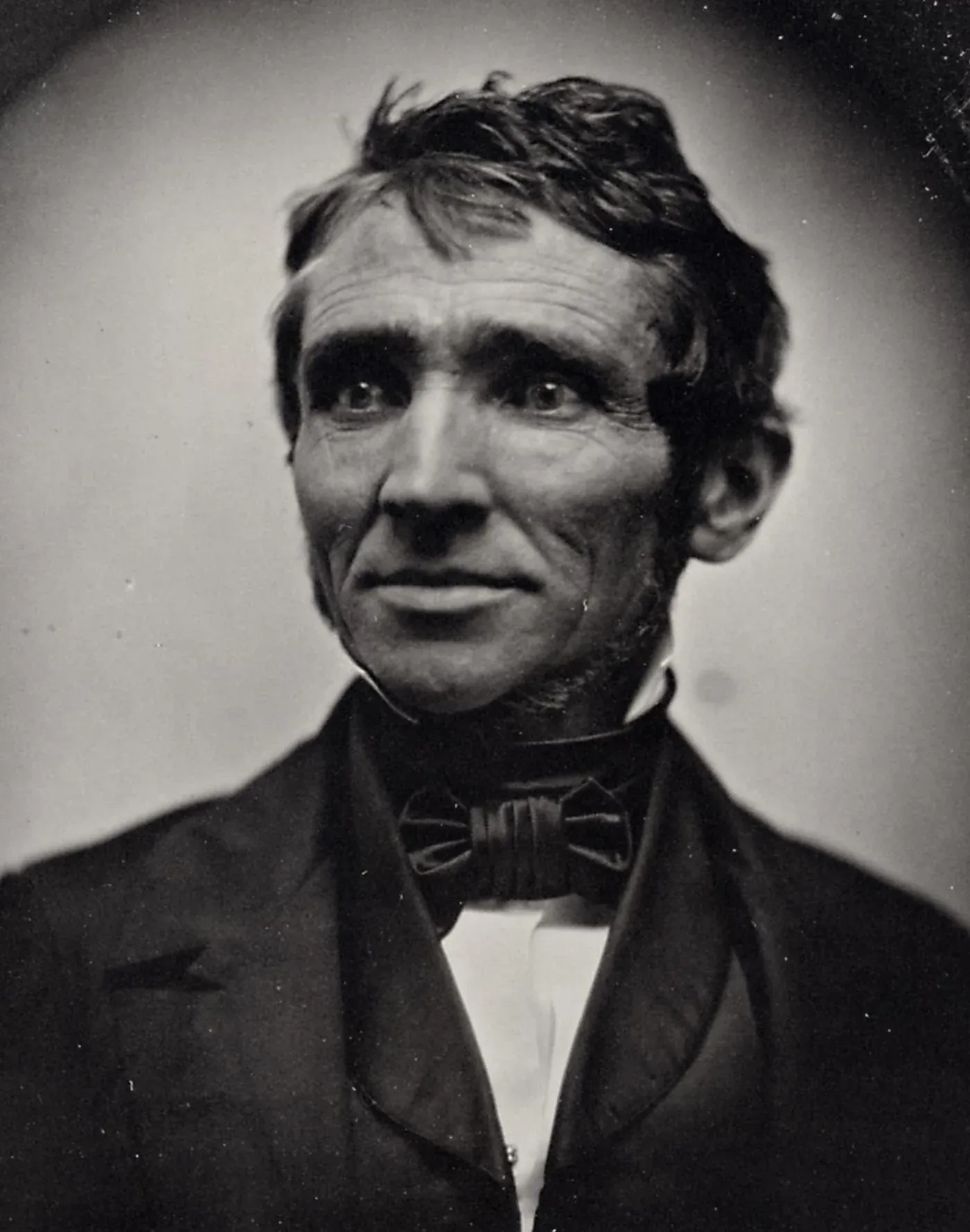
Charles Goodyear had spent five years and, by his family’s own account, every possession they owned chasing a much smaller kind of permanence: a rubber that would not melt in summer or crack in winter. The Panic of 1837 had already wiped out one backer’s fortune along with his own; by 1839 he was working out of the Eagle India Rubber Company’s general store in Woburn, Massachusetts, on credit and on the patience of people who had stopped expecting him to succeed.
Plate III
_crop.png)
The Accident, and the Five Years After It
The standard telling has Goodyear demonstrating a rubber-and-sulfur compound to a room of skeptics when a piece flew from his hand onto the store’s hot stove. What is well documented, whatever the exact circumstances, is what he found once it cooled: instead of melting into the usual black ooze, the scorched patch had charred at the very edge and turned smooth, dry and springy everywhere else, unaffected, as far as he could tell on the spot, by either heat or cold. It took him several more years of trial to turn that one accident into a repeatable process, eventually settling on steam heat under pressure for several hours as the reliable recipe. He did not patent the process until 1844, and even then trouble followed him: in Britain, the manufacturer Thomas Hancock filed his own sulfur-cure patent in November 1843 (eight weeks before Goodyear’s own British application reached the patent office) after examining rubber samples Goodyear had sent across the Atlantic to drum up interest. Under British law, which rewarded the first filing rather than the first discovery, Hancock’s patent stood; Goodyear spent much of the rest of his life fighting infringement cases on the other side of it. He called his process vulcanization, after Vulcan, the Roman god of the forge: fire, again, doing the fixing.
What Sulfur Actually Does to a Rubber Chain
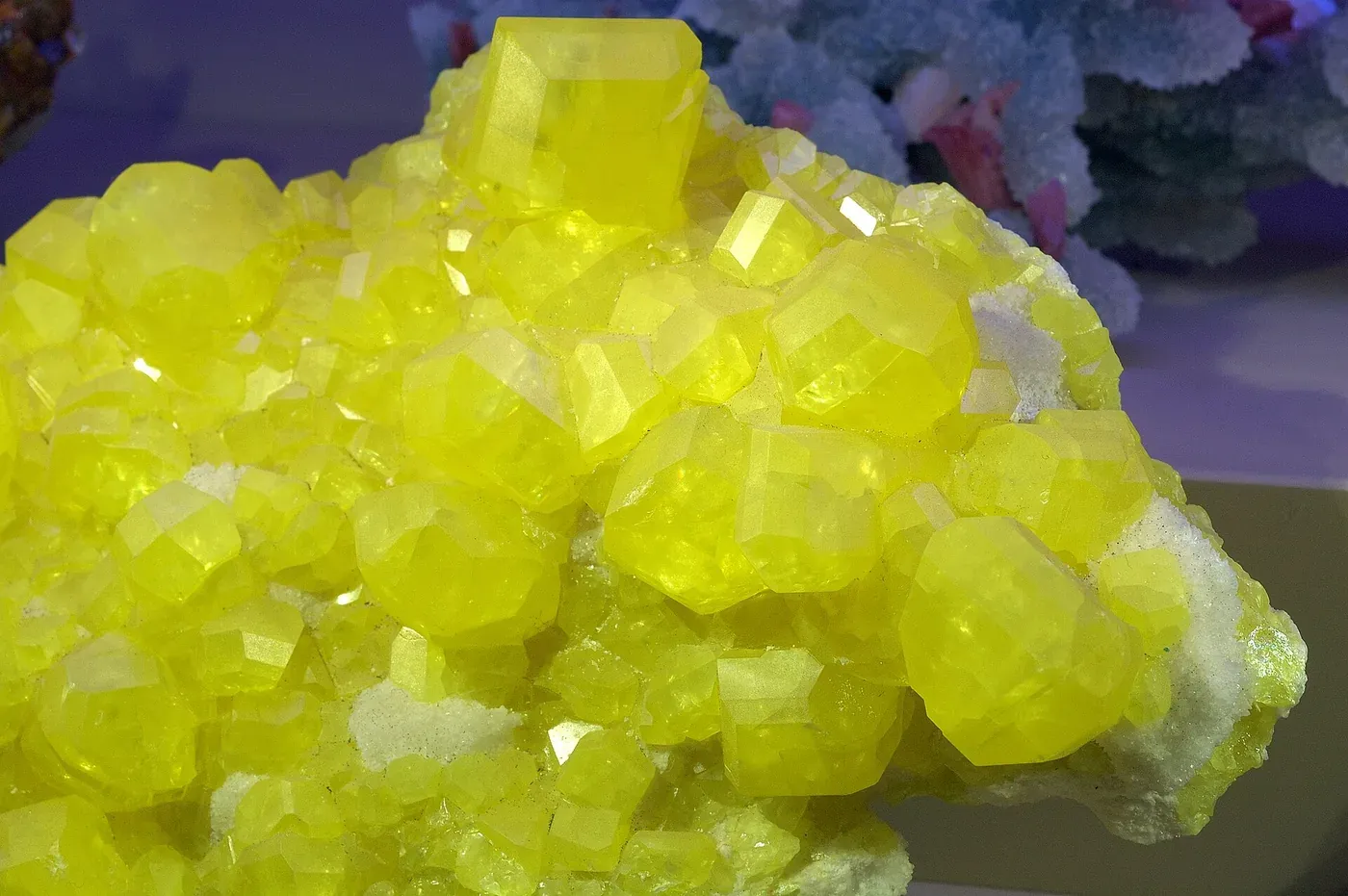
Unvulcanized natural rubber is a tangle of long, independent cis-1,4-polyisoprene chains, each one free to slide past its neighbours, which is exactly why raw rubber softens, flows and eventually creeps out of shape under load. Vulcanization does not touch that backbone at all; what it adds is a scattering of sulfur bridges linking one chain to the next at the reactive carbon next to each double bond. In an ordinary soft vulcanizate those bridges are sparse (on the order of one crosslink for every hundred or so isoprene units), just often enough to stop the chains from permanently sliding past each other, while leaving enough free chain between bridges for the whole network to stretch and spring back exactly as an elastomer should. It is a small chemical change with an outsized consequence: an occasional tie between neighbours turns a viscous liquid-in-waiting into a solid that remembers its own shape.
Plate IV

The Material That Resulted
The cured material sits just at the edge of floating, distinctly closer to water’s own density than any of the metals or hard resins it went on to replace. It bends light in roughly the range ordinary window glass does, and while it will never be mistaken for a good conductor, it holds back a meaningful electric field across even a thin section, useful enough that early telegraph and electrical trades adopted it well before anyone had a better insulator on hand. What actually solved the problem that had ruined so many rubber merchants in the 1830s was its behaviour with temperature: the same compound stays rubbery across a far wider span of heat and cold than raw latex ever did, no longer turning to paste on a warm day or brittle on a cold one, which is the entire reason it existed. It also changes shape without changing volume as it stretches: squeeze it, pull it, twist it, and it simply redistributes rather than compressing, the classic signature of a true elastomer. It can be drawn out to many times its resting length and will recover almost all of that stretch afterward, and it resists tearing well enough, once torn, not to keep tearing. That is a property natural rubber already had and vulcanization did nothing to diminish. Because the sulfur network is a permanent, covalent one, none of this can be undone by reheating: unlike the raw material, a vulcanizate cannot be re-softened and reshaped, only degraded. That same permanence, ironically, makes it far more resistant to the soil bacteria that slowly break down unvulcanized rubber. That is a durability that is exactly the point in a tire, and exactly the problem when the tire needs disposing of.
Manufacturing and the World It Built
Compounding blends raw rubber with sulfur, accelerators and antioxidants before the mixture is heated, typically somewhere in the range of 150 to 170°C, to drive the cure; too little time or heat leaves it under-cured and gummy, too much leaves it scorched and brittle. From that recipe came pneumatic tires, drive belts, hoses and gaskets, and (because the same cure that hardens the network also destroys most of the proteins in raw latex capable of triggering an allergic reaction) the vulcanized surgical glove, which is safer for far more people to wear than the raw material ever was. Natural rubber’s supply famously ran out from under Allied industry in the Second World War, when Japan’s advance cut off the Southeast Asian plantations and forced a crash program into synthetic substitutes, but vulcanization itself outlived that crisis untouched; every synthetic elastomer developed since still goes through some version of the same sulfur cure Goodyear stumbled into on a Massachusetts stovetop.
values with [n] cite the numbered references·estimates are flagged·“not yet available” and “N/A” are honest states, not gaps
fetching the model…
Vulcanized Natural Rubber repeat unit
- Abbreviation
- VNR
- Type
- variantpart of the natural-rubber family
- CAS number
- None (heterogeneous class or not assigned)
- Resin ID code
- none assigned
- Formula
- (C5H8)n[-CH2-C(CH3)=CH-CH2-]nThe chain repeat is natural rubber's own cis-1,4 isoprene unit. What vulcanization adds is not a change to that unit but sulfur bridges between chains (in a soft rubber roughly one crosslink per hundred units, too sparse to belong in a repeating structure).
- Repeat unit (BigSMILES)
{[][$]C/C(C)=C\C[$][]}- IUPAC name
- —
- Synonyms
- vulcanized rubber
- Also known as
- —
- Chemical family
- natural-rubberdiene-rubber
- Backbone class
- carbon-chain
- Polymerization mechanism
- natural-biosynthesis
- Constitutional monomer
- Isoprene
- Polymer class
- thermoset
- Year of origin
- 1839
- Era
- Decoding Nature's Legacy (1833-1902)
- Key figures
- Charles Goodyear
- Events referenced
- Announcement of the daguerreotype and photogenic drawing (January 1839) · Destruction of opium at Humen and opening moves of the First Opium War (1839) · Panic of 1837 (Goodyear's backer ruined) · Thomas Hancock's British vulcanization patent priority dispute (1843-1855)
- Polymerization type
- not yet available
- Common monomers (feedstocks)
- not yet available
- Catalysts
- sulfur
Natural rubber is heated with sulfur (optimal content around 10% for general-purpose vulcanizates), forming sulfur crosslinks at allylic C-H sites adjacent to the polyisoprene double bonds. Shorter sulfur crosslinks give better heat resistance; longer polysulfidic crosslinks give better dynamic (flex) properties but less heat resistance. Charles Goodyear discovered the process accidentally in 1839 (rubber-sulfur mixture dropped on a hot stove) and patented it in 1844.
- Tacticity
- cis-1,4 backbone (inherited from natural rubber), now crosslinked via sulfur bridges.
- Crystal structure
- not yet available
- Typical crystallinity
- not yet available
Molecular weight
- Number average (Mn)
- not yet available
- Mass average (Mw)
- not yet available
- Dispersity (Mw/Mn)
- not yet available
Mark-Houwink constants
not yet available
Sulfur crosslinks form a 3-D network that increases rigidity while still allowing elastic recovery, distinguishing vulcanized from unvulcanized rubber.
- Density
- 0.95 g/cm³[3]Vulcanized cis-polyisoprene/natural rubber.
- Melt flow index
- Not applicable
- Refractive index
- 1.5264[4]Pure-gum vulcanizate (natural or synthetic not distinguished in source).
- Transmittance
- not yet available
- Haze
- not yet available
- Gloss
- not yet available
- Water absorption
- not yet available
- Dielectric constant
- 2.68 (2.5–3)[4]1 kHz, pure-gum vulcanizate.
- Dielectric strength
- 50 kV/mm[3]Vulcanized; d = 0.6–0.8 mm.
- Electrical conductivity
- 5.1 × 10⁻¹⁴ (2 × 10⁻¹⁵–1 × 10⁻¹³) S/m[4]60 s, pure-gum vulcanizate.
- Glass transition (Tg)
- -63 (-72–-61) °C[4]Pure-gum vulcanizate (natural or synthetic not distinguished in source).
- Melting temperature (Tm)
- 40 °C[4]Residual crystallite melting in the pure-gum vulcanizate network; the sulfur-crosslinked network itself does not flow or melt at this temperature.
- Crystallization (Tc)
- Not applicable
- Heat deflection (HDT)
- not yet available
- Decomposition onset
- not yet available
- Thermal conductivity
- 0.153 W/(m·K)[4]Pure-gum vulcanizate.
- Tensile modulus
- 1.3 (1–2) MPa[4]Initial slope of stress-strain curve (Young's modulus), pure-gum vulcanizate, 60 s loading.
- Yield strength
- not yet available
- Tensile strength at break
- 28 MPa[3]Vulcanized, unfilled gum stock; also reported as 17–25 MPa for pure-gum vulcanizate in a separate source.
- Elongation at break
- 800 (750–850) %[4]Pure-gum vulcanizate.
- Impact strength (Izod)
- not yet available
- Impact strength (Charpy)
- not yet available
- Hardness
- 65 (30–100) Shore A[3]Vulcanized; a Shore D range of 30–45 is also reported.
- Flexural modulus
- not yet available
- Poisson's ratio
- 0.4999[4]Calculated from bulk/Young's moduli, pure-gum vulcanizate.
- Coefficient of friction
- not yet available
- Weathering / UV
- not yet available
- Hydrolysis resistance
- Not applicable
- Flammability (UL94)
- not yet available
- Limiting oxygen index
- not yet available
- Solubility parameter (δ)
- not yet available
Gas permeability
not yet available
Polymer-solvent interaction parameter (χ)
not yet available
- Processing methods
- compression/injection molding with sulfur cureextrusion
- Drying required
- not yet determined
- Processing temperature
- not yet available
- Shrinkage rate
- not yet available
- Tires & automotivetire treads and carcasses · hoses · gaskets
- Consumer & industrialshoe soles · conveyor belts · shock absorbers
- Medicalsurgical gloves (vulcanization removes ~99.9% of antigenic proteins)
- Recyclable
- No
- Biodegradable
- No
- Degradation pathway
- Sulfur crosslinking makes vulcanized rubber far more resistant to microbial degradation than raw natural rubber; not readily recyclable via reprocessing due to the thermoset network (devulcanization/ grinding into crumb rubber are the main reuse routes).
- LD50 (oral, rat)
- not yet available
- NFPA health
- not yet available
- NFPA flammability
- not yet available
- NFPA reactivity
- not yet available
- Carcinogenic classification
- not yet available
- [1]VulcanizationWikipediaAccessed 2026-07-14https://en.wikipedia.org/wiki/Vulcanization[wiki-vulcanization]
- [2]Natural rubberWikipediaAccessed 2026-07-14https://en.wikipedia.org/wiki/Natural_rubber[wiki-natural-rubber]
- [3]Handbook of PolymersChemTec Publishinghttps://www.worldcat.org/isbn/9781895198928[handbook-wypych-2016]
- [4]Polymer Data HandbookOxford University Presshttps://search.worldcat.org/search?q=Polymer+Data+Handbook+Mark+1999[handbook-mark-1999]
Illustrations
- Plate IGhent, photographed in October 1839, only months after Daguerre's process became public: among the first images anywhere fixed permanently by light and chemistry rather than by hand.Wikimedia Commons
- Plate IICommissioner Lin Zexu's destruction of confiscated opium at Humen, June 1839: one kind of chemical undoing, the same year rubber was about to be chemically remade.Wikimedia Commons
- Plate IIICharles Goodyear, photographed some years after the accident that made his name. By then he was still deep in the patent disputes it would take the rest of his life to fight.Wikimedia Commons
- Plate IVNative sulfur, the ordinary yellow mineral that, heated together with rubber, was the whole of Goodyear's accidental recipe.Wikimedia Commons