The Birth of Synthetic Polymers (1907-1938): The Bakelite Revolution
Polyurethane (PUR)
The Polymer That Dreams Are Made Of
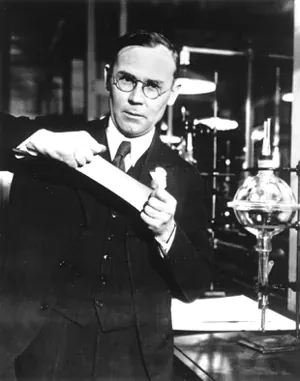
By 1937, Wallace Carothers had spent nearly a decade at DuPont turning small molecules into long ones, and had patented the results as thoroughly as any chemist in history. His polyesters and polyamides (the family that would be sold from the following year onward as nylon) covered the obvious ways of stringing an amine or an alcohol together with an acid to build a fiber. On the night of 28 April 1937, months before nylon was even announced to the public, Carothers took his own life in a Philadelphia hotel room, convinced, wrongly, that his career had come to nothing.
On the other side of the Atlantic, at IG Farben’s works in Leverkusen, that patent wall was somebody else’s problem to solve. Otto Bayer’s research group wanted a synthetic fiber to set against DuPont’s forthcoming nylon, but every direct route to one ran straight into Carothers’ claims. So Bayer’s team looked for a different bond entirely: not the amide linkage nylon was built on, but the reaction between a diisocyanate and a diol, which builds a chain through a urethane linkage instead. It was new chemistry, unclaimed by anyone, and the German patent for it was published in November 1937.
Plate I

The fiber Bayer’s reaction produced, sold as Perlon U, never troubled nylon’s grip on stockings; wartime Germany used it instead for brush bristles and filtration fabric, a workmanlike career next to nylon’s glamour. But the urethane linkage turned out to be extraordinarily promiscuous about what it would bond to either side of it, and that, not the fiber, is what made 1937 matter. Change the diisocyanate, change the polyol, add a chain extender or a blowing agent, and the same reaction yields a rigid foam, a soft one, a solid elastomer or a tough coating. Bayer had not found a rival to nylon. He had found a reaction with no fixed personality at all.
One Reaction, No Fixed Personality
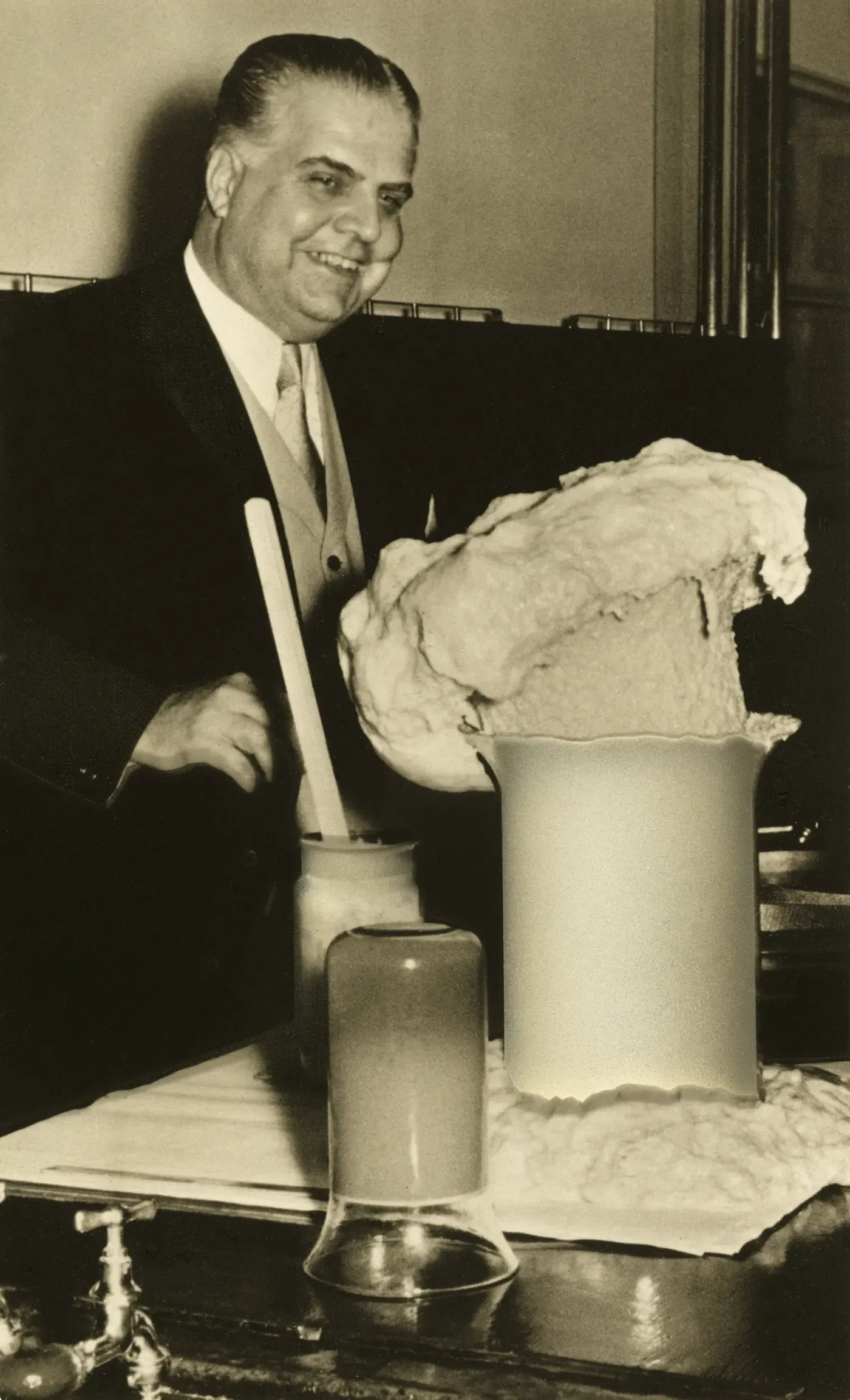
The urethane bond forms in a single, reliably exothermic step: an isocyanate group (-N=C=O) reacts with a hydroxyl group (-OH) to form the linkage -NH-COO- and nothing else (no water, no byproduct to drive off), which is why the reaction is called a polyaddition rather than a condensation. Run it between a simple diisocyanate and a simple diol and the product is a linear chain, useful mainly as a fiber or a solid. Run it in the presence of a little water, and the isocyanate reacts with that water instead, releasing carbon dioxide gas as it goes, and the same chemistry that makes a fiber also makes a foam, the escaping gas doing the work a physical blowing agent does in other plastics. That single accident of stoichiometry is why polyurethane became, within twenty years of Bayer’s patent, both a fiber nobody remembers and the material behind almost every foam cushion and insulating panel made since.
A Material with No Fixed Shape, and No Fixed Weight Either
Because the diisocyanate, the polyol and the degree of crosslinking are all adjustable, “polyurethane” is not one material but a spectrum, and its properties have to be read that way. At the dense end, cast or molded polyurethane sits close to water in density and can be tuned from a fairly soft rubber to something closer to a stiff engineering plastic; it takes remarkably little force to stretch a soft grade several times its own length before it lets go, which is why polyurethane elastomers roll into skateboard wheels and shoe soles instead of cracking under an impact the way a more rigid plastic would. At the foamed end the same chemistry is mostly trapped gas, which is what makes rigid polyurethane foam one of the better thermal insulators available for a building cavity, and what makes a flexible slab spring back after a chair has been sat in for a decade. Across the family, cured polyurethane resists oils, greases, dilute acids and alkalis, and most common solvents comfortably, though grades built from polyester polyols are noticeably more prone to breaking down in sustained damp than the polyether-based ones, a trade-off formulators choose around rather than avoid. It burns, but not eagerly: most solid grades will self-extinguish once the flame source is removed rather than sustain one on their own.
From Aircraft Dope to the Armchair
Wartime use was modest: German aircraft got polyurethane coatings, valued for resisting the same fuels and solvents an airfield handled every day, but that was a specialty application in a country losing a war, not a consumer product. The real expansion came after 1952, when polyisocyanate raw materials first became available on the open market, and again in 1954, when the first flexible polyurethane foam went into production. Furniture stuffed with polyurethane foam, rather than coiled springs and horsehair, reached ordinary living rooms within the decade: cheaper, lighter, and available in any firmness a cushion required.
Plate II

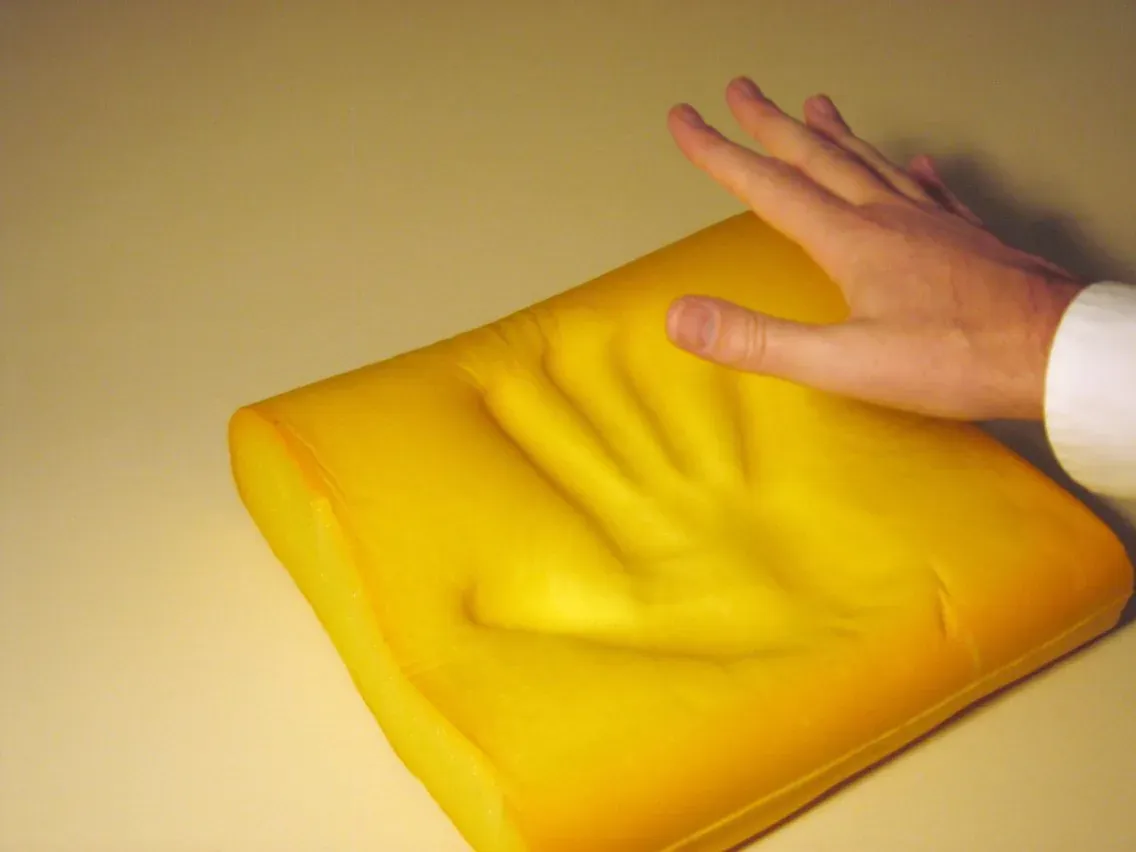
The best-known member of the family arrived by a different door entirely. In the mid-1960s, under a NASA contract, engineer Charles Yost developed a viscoelastic polyurethane foam intended to cushion aircraft ejection seats and absorb the crash-landing loads on the Apollo command module: a foam that yields slowly under load and returns just as slowly, rather than springing straight back the way ordinary cushioning foam does. It never actually flew in space; that detail gets lost in the marketing every mattress company built around it after NASA released the technology for public use in the 1980s, under names like “temper foam” and, eventually, memory foam.
Plates III & IV


A related but distinct branch of this chemistry (thermoplastic polyurethane, patented separately in the United States in the early 1950s) trades the crosslinked network for a chain that can be melted and reshaped like an ordinary plastic; that story, and the person who built it, belong on a page of their own.
Today the great bulk of polyurethane produced is still foam (around two-thirds of it, by weight), split between the flexible cushioning inside furniture and vehicle seats and the rigid insulation inside walls, roofs and refrigerators. The solid end of the family shows up as elastomers in shoe soles and industrial rollers, as protective and marine coatings, and, spun into filaments, as the stretch fiber sold as spandex or elastane. It is one reaction, endlessly retuned, doing almost none of the same job twice.
values with [n] cite the numbered references·estimates are flagged·“not yet available” and “N/A” are honest states, not gaps
fetching the model…
Polyurethane repeat unit
- Abbreviation
- PUR
- Type
- polymer family (hub)
- CAS number
- None (heterogeneous class or not assigned)
- Resin ID code
- none assigned
- Formula
- (C19H20N2O4)n[-O-(CH2)4-O-CO-NH-C6H4-CH2-C6H4-NH-CO-]nThe structure shown pairs MDI with 1,4-butanediol, one diisocyanate-diol combination of very many. Polyurethane is a linkage rather than a single chemistry: the same urethane group joins whatever diol and diisocyanate a formulation calls for, which is how one family spans soft foam to rigid insulation to elastomer.
- Repeat unit (BigSMILES)
{[][>]OCCCCOC(=O)Nc1ccc(cc1)Cc1ccc(cc1)NC(=O)[<][]}- IUPAC name
- —
- Synonyms
- —
- Also known as
- —
- Chemical family
- polyurethane
- Backbone class
- heterochain
- Polymerization mechanism
- step-growth-condensation
- Constitutional monomer
- Toluene diisocyanate (TDI)Methylene diphenyl diisocyanate (MDI)Polyol
- Polymer class
- —
- Year of origin
- 1937
- Era
- The Birth of Synthetic Polymers (1907-1938): The Bakelite Revolution
- Key figures
- Otto Bayer
- Events referenced
- Death of Wallace Carothers, DuPont's chief chemist and inventor of nylon (29 April 1937) · Otto Bayer's diisocyanate polyaddition patent published (November 1937)
- Polymerization type
- step-growth polyaddition
- Common monomers (feedstocks)
- toluene diisocyanate (TDI), methylene diphenyl diisocyanate (MDI), polyester or polyether polyols
- Catalysts
- not yet available
Otto Bayer and coworkers at IG Farben (Leverkusen) first made polyurethanes in 1937. Commercial polyisocyanates became available in 1952 and flexible foam production began in 1954. Industrially formed by mixing an isocyanate ('A-side') with a polyol blend containing catalysts and additives ('B-side'), then dispensing into molds/substrates to cure. Foams account for ~67% of all polyurethane produced (2016 data); ~25 million tonnes produced globally in 2019.
- Tacticity
- not yet available
- Crystal structure
- Triclinic unit cell most commonly reported for hard-segment crystallites (e.g. MDI/1,4-butanediol); polymorphs I and II form under quiescent crystallization, polymorph III under orientation/strain.
- Typical crystallinity
- 0–13 %[2]
Molecular weight
- Number average (Mn)
- not yet available
- Mass average (Mw)
- not yet available
- Dispersity (Mw/Mn)
- not yet available
| Solvent | T | M range | K | a |
|---|---|---|---|---|
| dimethylacetamide (DMA)[3] | 298 K | — | 0.087 mL/g | 1.43 |
Rigid foams use high crosslink density (thermal insulation); flexible foams use longer chain segments with lower crosslinking; elastomers sit at an intermediate crosslink density.
- Density
- 1.1–1.25 g/cm³[2]solid/cast form, general (Wypych); a fully crystalline PU is calculated at 1.322 g/cm³, and an MDI/1,4-butanediol system is measured at 1.297 g/cm³ (Mark)
- Melt flow index
- Not applicableFormed by reactive polyaddition/casting, not conventional melt processing, for most grades.
- Refractive index
- Not applicable
- Transmittance
- not yet available
- Haze
- not yet available
- Gloss
- not yet available
- Water absorption
- 2.5 %[3]water vapor absorption, MDI/ethylene glycol system
- Dielectric constant
- 7.8–9.4[2]100 Hz-1 MHz, solid/cast form
- Dielectric strength
- not yet available
- Electrical conductivity
- 2.08 × 10⁻¹⁰ S/m[2]reciprocal of reported volume resistivity, 4.8×10⁹ Ω·m, solid/cast form
- Glass transition (Tg)
- -60.3–-19 °C[2]solid/cast form, general; Mark reports much higher hard-segment Tg values for specific systems, e.g. -2 to 90 °C across HMDI/BD, HMDI/DEG, and MDI/EG
- Melting temperature (Tm)
- 141–157 °C[2]DSC, solid/cast form, general; Mark reports 123–225 °C across specific systems (HMDI/DEG, HMDI/OFHD, TDI/EG, MDI/EG)
- Crystallization (Tc)
- Not applicable
- Heat deflection (HDT)
- 123–232 °C[2]1.8 MPa, solid/cast form
- Decomposition onset
- 120–126 °C[2]as reported; unusually low for typical PU thermal decomposition (commonly cited around 250–300 °C), possibly reflecting a specific low-stability formulation
- Thermal conductivity
- not yet availableRigid PUR foam is a well-known low-thermal-conductivity insulation material; the only handbook figure found (0.13 W/(m·K)) is explicitly for the melt state, not solid, so is not recorded here.
- Tensile modulus
- not yet available
- Yield strength
- 31–57.2 MPa[2]tensile stress at yield, solid/cast form
- Tensile strength at break
- 7.6–66 MPa[2]solid/cast form
- Elongation at break
- 350–1200 %[2]solid/cast form
- Impact strength (Izod)
- not yet available
- Impact strength (Charpy)
- not yet available
- Hardness
- 60–95 Shore A[2]solid/cast form; harder grades reported separately as Shore D 36–91
- Flexural modulus
- 540–3000 MPa[2]solid/cast form
- Poisson's ratio
- not yet available
- Coefficient of friction
- not yet available
- Solvent: acids (dilute/concentrated)
- good[2]solid/cast form
- Solvent: alcohols
- good[2]solid/cast form
- Solvent: alkalis
- good[2]solid/cast form
- Solvent: aliphatic hydrocarbons
- very good[2]solid/cast form
- Solvent: aromatic hydrocarbons
- very good[2]solid/cast form
- Solvent: esters
- good[2]solid/cast form
- Solvent: greases & oils
- good[2]solid/cast form
- Solvent: ketones
- good[2]solid/cast form
- Weathering / UV
- not yet available
- Hydrolysis resistance
- not yet availableEster-based PUR is known to be more hydrolysis-prone than ether-based PUR. This is a real, widely-cited distinction, but not independently confirmed with a source.
- Flammability (UL94)
- V-2[2]solid/cast form
- Limiting oxygen index
- 25 %[2]solid/cast form
- Solubility parameter (δ)
- 22.8 MPa^0.5[2]Hildebrand parameter, solid/cast form, general; Mark reports 21–27 MPa^0.5 across specific MDI/1,4-butanediol and MDI/ethylene glycol systems
Gas permeability
not yet available
Polymer-solvent interaction parameter (χ)
- dimethylformamide (DMF), TDI/1,4-butanediol system
- 0.122[3]
- Processing methods
- two-component reactive molding/castingfoam-in-place/spray foamreaction injection molding (RIM)
- Drying required
- not yet determined
- Processing temperature
- Not applicable
- Shrinkage rate
- 1.2–2.5 %[2]solid/cast form
- Foamsrigid thermal insulation · flexible cushioning foam~67% of all PUR produced (2016).
- Elastomersshoe soles
- Coatings & adhesivesprotective coatings · adhesives
- Fibersspandex/elastane
- Recyclable
- No
- Biodegradable
- No
- Degradation pathway
- not yet available
As a broad, highly formulation-dependent thermoset/elastomer family, end-of-life handling varies widely by product type; chemical recycling (e.g. glycolysis) exists for some grades but is not yet mainstream.
- LD50 (oral, rat)
- [2]reported as >5,000 mg/kg, solid/cast form
- NFPA health
- not yet available
- NFPA flammability
- not yet available
- NFPA reactivity
- not yet available
- Carcinogenic classification
- not yet available
- [1]PolyurethaneWikipediaAccessed 2026-07-14https://en.wikipedia.org/wiki/Polyurethane[wiki-polyurethane]
- [2]Handbook of PolymersChemTec Publishinghttps://www.worldcat.org/isbn/9781895198928[handbook-wypych-2016]
- [3]Polymer Data HandbookOxford University Presshttps://search.worldcat.org/search?q=Polymer+Data+Handbook+Mark+1999[handbook-mark-1999]
Illustrations
- Plate IWallace Carothers in his DuPont laboratory. His patents on polyester and polyamide fibers were so comprehensive that a rival chemistry, not a rival patent fight, was the only way around them.Wikimedia Commons
- Plate IIOtto Bayer in 1952, demonstrating the reaction he had patented fifteen years earlier: mix an isocyanate with a polyol, and the beaker fills itself.Wikimedia Commons
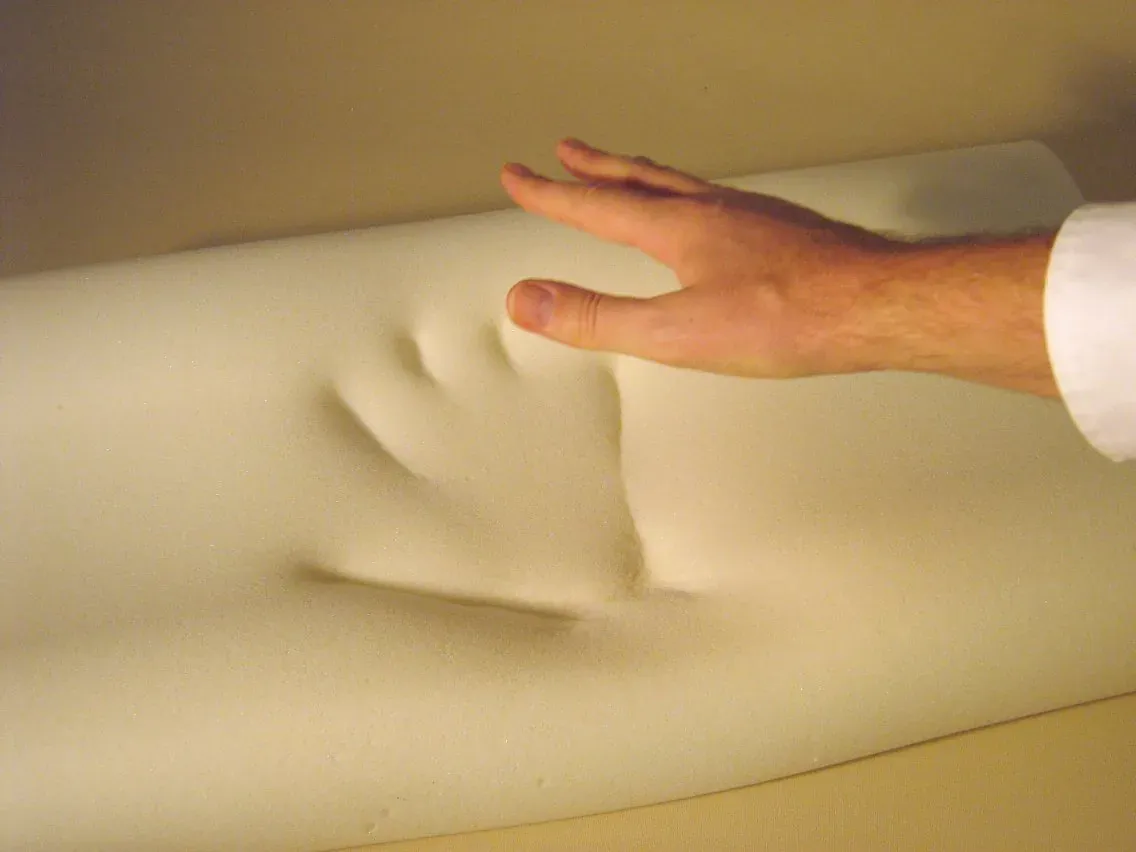
- Plate IIIConventional flexible polyurethane foam recovers its shape within seconds of a hand lifting away.Wikimedia Commons
- Plate IVViscoelastic 'memory' polyurethane foam holds the same impression far longer: the slow recovery that gives the material its name.Wikimedia Commons