The Birth of Synthetic Polymers (1907-1938): The Bakelite Revolution
The Carothers Equation
When Polymers Cross the Line
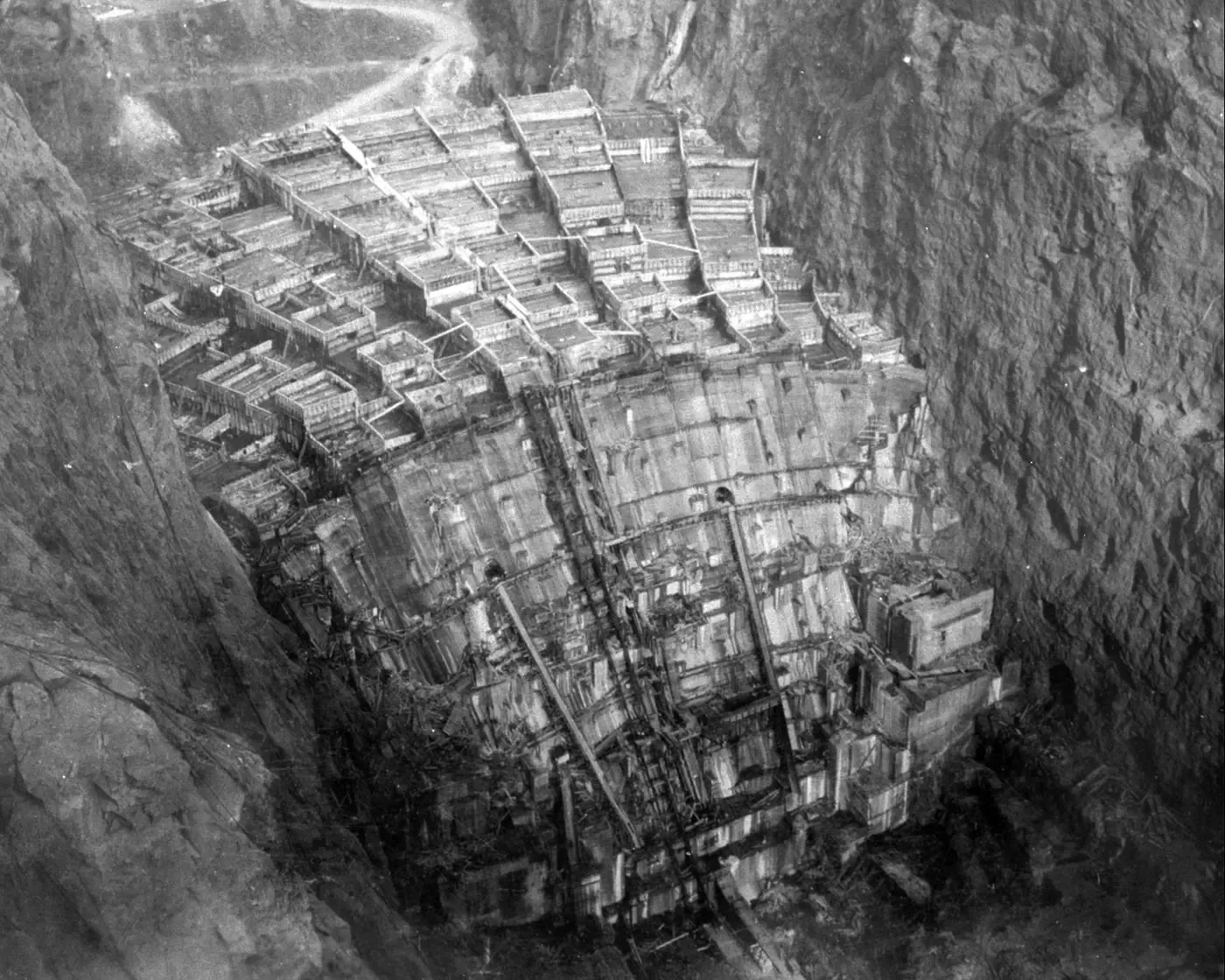
Nineteen thirty-six was the year concrete taught American engineers to stop guessing. Hoover Dam, rising out of Black Canyon on the Nevada–Arizona line, could not be poured as a single block: a mass of concrete that size generates so much heat as it cures that one continuous pour would have taken more than a century to cool, cracking itself apart from the inside long before it finished. The solution was to pour it as hundreds of separate interlocking columns, each laced with pipework carrying river water to draw the curing heat away. Nobody on the project was hoping for the best; they had calculated, in advance, exactly how far each pour had to go before the next could safely follow. Begun in 1931, the dam was substantially complete by the spring of 1936, years ahead of the government’s own schedule.
Plate I

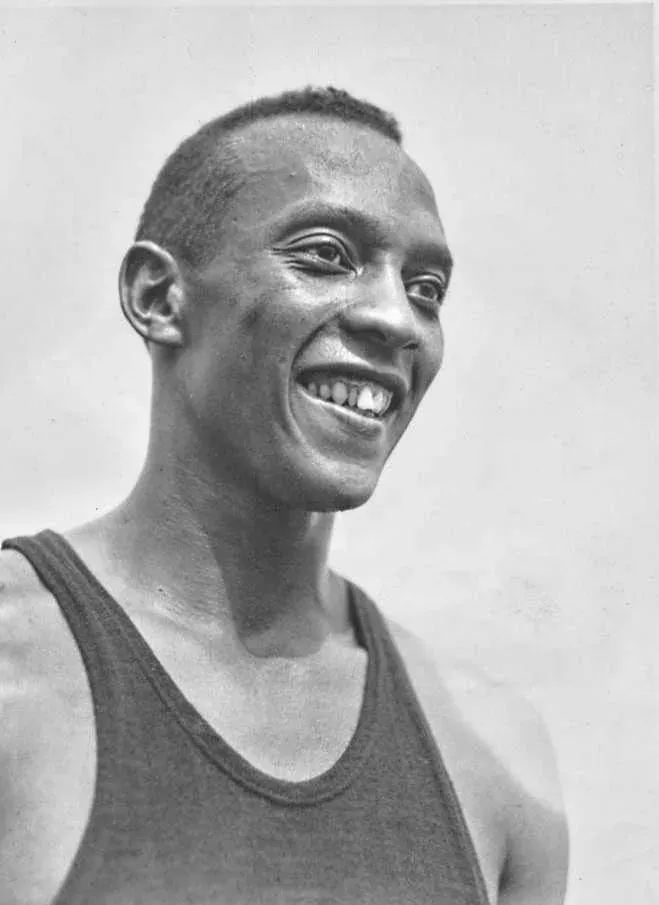
That August, in a stadium built to advertise a regime’s confidence in fixed, racial limits on human capability, Jesse Owens ran and jumped his way to four Olympic gold medals in Berlin. He did not so much argue with the theory as make it irrelevant.
Plate II

At the DuPont Experimental Station in Wilmington, Delaware, a different kind of limit was being worked out that same year: not a limit on what a person could do, but a precise, numerical limit on how far a chemical reaction had to go before it produced anything useful at all.
A Question of How Far
By 1936, Wallace Carothers had spent close to a decade proving, by deliberate synthesis, that Hermann Staudinger’s giant molecules were real. His own life (and its unhappy end the following year) is told elsewhere in this Atlas; what belongs here is the number he left behind.
Step-growth polymerization, the kind that builds nylon, polyester and the phenolic networks behind Bakelite, does not behave like the addition reactions organic chemists already understood well. Every molecule in the flask, however short, carries a reactive end. Two monomers join to make a dimer; the dimer reacts with another monomer, or with another dimer, to make something longer; and the process continues, chain fusing with chain, for as long as reactive ends remain to find each other. There is no single moment at which “the polymer” appears: the average size of everything in the vessel simply creeps upward as the reaction proceeds, and the question that mattered was exactly how fast.
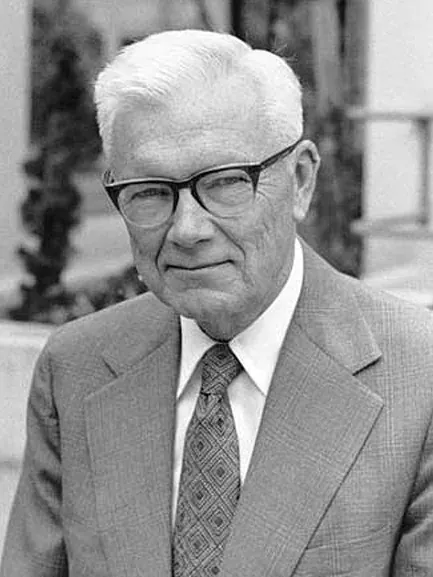
Carothers set that question to a young physical chemist he had just hired named Paul Flory, who arrived at the Experimental Station in July 1934 straight out of his doctorate with no background in polymers at all. Carothers wanted his skill in reaction kinetics, not his prior expertise, and gave him the specific problem of relating a chain’s length to how far the reaction had run. Both men published in 1936: Carothers in the Transactions of the Faraday Society, Flory (more rigorously, using the statistics of random combination) in the Journal of the American Chemical Society. They arrived at the same relationship.
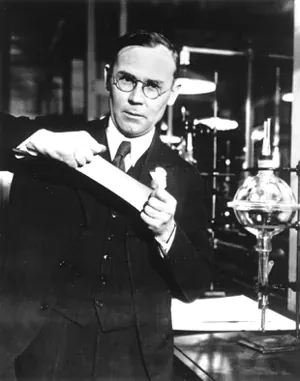
Plate III

Write p for the fraction of the available reactive groups that have actually reacted, and Xn for the average number of monomer units now strung together in each chain. The relationship is Xn = 1 / (1 − p), and the shape of that curve is the whole discovery. At ninety percent conversion (a figure that would count as a finished, successful reaction in almost any other branch of chemistry) the average chain is only ten units long: a short oligomer, nowhere near a usable fibre. At ninety-five percent conversion it is twenty units. It takes conversion past ninety-nine percent, a level of completeness ordinary organic reactions never bother chasing, before the average chain reaches roughly a hundred units, the rough threshold at which a condensation polymer starts to behave like a fibre or a plastic rather than a wax or an oil.
That is why step-growth polymerization is unforgiving in a way addition polymerization is not: every last trace of unreacted acid or amine has to be hunted down, and every trace of water (which can hydrolyse a chain back into two shorter ones) has to be kept out, because the equation punishes incompleteness far more severely than intuition suggests. It also explains how to do the opposite on purpose: adding a slight excess of one reactant, or a pinch of a monofunctional “chain stopper” that caps an end instead of extending it, holds the conversion below its natural ceiling and produces, reliably, a polymer of whatever modest length an application actually calls for.
Extending the Idea to Networks
Flory did not stop at chain length. In the same stretch of work he extended the analysis from ordinary two-ended monomers to molecules carrying three or more reactive groups (branch points) and showed that past a certain critical conversion, a system built from such monomers stops behaving like a collection of separate molecules and forms a single network spanning the whole vessel: a gel. The critical extent of reaction depends only on the average number of reactive groups per monomer, a relationship Flory and Walter Stockmayer treated statistically in the years that followed. It is the reason a resin like Bakelite’s phenolic network cures rather than merely thickens; this is the same Experimental Station habit of asking exactly how far a reaction has to go, applied to a different kind of ending.
Plate IV

Modern polymer chemists still reach for Xn = 1 / (1 − p) before they reach for anything more elaborate. It remains the fastest way to know, for any step-growth system, exactly how much further a reaction has to run before it is worth taking off the heat. That is the same question Carothers set out to answer the year an American dam and an American sprinter were both, in their own ways, quietly retiring the idea that some limits could only be guessed at.
Working at DuPont's Experimental Station from 1928, Wallace Carothers worked out the mathematical theory of step-growth polymerization. The Carothers equation relates the average degree of polymerization (Xn) to the fractional monomer conversion (p): Xn = 1/(1-p). Its central, non-obvious insight is that step-growth polymerization requires extremely high conversion to reach useful molecular weights: at 95% conversion Xn is only 20, and it takes 99%+ conversion to reach chain lengths of 100 or more. This theoretical framework guided Carothers' own team to two landmark materials: neoprene (the first synthetic rubber, synthesized April 1930) and, after Carothers shifted to polyamide research in 1934, nylon 6,6 (first made February 28, 1935; publicly announced October 27, 1938, after Carothers' death).
- Number-average degree of polymerization
- Fractional conversion (extent of reaction) of monomer functional groups into polymer
- Year of origin
- 1936
- Era
- The Birth of Synthetic Polymers (1907-1938): The Bakelite Revolution
- Key figures
- Wallace Carothers · Paul Flory
- Events referenced
- Hoover Dam substantially completed (spring 1936) · Jesse Owens wins four gold medals at the Berlin Olympics (August 1936)
- [1]Wallace CarothersWikipediaAccessed 2026-07-23https://en.wikipedia.org/wiki/Wallace_Carothers[wiki-wallace-carothers]
Illustrations
- Plate IHoover Dam under construction, February 1934: poured as separate, individually calculated columns rather than one continuous mass, because engineers already knew exactly how far each pour had to cure.Wikimedia Commons
- Plate IIJesse Owens in 1936, the year a regime's confident theory of fixed human limits met a sprinter who ignored it.Wikimedia Commons
- Plate IIICarothers demonstrating a synthetic fibre's cold-drawing (the practical payoff of knowing in advance exactly how far a reaction needed to run).Wikimedia Commons
- Plate IVPaul Flory, photographed in 1973, the year before his own Nobel Prize. He was the twenty-six-year-old kinetics specialist Carothers had hired in 1934 to work out the mathematics no one else in the lab could do.Wikimedia Commons