The Post-War Boom (1946-1960)
Polyvinylidene fluoride (PVDF)
The Piezoelectric Performer
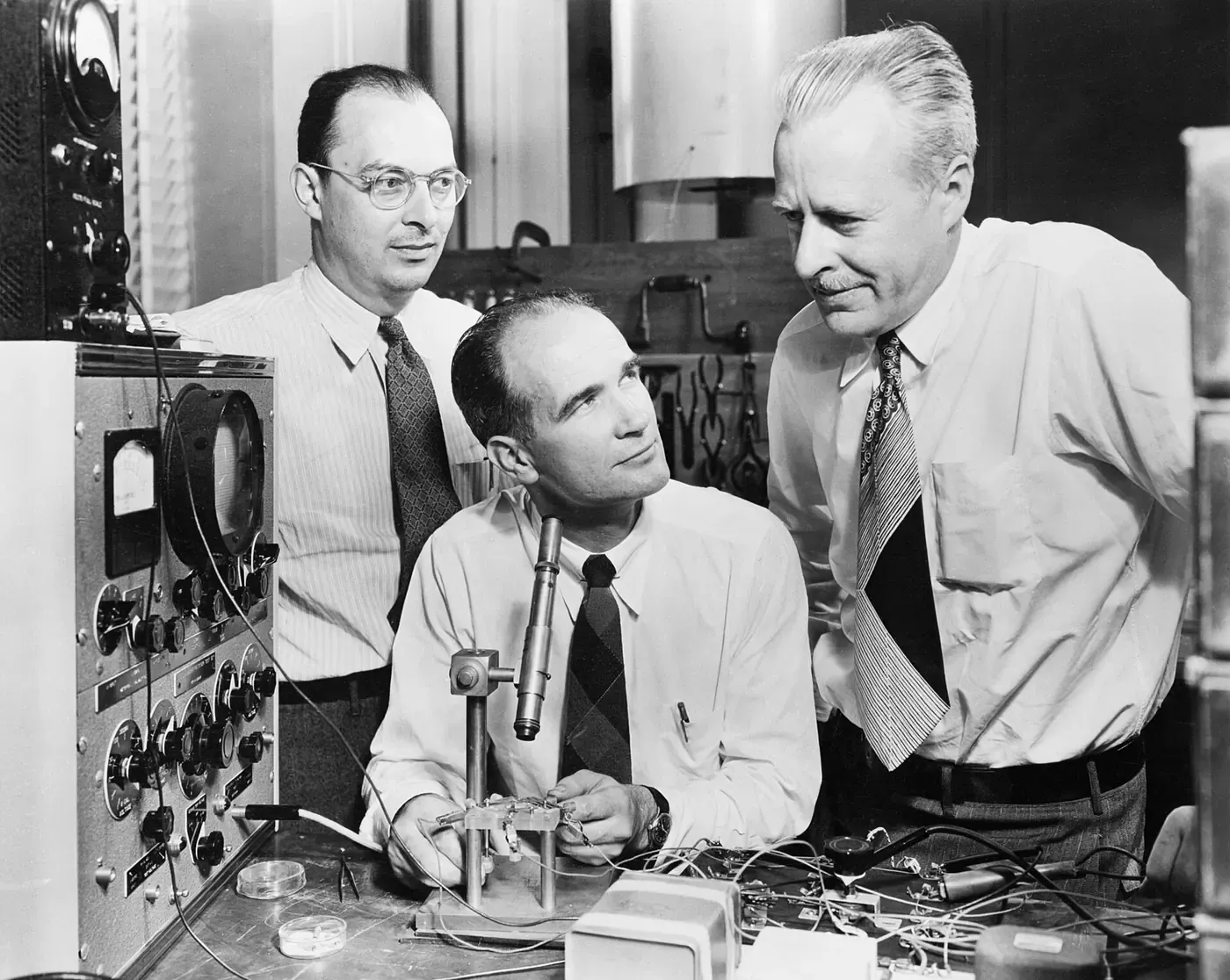
Some scientific achievements announce themselves the moment they happen. On 14 October 1947, Chuck Yeager pushed the Bell X-1 past the speed of sound over the Mojave Desert and the sonic boom did the announcing for him. Two months later, on 16 December, John Bardeen and Walter Brattain assembled a sliver of germanium and two gold contacts at Bell Labs and amplified a signal for the first time with no moving parts and no vacuum tube: the first transistor, though the world would not be told its name for another six months. Both moments are remembered as the instant their significance became obvious.
Plate I

.jpg)
Polyvinylidene fluoride did not have a moment like that. DuPont chemists Thomas Ford and William Hanford had filed a patent in 1944, in the middle of the war, on a fluorinated polymer that nobody outside their own laboratory had a use for; the patent would not even issue until February 1948. By 1947 it had already spent three quiet years exactly where PTFE’s own 1938 patent application had spent its early life (filed, unresolved, and unglamorous), while, elsewhere that same season, two entirely different inventions were making instant headlines. PVDF’s own moment of obvious significance was still twenty-two years away.
Plate II

A Fluoropolymer With a Lopsided Molecule
PVDF is built from a monomer that PTFE’s is not: vinylidene fluoride, in which one carbon of the double bond carries two hydrogens and the other carries two fluorines, rather than fluorine on every position. That asymmetry is the whole story. Where PTFE’s backbone is wrapped in fluorine on every side and therefore electrically neutral and inert in every direction, PVDF’s backbone alternates a hydrogen-rich face with a fluorine-rich one, and that imbalance gives each repeat unit a small, permanent electrical dipole pointing across the chain rather than along it. Ford and Hanford’s 1944 patent already noted that the new polymer could be cold-drawn into tough films and fibers, more workable than PTFE straight out of the reactor. Nobody involved recorded that they had also built the first plastic that could behave like a crystal wired for electricity; that would take another generation of research to notice.
From Patent to Product
PVDF sat as a laboratory curiosity through the 1950s. The Pennsylvania Salt Manufacturing Company (Pennsalt, later Pennwalt, and today part of Arkema) began the work of scaling it into a commercial resin, and by 1961 the company was selling the first production grades under the trade name Kynar. Solvay’s Solef and Kureha’s KF followed as the wider fluoropolymer industry grew around it. Unlike PTFE, PVDF melts cleanly enough to be extruded, injection-moulded and cast into film by ordinary thermoplastics equipment, which is precisely what let it move into industrial piping, wire insulation and protective coatings well before anyone had found its more interesting trick.
The Trick: Piezoelectricity
That trick arrived in 1969, when the Japanese researcher Heiji Kawai found that PVDF film, mechanically stretched and then poled under a strong electric field at elevated temperature, produced a piezoelectric response far larger than any other polymer had shown, strong enough to be useful rather than merely measurable. The stretching pulls the polymer from its non-polar crystal form into a polar one in which the chain dipoles line up more or less side by side; the poling step then drags those dipoles, still free to rotate somewhat within the crystal, into alignment with each other, and locks that alignment in as the film cools. A poled PVDF film generates a voltage when flexed or compressed, and, run the process in reverse, visibly flexes when a voltage is applied across it. It was this discovery, three decades after Ford and Hanford’s original patent, that gave PVDF the identity it is known by today, and it happened only because the base polymer was tough, drawable and melt-processable enough to survive the stretching and poling in the first place.
What the Material Is Like to Handle
PVDF sits lighter than PTFE but still denser than water, and it keeps its shape and most of its strength across a wide working-temperature range, though it gives up that strength well below the temperatures PTFE shrugs off. It resists acids, bases and most organic solvents about as thoroughly as a fluoropolymer is expected to, with the notable exception of ketones and esters, which do attack it. That is a gap worth knowing before choosing it for a particular chemical service. Its resistance to sunlight and weathering is outstanding, which is why architectural coatings remain one of its most visible jobs; a Kynar-based finish on an aluminium panel was already being sold as a long-life alternative to paint by the mid-1960s and coatings of that kind still cover buildings shrugging off decades of UV exposure. Electrically, PVDF is unusual among plastics for how strongly it responds to an applied field, a property directly tied to the same chain dipoles behind its piezoelectric behaviour, and it is prized in battery manufacturing as a binder that holds electrode particles together without reacting with the battery’s own chemistry.
Plate III

Made By the Same Chemistry That Made PTFE Simple
Commercial PVDF is produced much as PTFE is: the monomer is polymerised by free radicals, in either suspension or emulsion, with water as the working fluid and persulfate or peroxide initiators driving the reaction under moderate heat and pressure. Suspension polymerisation gives a powder suited to moulding; emulsion polymerisation gives a fine latex that can be cast directly into coatings and films. Because the polymer melts and flows, unlike PTFE, both routes feed straight into standard extrusion and moulding lines rather than requiring the powder-press-and-sinter process PTFE demands. That is the one significant processing advantage PVDF holds over its older, more famous relative.
Where a Piezoelectric Plastic Goes to Work
PVDF’s piezoelectric films now turn up in tactile sensor arrays, strain gauges and acoustic transducers, where their combination of flexibility and electrical response outperforms brittle piezoelectric ceramics on a per-weight basis. Pioneer sold hi-fi tweeters built around PVDF film diaphragms as early as the mid-1970s, an early commercial vote of confidence in Kawai’s discovery. The rest of PVDF’s working life is quieter: chemical-process piping rated for aggressive fluids and elevated temperature, wire insulation, biomedical membranes, roofing and coil coatings, and, in un-poled form, filament for 3D printing.
Plate IV

values with [n] cite the numbered references·estimates are flagged·“not yet available” and “N/A” are honest states, not gaps
fetching the model…
Polyvinylidene fluoride repeat unit
- Abbreviation
- PVDF
- Type
- polymer family (hub)
- CAS number
- 24937-79-9
- Resin ID code
- none assigned
- Formula
- (C2H2F2)n[-CH2-CF2-]n
- Repeat unit (BigSMILES)
{[][$]CC(F)(F)[$][]}- IUPAC name
- Poly(1,1-difluoroethylene)
- Synonyms
- Kynar; Hylar; Solef; KF
- Also known as
- KynarHylarSolef
- Chemical family
- fluoropolymer
- Backbone class
- carbon-chain
- Polymerization mechanism
- free-radical
- Constitutional monomer
- Vinylidene fluoride
- Polymer class
- thermoplastic
- Year of origin
- 1947
- Era
- The Post-War Boom (1946-1960)
- Key figures
- Thomas Ford · William Hanford · Heiji Kawai
- Events referenced
- Chuck Yeager and the Bell X-1 breaking the sound barrier (October 1947) · Invention of the transistor at Bell Labs (December 1947)
- Polymerization type
- free-radical chain-growth
- Common monomers (feedstocks)
- vinylidene fluoride
- Catalysts
- not yet available
Synthesized via free-radical polymerization of vinylidene fluoride monomer. Major manufacturers include Arkema (Kynar), Solvay (Hylar, Solef), and Kureha (KF). Strong piezoelectric activity in poled thin films was documented in 1969.
- Tacticity
- Predominantly head-to-tail (isoregic) addition, ~95–97%; head-to-head/tail-to-tail defects ~3.5–6%.
- Crystal structure
- Polymorphic: the beta (β) phase has the highest dipolar moment per unit cell and dominates PVDF's piezoelectric/ferroelectric behavior once poled. Four crystal forms are documented: Form I/α (orthorhombic, a=0.858, b=0.491, c=0.256 nm), Form II/β (monoclinic, a=0.496, b=0.964, c=0.462 nm, β≈90°), Form III/γ (orthorhombic, a=0.497, b=0.966, c=0.966 nm), Form IV/δ (orthorhombic, same cell as β).
- Typical crystallinity
- 54 (32–76) %[2]41–46% by DSC, 33–41% by WAXS
Molecular weight
- Number average (Mn)
- 64000–380000 g/mol[2]
- Mass average (Mw)
- 60000–534000 g/mol[2]
- Dispersity (Mw/Mn)
- 2.4 (1.6–3.2)[2]
| Solvent | T | M range | K | a |
|---|---|---|---|---|
| dimethylacetamide (DMA)[3] | — | — | 0.0000178 mL/g | 0.74 |
| dimethylformamide (DMF)[3] | — | — | 0.0000317 mL/g | 0.7 |
| N-methylpyrrolidone (NMP)[3] | — | — | 0.0000488 mL/g | 0.68 |
| acetophenone[3] | 358 K | — | 0.000213 mL/g | 0.62 |
| benzophenone[3] | 438 K | — | 0.00136 mL/g | 0.44 |
| benzophenone (180 °C)[3] | 453 K | — | 0.000754 mL/g | 0.49 |
- Density
- 1.795 (1.76–1.83) g/cm³[2]20 °C; amorphous 1.68, crystalline 1.92–1.98 g/cm³
- Melt flow index
- 0.5–45 g/10min[2]230 °C / 2.16 kg
- Refractive index
- 1.455 (1.42–1.49)[2]20 °C
- Transmittance
- 85–94 %[2]
- Haze
- 3–13 %[2]
- Gloss
- 25 %[2]60°, Gardner, ASTM D523
- Water absorption
- 0.02–0.07 %[2]equilibrium, 23 °C water immersion
- Dielectric constant
- 9.75 (9–10.5)[2]1 kHz; at 1 MHz: 7–9.9
- Dielectric strength
- 65 (63–67) kV/mm[2]specimen thickness 0.6–0.8 mm
- Electrical conductivity
- 4.35 × 10⁻¹³–6.67 × 10⁻¹³ S/m[2]reciprocal of reported volume resistivity, 1.5–2.3×10¹² Ω·m
- Glass transition (Tg)
- -43 (-57–-29) °C[2]exp.; calc.=-67 °C
- Melting temperature (Tm)
- 158–200 °C[2]DSC; main melting peak 167–169 °C
- Crystallization (Tc)
- 116 (92–140) °C[2]
- Heat deflection (HDT)
- 75.5 (36–115) °C[2]1.8 MPa
- Decomposition onset
- 375 °C[2]in air; 410 °C in nitrogen
- Thermal conductivity
- 0.21 (0.17–0.25) W/(m·K)[2]23 °C
- Tensile modulus
- 1194.4 (420–2200) MPa[3]commercial grade; Wypych 2016 reports a broader range of 420–2,200 MPa across grades
- Yield strength
- 14–60 MPa[2]tensile stress at yield; Mark 1999 reports 38–52 MPa at 25 °C, 42.8 MPa for a commercial grade
- Tensile strength at break
- 50 (42–58) MPa[3]homopolymer, 25 °C; ultimate tensile strength for a commercial grade: 43.8 MPa
- Elongation at break
- 43 %[3]commercial grade; Wypych 2016 reports a broader range of 20–600% across grades
- Impact strength (Izod)
- 50–1000 J/m[2]notched, 23 °C; spans grades
- Impact strength (Charpy)
- not yet available
- Hardness
- 75 (70–80) Shore D[2]
- Flexural modulus
- 200–2200 MPa[2]
- Poisson's ratio
- 0.383[2]
- Coefficient of friction
- 0.155 (0.14–0.17)[2]PVDF against steel
- Solvent: water
- Insoluble[1]
- Solvent: acids_bases_and_aggressive_solvents
- Excellent resistance; rated to 120°C for chemical-process piping[1]
- Solvent: acids
- resistant[2]dilute and concentrated
- Solvent: alcohols
- resistant[2]
- Solvent: alkalis
- resistant (diluted)[2]
- Solvent: aliphatic hydrocarbons
- resistant[2]
- Solvent: aromatic hydrocarbons
- resistant[2]
- Solvent: esters
- non-resistant[2]
- Solvent: halogenated hydrocarbons
- resistant[2]
- Solvent: ketones
- non-resistant[2]
- Weathering / UV
- Resists nuclear radiation and UV damage[1]
- Hydrolysis resistance
- not yet available
- Flammability (UL94)
- V-0[2]
- Limiting oxygen index
- 59.5 (44–75) %[2]
- Solubility parameter (δ)
- 17.6 (16.8–18.4) MPa^0.5[2]
Gas permeability
- Ar
- 1.5 × 10⁻¹⁴ cm³(STP)·cm/(cm²·s·Pa)[3]25 °C, 5.21×10⁻³ cm specimen thickness
Polymer-solvent interaction parameter (χ)
not yet available
- Piezoelectric devicestactile sensor arrays · strain gauges · acoustic transducersPiezoelectric coefficient of poled thin films ~6–7 pC/N, about 10x larger than other polymers; exhibits a negative d33 (compresses under applied field).
- Energy storagelithium-ion battery electrode binderStandard binder material; chemically inert throughout battery operation.
- Chemical processingchemical-resistant piping (rated to 120°C)
- Otherwire insulation · biomedical membranes · roofing coatings · 3D printer filament
- Recyclable
- No
- Biodegradable
- No
- Degradation pathway
- not yet available
- LD50 (oral, rat)
- not yet available
- NFPA health
- not yet available
- NFPA flammability
- not yet available
- NFPA reactivity
- not yet available
- Carcinogenic classification
- not listed by ACGIH, NIOSH, NTP[2]
- [1]Polyvinylidene fluorideWikipediaAccessed 2026-07-14https://en.wikipedia.org/wiki/Polyvinylidene_fluoride[wiki-pvdf]
- [2]Handbook of PolymersChemTec Publishinghttps://www.worldcat.org/isbn/9781895198928[handbook-wypych-2016]
- [3]Polymer Data HandbookOxford University Presshttps://search.worldcat.org/search?q=Polymer+Data+Handbook+Mark+1999[handbook-mark-1999]
Illustrations
- Plate IChuck Yeager in the cockpit of the Bell X-1 in 1947: a breakthrough the world understood within hours, unlike the quiet fluoropolymer patent DuPont had pending that same year.Wikimedia Commons
- Plate IIJohn Bardeen, William Shockley and Walter Brattain with the apparatus behind the first transistor, in a Bell Labs publicity photograph: an invention the public understood as revolutionary within months, not decades.Wikimedia Commons
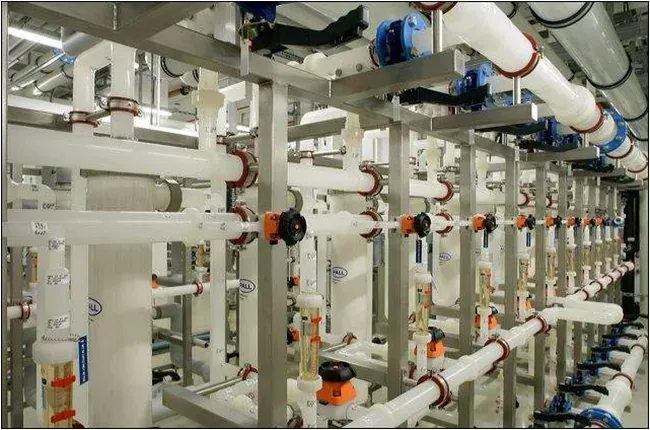
- Plate IIIA PVDF piping installation carrying ultrapure water in a semiconductor fabrication plant: the kind of unglamorous, highly corrosive-resistant service the material has quietly filled since the 1960s, well before anyone cared about its piezoelectricity.Wikimedia Commons
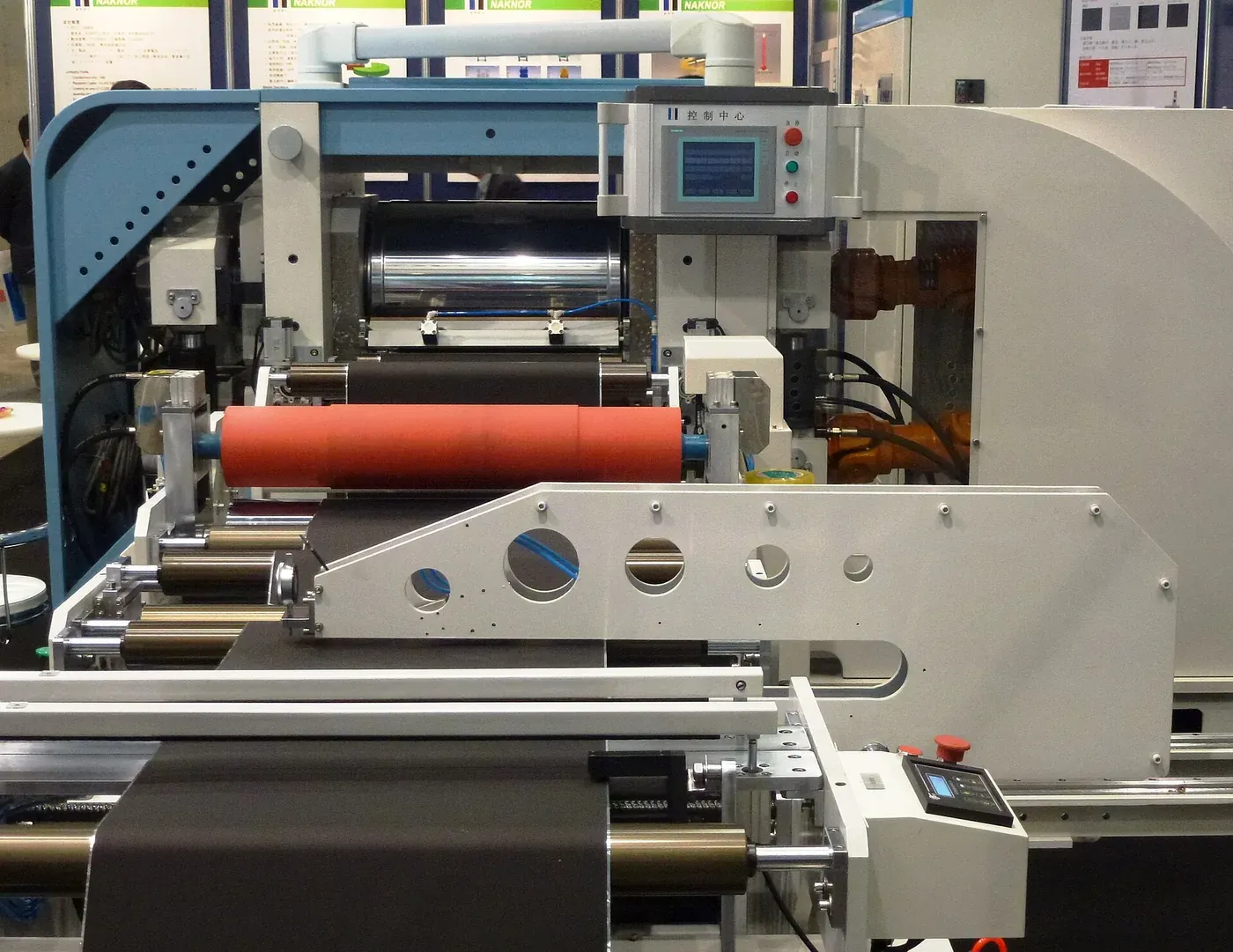
- Plate IVA calendering line compressing lithium-ion battery electrode film to its final thickness: the kind of production step where a PVDF binder holds the electrode's active particles onto the foil through repeated rolling and handling.Wikimedia Commons