The Post-War Boom (1946-1960)
Polypropylene (PP)
The Plastic That Bent the Rules
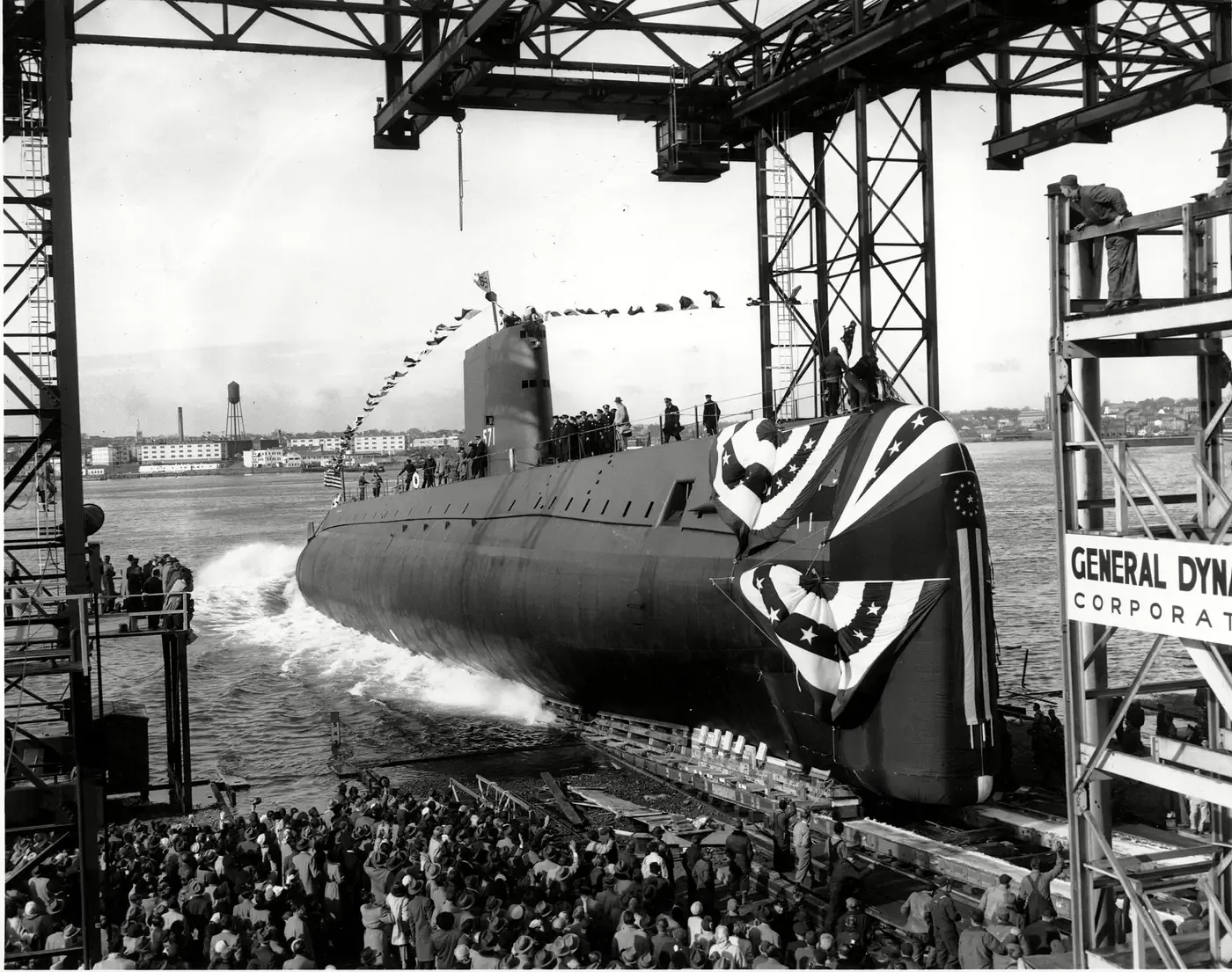
On 21 January 1954, a crowd at Groton, Connecticut watched a submarine slide down the ways into the Thames River under a fringe of bunting: USS Nautilus, the first vessel ever driven by a nuclear reactor rather than a tank of fuel. It was the kind of year that liked to announce it could rearrange matter at scales nobody had touched before: the reactor rearranging atomic nuclei, and, seven weeks later and on a much smaller stage, an industrial chemist in Milan rearranging the way a plastic’s own molecules chose to line up.
Plate I

A Discovery Made Twice
Propylene, the three-carbon cousin of the ethylene that had already become polyethylene, was well known to be difficult. Left to polymerize on its own it produced a sticky, useless amorphous gum, because its dangling methyl groups had no reason to line up in any order at all. What changed in 1954 was a catalyst, not the monomer: Karl Ziegler’s low-pressure, titanium-based coordination chemistry, discovered at Mülheim the previous year and already the subject of its own remarkable story. Giulio Natta, a Milan Polytechnic professor consulting for the Italian chemical giant Montecatini, saw immediately that a catalyst able to add ethylene units in strict order might do something even more interesting to propylene’s lopsided molecule: force every methyl group onto the same side of the chain. On 11 March 1954 his team succeeded, and Natta wrote two words in his lab diary: fatto il polipropilene, “made polypropylene.” The result was isotactic polypropylene: crystalline, tough and, unlike anything propylene had produced before, actually useful.
Plate II
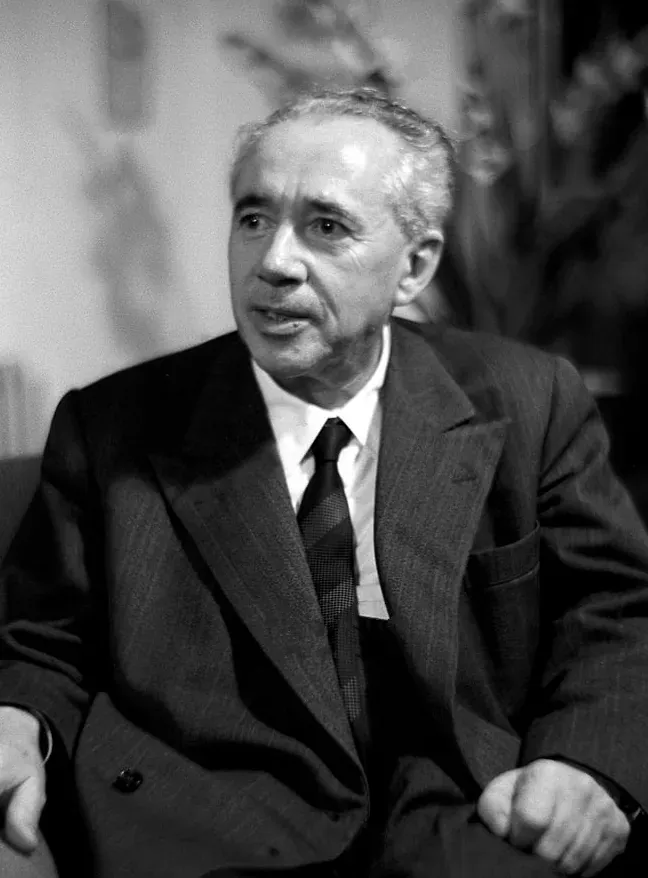

Natta was not alone, and did not know it yet. In Germany that same March, a Farbwerke Hoechst chemist named Karl Rehn made isotactic polypropylene independently, using catalyst chemistry that had also come from Ziegler. Hoechst chose not to patent the discovery. Montecatini did, filing in Italy in June 1954 in the names of Natta, Piero Pino and Giorgio Mazzanti, which is the main reason the world remembers Natta’s laboratory and not Rehn’s. The full account of Ziegler’s catalyst chemistry, and of how his and Natta’s separate breakthroughs came to share a Nobel Prize, belongs to their own page in this Atlas; polypropylene’s part of that story is what happened once the catalyst reached propylene.
Whoever Files First
What followed was one of the longest-running patent disputes in the history of the chemical industry, and it complicates the tidy story above considerably. Three years before Natta ever ran his propylene experiment, two Phillips Petroleum chemists in Oklahoma, J. Paul Hogan and Robert Banks, had already produced a crystalline solid from propylene in 1951 while developing the chromium-based catalyst that gave the world high-density polyethylene, without yet recognising, as Natta’s X-ray work would show three years later, that its crystallinity came from a regular, stereoregular arrangement of the chain. Phillips filed its own patent application in 1956. What followed was a priority fight among Phillips, Montecatini and Ziegler’s own institute that dragged through the US Patent Office and federal courts for the better part of three decades. A 1971 patent-office ruling initially favoured Montecatini; on appeal, the US courts eventually found the other way, and in March 1983 (twenty years after the Nobel Prize and nine years after Natta’s death) the United States Patent and Trademark Office finally issued Phillips the composition-of-matter patent for crystalline polypropylene. Montecatini kept the commercial head start that mattered more in practice: full-scale isotactic polypropylene production began under its name in 1957, three years after Natta’s own diary entry and the same year the material started reaching an actual market.
Plate III
.jpg)
One Backbone, Three Personalities
Set the legal history aside and the chemistry is simple enough to sketch in one sentence: polypropylene is polyethylene’s backbone with a methyl group hanging off every other carbon. What that single substitution does is give the chain a choice it did not have before, and the choice is what tacticity means. If every methyl group ends up on the same side of the backbone, the chain is isotactic, and its regularity lets neighbouring chains pack together into the crystalline regions that make the material strong and heat-resistant; this is the form Natta made, and it still accounts for the overwhelming majority of polypropylene produced today. If the methyl groups alternate sides in a regular pattern, the chain is syndiotactic: still ordered, still somewhat crystalline, but differently enough in its properties to serve specialised roles of its own. And if the methyl groups fall on whichever side chance puts them, the chain is atactic, unable to pack into any regular structure at all, permanently amorphous, and useful precisely because it stays soft and tacky, in sealants and adhesives rather than rigid parts. One monomer, one catalyst family, and three distinct materials depending entirely on which way a methyl group points.
What the Methyl Group Buys You
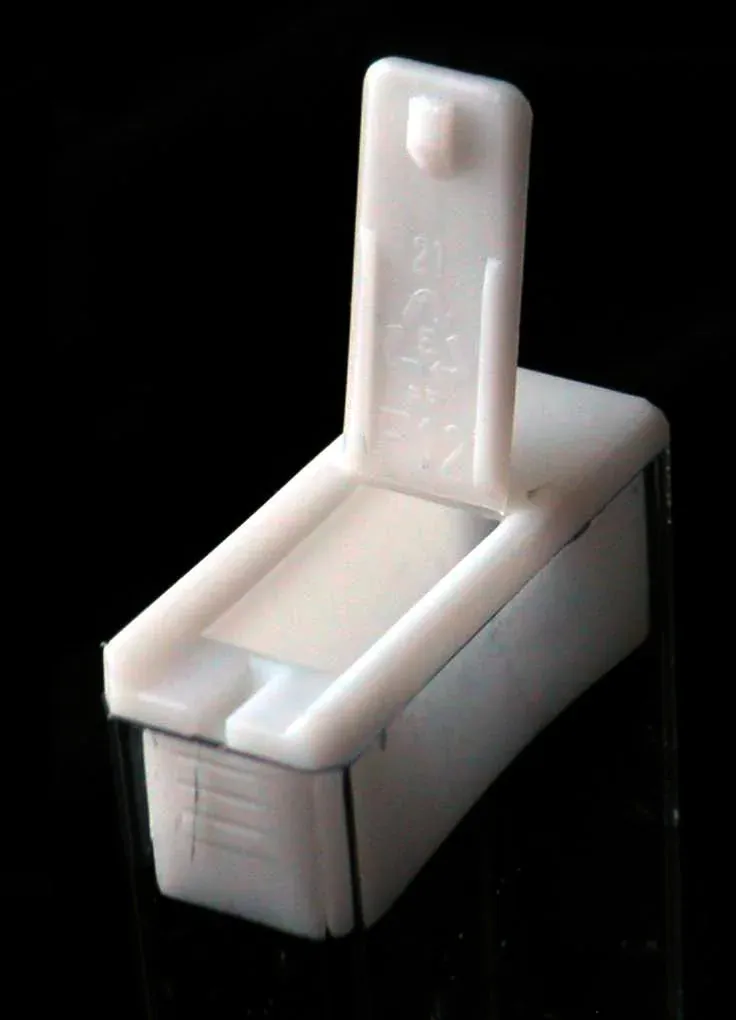
Polypropylene sits lighter than almost any other commodity plastic (it is one of the few that floats in water rather than sinking), and that extra methyl group buys it a real advantage over its polyethylene cousin: a higher working temperature, enough to survive a hot-fill packaging line or a trip through an autoclave that would soften a polyethylene part. It gives up a little low-temperature toughness in return, and unmodified polypropylene can turn brittle in a hard frost where polyethylene keeps its flexibility. Its most famous trick, though, is neither strength nor heat resistance but fatigue: a thin, precisely moulded strip of isotactic polypropylene can be folded back on itself many thousands of times without cracking, which is the entire reason it is called a living hinge and the reason a shampoo-bottle cap or a ketchup-bottle top can be flipped open every day for years without ever breaking off. Chemically it resists almost everything a household or a factory floor can throw at it, with one specific exception: unstabilised polypropylene weathers poorly in direct sunlight, and outdoor grades need a UV package to survive.
Plate IV

From Catalyst to Chair
The polymerization itself runs in a reactor held at a moderate 50 to 80°C and 20 to 40 bar, far gentler conditions than the high-pressure route that makes LDPE. This is Ziegler’s low-pressure legacy again. Producers choose between two main reactor designs: a gas-phase process, in which propylene vapour polymerizes onto solid catalyst particles suspended in a fluidised bed, and a slurry process, in which the growing polymer particles form in liquid propylene or a hydrocarbon diluent. Either way, the output is a fine white powder that is then melted, compounded with additives, and extruded into the pellets that leave the plant.
The catalyst itself kept improving long after 1954. Natta’s original titanium trichloride, activated with an aluminium alkyl, gave isotacticity around 40%, good enough to be useful, far from perfect. Modern Ziegler-Natta systems, built on magnesium chloride supports with carefully chosen electron donors, now push past 98%, and metallocene catalysts added a further layer of control by offering a single, well-defined active site in place of several. That control is what let the industry branch polypropylene into distinct grades: plain homopolymer for rigid packaging; random copolymers with a little ethylene worked in for clarity and a lower melting point; impact copolymers, with rubbery ethylene-propylene domains built in during polymerization, for parts that need to survive a cold-weather knock; controlled-rheology grades for fibre spinning; high-melt-strength grades for foams; and ultra-pure medical grades for syringes and diagnostic devices.
Where It Ended Up
Polypropylene’s combination of light weight, heat tolerance and fatigue resistance sent it everywhere a living hinge, a food container or a car interior panel was needed: packaging films, carpet and rope fibre, automotive trim, and the medical devices whose demand surged during the COVID-19 pandemic, from testing cartridges to the nonwoven fabric of a protective mask. More recently it has taken on a role in the switch to electric vehicles, as a separator material inside lithium-ion battery packs, where its combination of chemical stability and controllable porosity matters more than any of its more famous properties.
Looking Forward
Polypropylene’s recyclability is now doing as much work for its reputation as its original properties once did: chemical recycling routes that dissolve and reprecipitate the polymer, or break it back down toward monomer, are being built out specifically because there is already so much of it in circulation to recover. Bio-based feedstocks are further off but under active development. None of it changes the underlying trick discovered in that Milan laboratory in March 1954: that a plastic’s properties can be dialled in not by changing its monomer, but by controlling, one methyl group at a time, which way the chain happens to be facing.
values with [n] cite the numbered references·estimates are flagged·“not yet available” and “N/A” are honest states, not gaps
fetching the model…
Polypropylene repeat unit
- Abbreviation
- PP
- Type
- polymer family (hub)
- CAS number
- 9003-07-0
- Resin ID code
- 5
- Formula
- (C3H6)n[-CH2-CH(CH3)-]nTacticity (isotactic/syndiotactic/atactic) is a configurational property that drastically changes behavior despite an identical repeat unit. See the configuration-vs-conformation concept entry. The 3D model shows an isotactic triad.
- Repeat unit (BigSMILES)
{[][$]CC(C)[$][]}- IUPAC name
- Poly(propylene)
- Synonyms
- polypropene
- Also known as
- polypropene
- Chemical family
- polyolefin
- Backbone class
- carbon-chain
- Polymerization mechanism
- coordination
- Constitutional monomer
- Propylene
- Polymer class
- thermoplastic
- Year of origin
- 1954
- Era
- The Post-War Boom (1946-1960)
- Key figures
- Giulio Natta · Karl Ziegler · J. Paul Hogan · Robert Banks · Karl Rehn
- Events referenced
- Launch of USS Nautilus, the first nuclear-powered submarine (21 January 1954)
- Polymerization type
- coordination chain-growth
- Common monomers (feedstocks)
- propylene
- Catalysts
- Ziegler-Natta (TiCl4/MgCl2); metallocene (for syndiotactic grades)
Polymerization first demonstrated by Phillips Petroleum chemists in 1951; stereoselective polymerization to the isotactic form was discovered by Giulio Natta and Karl Rehn in March 1954 (building on Karl Ziegler's coordination-catalysis work), leading to commercial production by Montecatini from 1957.
- Tacticity
- Isotactic (iPP, dominant commercial form, semi-crystalline), syndiotactic (sPP, alternating methyl orientation, slightly less crystalline, made via metallocene catalysis), and atactic (aPP, random/amorphous, used as sealant and bitumen additive).
- Crystal structure
- not yet available
- Typical crystallinity
- 29–75 %[3]isotactic (Wypych); Mark reports 50–70% as typical commercial (DSC); generic Wypych PP entry spans 3.2–67% across tacticities
Molecular weight
- Number average (Mn)
- 5000–166000 g/mol[3]isotactic
- Mass average (Mw)
- 158000–580000 g/mol[3]isotactic
- Dispersity (Mw/Mn)
- 1.9–9.7[3]isotactic; 3.0–3.9 for metallocene-catalyzed grades
Mark-Houwink constants
not yet available
- Density
- 0.9–0.91 g/cm³[3]20°C, isotactic (commercial form); generic Wypych PP entry gives 0.84–0.91
- Melt flow index
- 1.9–31 g/10min[3]230°C/2.16 kg, isotactic
- Refractive index
- 1.49–1.503[3]20°C, isotactic
- Transmittance
- 50–90 %[3]isotactic film; quenched 60–90%, slowly cooled 50–65%
- Haze
- 0.3 (0.2–0.9) %[3]isotactic; biaxially oriented metallocene grade 0.2–0.9%
- Gloss
- 99 (94–99) %[3]60°, Gardner (ASTM D523), isotactic; biaxially oriented metallocene grade 94–98%
- Water absorption
- 0.02–0.04 %[3]equilibrium, water immersion, 23°C; generic PP entry (not isotactic-specific)
- Dielectric constant
- 2.2–2.3[3]100 Hz-1 MHz, isotactic
- Dielectric strength
- 24 (17–30) kV/mm[4]298 K (ASTM D149), isotactic; a second cited source gives 21.7–30 kV/mm at 298 K, 17 kV/mm at 393 K
- Electrical conductivity
- 1 × 10⁻¹⁵–1 × 10⁻¹⁴ S/m[3]reciprocal of reported volume resistivity, 1x10^14-1x10^15 ohm-m, isotactic (Mark chapter corroborates with 10^16–10^17 ohm-cm = 10^14–10^15 ohm-m)
- Glass transition (Tg)
- -10 °C[3]isotactic (dedicated Wypych PP,iso entry); generic Wypych PP entry reports exp.=-8 (-3.2 for isotactic specifically); Mark's DMA measurement gives a positive Tg of 2–11°C (283.7 K at 30 Hz, 275.5 K at 1 Hz). Sources disagree
- Melting temperature (Tm)
- 151–171 °C[3]DSC, isotactic; commercial grade 151–166°C, high-isotacticity material 157–171°C, biaxially oriented metallocene 148–151°C
- Crystallization (Tc)
- 116–140 °C[3]generic PP entry, labeled "Crystallization temperature"; isotactic-specific entry separately reports a "rapid crystallization temperature" of 138–144°C
- Heat deflection (HDT)
- 55 °C[3]1.8 MPa, isotactic
- Decomposition onset
- 328 °C[3]generic PP entry (explicitly labeled onset); isotactic-specific Wypych entry separately reports 240°C, Mark reports 350°C (TGA, helium), criteria not directly comparable
- Thermal conductivity
- not yet available
- Tensile modulus
- 825–1700 MPa[3]isotactic (825 MPa, commercial grade; 910 alpha-form, 820 beta-form per Wypych PP,iso entry); generic Wypych PP entry separately reports 1,700 MPa (unfilled base grade)
- Yield strength
- 34.5 (33–36) MPa[3]isotactic (33–36 MPa, Wypych); Mark's isotactic homopolymer entry gives 34.5 MPa; generic Wypych PP entry close at 31–35.2 MPa
- Tensile strength at break
- 30 (26–32) MPa[3]isotactic, commercial unoriented grade (30 MPa); generic Wypych PP unfilled range 26–32 MPa; oriented film values are much higher (130–300 MPa MD/TD, biaxially stretched)
- Elongation at break
- 10–500 %[3]isotactic entry 90–500%; generic Wypych PP unfilled entry narrower at 10–140%
- Impact strength (Izod)
- 27 (18–69) J/m[3]notched, 23°C; isotactic entry 25–39 J/m (Mark's isotactic homopolymer 27 J/m); generic Wypych PP entry wider at 18–69 J/m
- Impact strength (Charpy)
- not yet available
- Hardness
- 90–105 Rockwell R[3]isotactic (R95-105, Wypych; R90, Mark homopolymer); generic Wypych PP entry narrower at R102-103
- Flexural modulus
- 1389 (1150–1600) MPa[3]isotactic 1,150–1,570 MPa (Wypych); Mark's isotactic homopolymer 1,389 MPa; generic Wypych PP entry 1,240–1,600 MPa
- Poisson's ratio
- 0.38[3]isotactic
- Coefficient of friction
- 0.27–0.36[3]ASTM D1894, generic PP entry; vs chrome steel 0.27–0.29, vs aluminum 0.35–0.36
- Solvent: acids
- very good[3]dilute and concentrated
- Solvent: alcohols
- very good[3]
- Solvent: alkalis
- very good[3]
- Solvent: aliphatic hydrocarbons
- fair to poor[3]
- Solvent: aromatic hydrocarbons
- poor[3]
- Solvent: esters
- fair[3]
- Solvent: greases & oils
- good to fair[3]
- Solvent: halogenated hydrocarbons
- poor[3]
- Solvent: ketones
- good[3]
- Weathering / UV
- Poor unstabilized (cracks form after 228 h Xenotest exposure); requires UV absorber/HALS stabilizer package for outdoor use. Syndiotactic PP is substantially more UV-stable than isotactic.[3]
- Hydrolysis resistance
- Not applicable
- Flammability (UL94)
- HB[3]unfilled grade; V-0 achievable with flame retardants
- Limiting oxygen index
- 17–19 %[3]isotactic reports 17% (Mark corroborates at 17.4%); generic Wypych PP entry 17–19%
- Solubility parameter (δ)
- 17.2–19.2 MPa^0.5[3]isotactic 17.2–18.8 (Wypych; Mark reports 17.3–18.8 by inverse-phase GC); generic Wypych PP entry 18.0–19.2
Gas permeability
- O₂
- 7.73 × 10⁻¹⁴ cm³(STP)·cm/(cm²·s·Pa)[4]298 K, isotropic film, all pressures, isotactic
- CO₂
- 2.37 × 10⁻¹³ cm³(STP)·cm/(cm²·s·Pa)[4]298 K, <1 atm, isotactic
- water vapor
- 3.83 × 10⁻¹² cm³(STP)·cm/(cm²·s·Pa)[4]298 K, isotactic
Polymer-solvent interaction parameter (χ)
not yet available
- Processing methods
- injection moldingfilm extrusionfiber spinningliving-hinge molding
- Drying required
- Yes
- Packagingpackaging films · food containers
- Textilescarpets · ropes
- Automotiveinterior/exterior components
- Consumer & medicalliving hinges · piping systems · medical devices
- Recyclable
- Yes
- Biodegradable
- No
- Degradation pathway
- not yet available
Resin identification code 5.
- LD50 (oral, rat)
- 5000 mg/kg[3]>5,000 (isotactic and generic PP entries agree)
- NFPA health
- 1[3]HMIS rating, 0–4 scale; isotactic and generic PP entries agree
- NFPA flammability
- 1[3]HMIS rating, 0–4 scale; isotactic and generic PP entries agree
- NFPA reactivity
- 0[3]HMIS rating, 0–4 scale; isotactic and generic PP entries agree
- Carcinogenic classification
- not listed by ACGIH, NIOSH, NTP[3]
TLV (ACGIH): 3 mg/m³ respirable, 10 mg/m³ total. OSHA: 5 mg/m³ respirable, 15 mg/m³ total. Mutagenic, teratogenic and reproductive toxicity not known; skin (rabbit) LD50 >2,000 mg/kg.
- [1]PolypropyleneWikipediaAccessed 2026-07-14https://en.wikipedia.org/wiki/Polypropylene[wiki-polypropylene]
- [2]Resin Identification Codes (RICs), as Specified by ASTM D7611The ANSI BlogAccessed 2026-07-14; confirms PVC = RIC 3https://blog.ansi.org/ansi/resin-identification-codes-rics-astm-d7611/[ansi-resin-codes]
- [3]Handbook of PolymersChemTec Publishinghttps://www.worldcat.org/isbn/9781895198928[handbook-wypych-2016]
- [4]Polymer Data HandbookOxford University Presshttps://search.worldcat.org/search?q=Polymer+Data+Handbook+Mark+1999[handbook-mark-1999]
Illustrations
- Plate IUSS Nautilus launched at Groton, Connecticut, 21 January 1954. That same year, on a molecular scale, chemists learned to arrange a polymer chain just as deliberately.Wikimedia Commons
- Plate IIGiulio Natta, whose Milan laboratory produced isotactic polypropylene in March 1954 by forcing every methyl group in the chain onto the same side of the backbone.Wikimedia Commons
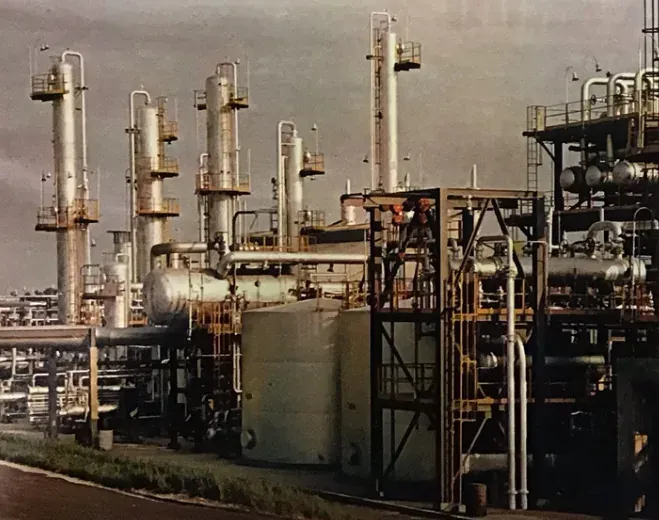
- Plate IIIMontecatini's Ferrara petrochemical works, photographed in 1962. It was part of the industrial buildout that carried isotactic polypropylene from Natta's laboratory to the world market after 1957.Wikimedia Commons
- Plate IVA living hinge, moulded as a single thinned strip of isotactic polypropylene. This is the trick that makes this the least noticed remarkable plastic in most kitchens.Wikimedia Commons