The Post-War Boom (1946-1960)
Polyisopropylacrylamide (PNIPAM)
On 17 July 1955, Disneyland opened its gates in Anaheim, California, and did exactly what it had been built to do: several thousand children ran down a tree-lined walkway toward a castle that had not existed the year before, designed specifically to look as though it always had. It was one of the most carefully engineered pieces of make-believe the century had produced, and it arrived with months of advance fanfare behind it.
Plate I


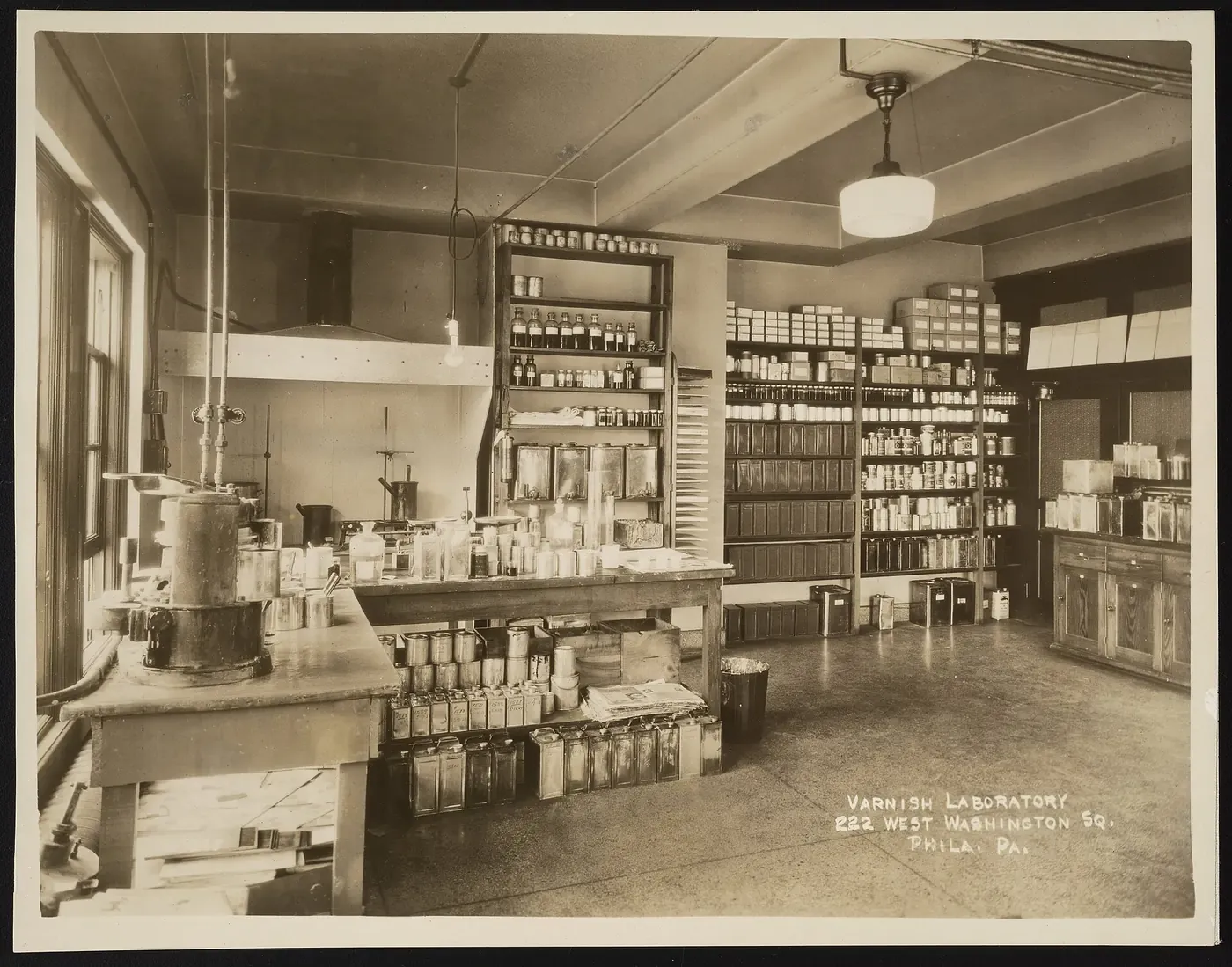
The same year, in a rather less enchanted setting, a different kind of construction was under way with no fanfare of any kind. Chemists at Röhm & Haas in Philadelphia (Edward H. Specht, Andrew Neuman, and Harry T. Neher) had filed a patent in January 1954 for a general method of making acrylamide compounds from acetylene, carbon monoxide, and various amines. Among the dozens of related molecules the patent covered was one built from acrylamide and isopropylamine: N-isopropylacrylamide, the monomer that, polymerized, becomes PNIPAM. The patent was granted in December 1956, and no surviving public record pins down the exact day the polymer itself was first made. What can be said honestly is that 1955 sits squarely in the middle of that process: the filing already a year old, the grant still a year away, the molecule known only to the small number of chemists who had made it.
Plate II

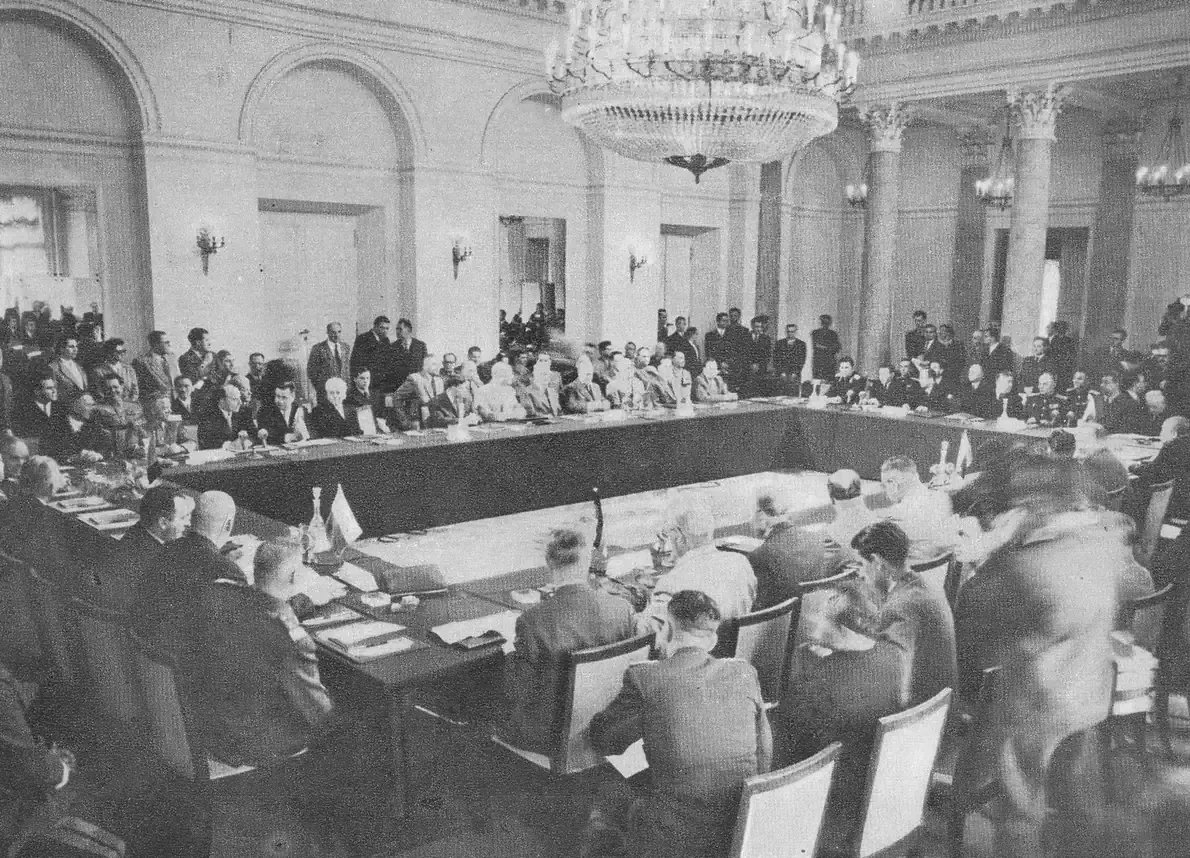
Ten weeks before Disneyland opened, on 14 May 1955, the Soviet Union and seven allied states had signed the Warsaw Pact in a formal ceremony in Warsaw. This was a treaty that mostly wrote down, with signatures and a chandeliered hall, a military relationship that had already existed in practice since the years right after the war. Both events, in their very different registers, were 1955 putting an official face on something that already was.
Plate III

PNIPAM’s own arrival ran in the opposite direction: a real molecule, sitting in a flask, that nobody had yet decided was worth a second look. It would take until 1968 for two chemists, M. Heskins and J. E. Guillet, to notice and describe the polymer’s strangest trick: it dissolves readily in cold water, and then, warmed to just about the temperature of the human body, collapses out of solution entirely, as though it had changed its mind about the water’s company. For more than a decade the molecule had been sitting on a shelf, carrying a property nobody had thought to test for.
Molecular Identity: A Temperature-Sensitive Centipede
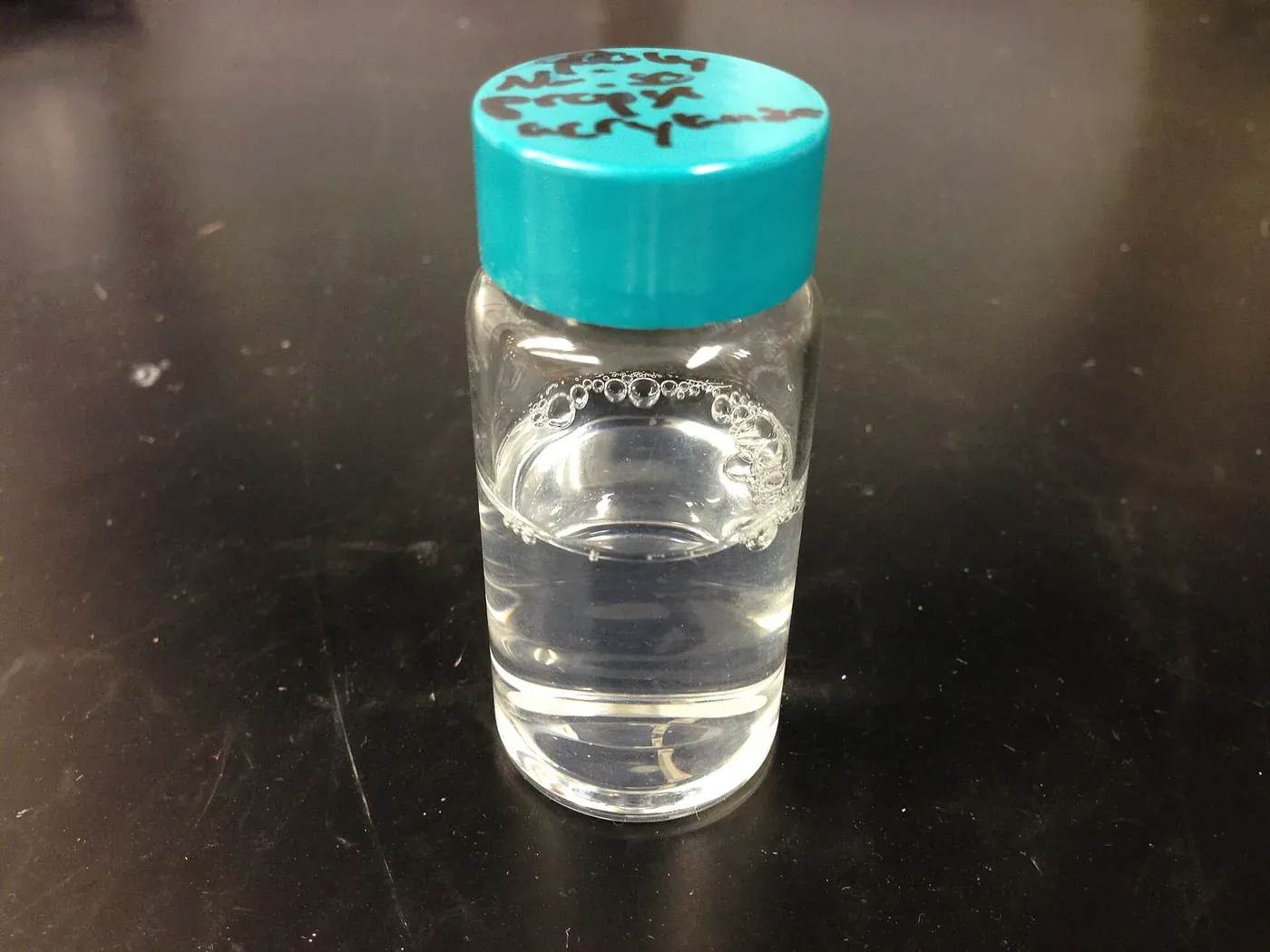
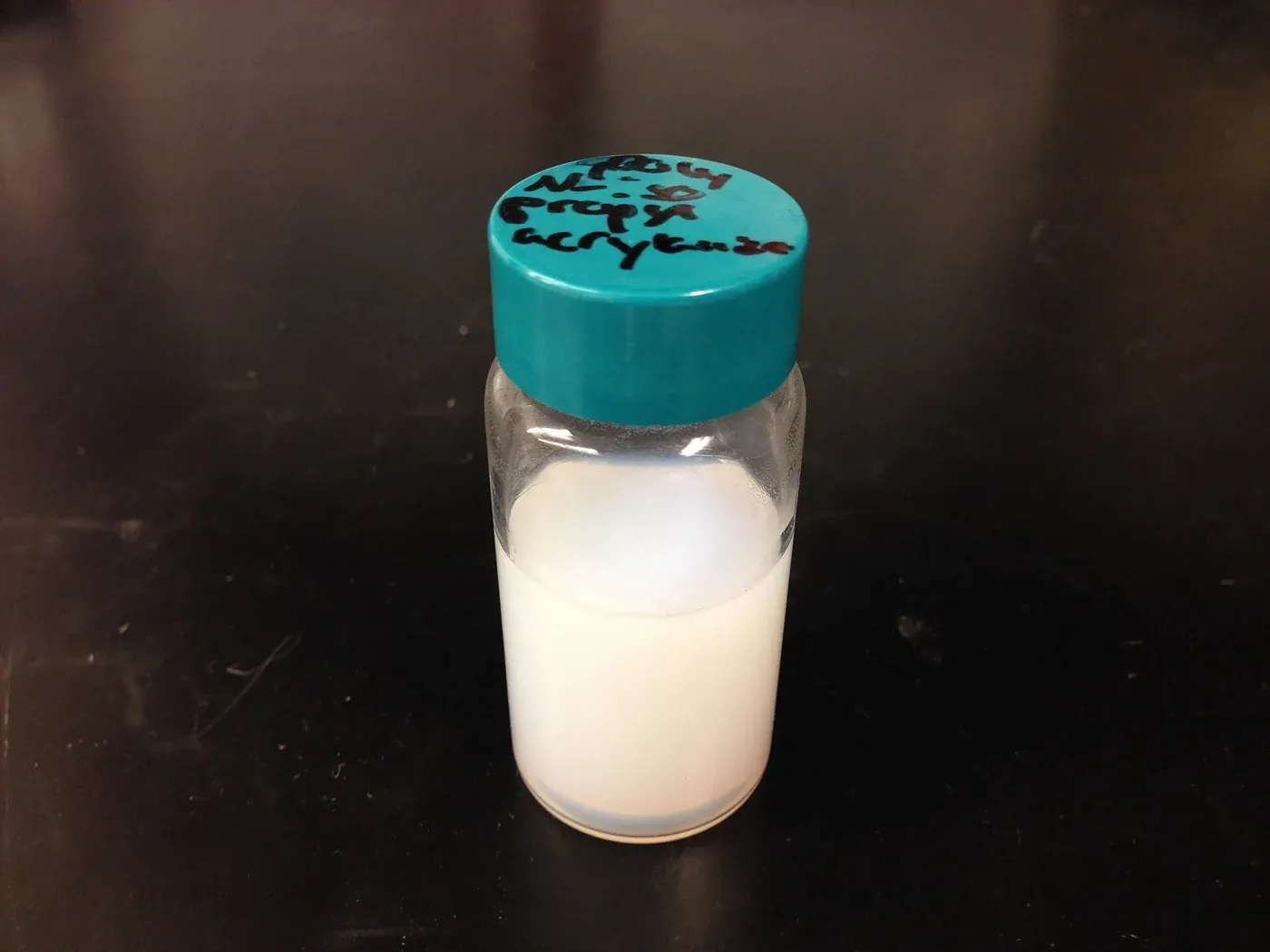
PNIPAM’s structure resembles a backbone chain with dangling isopropyl groups: a molecular centipede with temperature-sensitive legs. Those groups, together with the polymer’s amide linkages, govern its behavior in water. Below its critical temperature the amide groups hydrogen-bond with water and the chains stretch out, water-loving and soluble; above it, the chains collapse into tight, water-shy balls, a transition the Atlas covers in more depth on its page about upper and lower critical solution temperatures.
Plates IV & V


Properties: A Material Defined by a Threshold
Most of what makes PNIPAM interesting cannot be captured in the usual language of a structural plastic, and that is really the point of it. It is rarely if ever used as a dry solid; nearly everything it does happens in water, where its behavior changes qualitatively rather than gradually as the temperature crosses its critical point: below it, a swollen, hydrophilic network or a dissolved coil; above it, a collapsed globule that has pushed nearly all of its water back out. As a crosslinked gel it does not dissolve at all, but the same threshold still governs it: the network holds its shape while its swollen volume contracts sharply once the critical temperature is crossed. Reported values for its dry-state density, its glass transition, and its melting behavior vary enough between sources that none of them are treated as settled here. This is an instability that is itself informative. PNIPAM was never engineered to be measured the way a structural plastic is measured. It was made, accidentally, in the mid-1950s, and only understood, on purpose, more than a decade later, to respond.
Manufacturing the Molecular Chameleon
PNIPAM is made by free-radical polymerization of N-isopropylacrylamide, typically carried out in an inert atmosphere using initiators such as ammonium persulfate or AIBN. The reaction can run in various solvents, though water is the most common choice for its environmental friendliness.
The critical challenge is temperature control. Because the growing chains exhibit their temperature-sensitive behavior even as they form, the reaction has to be managed carefully to produce a uniform product: making a polymer that reacts to warmth means that its own manufacture is an exercise in thermal precision, the chameleon changing color even on the workbench where it is born.
Applications: From Medicine to Smart Windows
PNIPAM’s temperature-responsive behavior has carried it into fields from drug delivery to smart textiles. In medicine, it enables temperature-triggered drug-release systems, releasing a payload only once it reaches the slightly elevated temperature of inflamed tissue. In tissue engineering, PNIPAM-based scaffolds can hold cells at room temperature and gently release them, and the sheets they grow on, once warmed to body temperature. This is a technique now used to harvest intact sheets of cultured cells without the enzymes that would otherwise damage them.
The horizon keeps expanding. Recent work on 3D printing with PNIPAM-based inks points toward structures that change shape with temperature, hinting at self-assembling furniture or adaptive architecture. The curious laboratory creation of the 1950s may yet help unlock a future in which materials think for themselves.
values with [n] cite the numbered references·estimates are flagged·“not yet available” and “N/A” are honest states, not gaps
fetching the model…
Polyisopropylacrylamide repeat unit
- Abbreviation
- PNIPAM
- Type
- polymer family (hub)
- CAS number
- 25189-55-3
- Resin ID code
- none assigned
- Formula
- (C6H11NO)n[-CH2-CH(CONHCH(CH3)2)-]n
- Repeat unit (BigSMILES)
{[][$]CC(C(=O)NC(C)C)[$][]}- IUPAC name
- Poly(N-isopropylacrylamide)
- Synonyms
- poly(N-isopropylacrylamide)
- Also known as
- —
- Chemical family
- acrylicstimuli-responsive-polymer
- Backbone class
- carbon-chain
- Polymerization mechanism
- free-radical
- Constitutional monomer
- N-isopropylacrylamide
- Polymer class
- thermoplastic
- Year of origin
- 1955
- Era
- The Post-War Boom (1946-1960)
- Key figures
- Edward H. Specht · Andrew Neuman · Harry T. Neher · M. Heskins · J. E. Guillet
- Events referenced
- Disneyland opens in Anaheim, California (17 July 1955) · The Warsaw Pact is signed (14 May 1955)
- Polymerization type
- free-radical chain-growth
- Common monomers (feedstocks)
- N-isopropylacrylamide
- Catalysts
- not yet available
The monomer was first synthesized in 1956 (Sprecht); a 1957 patent covered its use as a rodent repellent. The polymer's distinctive thermoresponsive behavior in aqueous solution was first reported in 1968, and research interest expanded significantly in the 1980s once its applications were recognized. Made via free-radical polymerization (homo-, co-, or terpolymerization for property tuning).
- Tacticity
- not yet available
- Crystal structure
- not yet available
- Typical crystallinity
- not yet available
Molecular weight
- Number average (Mn)
- not yet available
- Mass average (Mw)
- not yet available
- Dispersity (Mw/Mn)
- not yet available
Mark-Houwink constants
not yet available
Exhibits a lower critical solution temperature (LCST) around 32°C: the chain is hydrophilic and extended below this temperature, then collapses into a hydrophobic globule above it. The exact transition temperature can shift 5–10°C or more depending on concentration, molar mass, dispersity, and end-group chemistry. See the-ucst-lcst-concept for the general phenomenon.
- Density
- 1.386 g/cm³[2]Dry state
- Melt flow index
- not yet available
- Refractive index
- 1.5[2]Dry polymer (swollen polymer: 1.36)
- Transmittance
- not yet available
- Haze
- not yet available
- Gloss
- not yet available
- Water absorption
- not yet available
- Dielectric constant
- not yet available
- Dielectric strength
- not yet available
- Electrical conductivity
- not yet available
- Glass transition (Tg)
- not yet available
- Melting temperature (Tm)
- 96 °C[1]
- Crystallization (Tc)
- not yet available
- Heat deflection (HDT)
- Not applicable
- Decomposition onset
- not yet available
- Thermal conductivity
- not yet available
- Tensile modulus
- 0.1–1.3 MPa[2]Storage modulus (compressive) of the polymer gel, oscillatory testing; 30 °C: 0.1 MPa, 60 °C: 1.3 MPa (large increase reflects LCST-driven collapse).
- Yield strength
- Not applicable
- Tensile strength at break
- Not applicable
- Elongation at break
- Not applicable
- Impact strength (Izod)
- Not applicable
- Impact strength (Charpy)
- Not applicable
- Hardness
- Not applicable
- Flexural modulus
- Not applicable
- Poisson's ratio
- not yet available
- Coefficient of friction
- not yet available
- Solvent: water
- LCST behavior: soluble below ~32°C, insoluble/collapsed above it[1]
- Weathering / UV
- Not applicable
- Hydrolysis resistance
- Not applicable
- Flammability (UL94)
- Not applicable
- Limiting oxygen index
- not yet available
- Solubility parameter (δ)
- not yet available
Gas permeability
not yet available
Polymer-solvent interaction parameter (χ)
- Processing methods
- free-radical solution/emulsion polymerizationcrosslinking (for microgel/hydrogel forms)
- Drying required
- not yet determined
- Processing temperature
- Not applicable
- Shrinkage rate
- Not applicable
- Pharmaceuticalcontrolled drug delivery systems · tissue engineering scaffoldsIntramuscular formulations show 48–66 day half-life depending on molecular weight.
- Materialssmart hydrogels and microgels · biosensors and thin films · gel actuators
- Industrialtertiary/enhanced oil recovery
- Recyclable
- No
- Biodegradable
- No
- Degradation pathway
- not yet available
- LD50 (oral, rat)
- not yet available
- NFPA health
- not yet available
- NFPA flammability
- not yet available
- NFPA reactivity
- not yet available
- Carcinogenic classification
- not yet available
- [1]Poly(N-isopropylacrylamide)WikipediaAccessed 2026-07-14https://en.wikipedia.org/wiki/Poly(N-isopropylacrylamide)[wiki-pnipam]
- [2]Polymer Data HandbookOxford University Presshttps://search.worldcat.org/search?q=Polymer+Data+Handbook+Mark+1999[handbook-mark-1999]
Illustrations
- Plate IOpening day at Disneyland, 17 July 1955: engineered wonder, announced to the world months in advance.Wikimedia Commons
- Plate IIA laboratory at Röhm & Haas's Philadelphia home office. Röhm & Haas was the company whose chemists patented the first synthesis of the monomer behind PNIPAM.Wikimedia Commons
- Plate IIIDelegates sign the Warsaw Pact in Warsaw on 14 May 1955, formalizing an alliance that had operated in practice for years already.Wikimedia Commons
- Plate IVA PNIPAM solution below its critical temperature: clear, hydrated, and fully dissolved.Wikimedia Commons
- Plate VThe same solution warmed past its critical temperature: the chains have collapsed and turned the liquid opaque within moments.Wikimedia Commons