The Birth of Synthetic Polymers (1907-1938): The Bakelite Revolution
Polyacrylic Acid (PAA)
The Love Affair with Water
In August 1929, Otto Röhm wrote to his partner Otto Haas with the sort of number a manufacturer enjoys putting on paper: output of their splinterproof safety glass had reached ten thousand units a month. Luglas was two panes bonded by a clear, rigid acrylic core, and it did not shower a driver in fragments when the outer sheet broke; the firm had been building it since the late 1920s, and the market had finally arrived. Within three months, a much larger kind of breakage began. Black Tuesday hit the New York Stock Exchange on 29 October with its heaviest trading day on record, and a decade of paper wealth started disappearing in an afternoon that would not really finish unwinding until the following decade did.
Plate I


Neither event has much directly to do with the polymer on this page, and it is worth being honest about why. Luglas was built from a polymerized acrylic ester, a close relative of polyacrylic acid but not the same substance. It was chosen precisely because, unlike the plain acid, it would not dissolve in water. Pure polyacrylic acid, built directly on acrylic acid’s own carboxyl groups, does the opposite of holding a rigid shape in the rain: every unit along its chain reaches for water and does not let go. That made it exactly the wrong material for a windshield, and in 1929 it was, for that reason, the unglamorous relation left out of the trademark filing: worth a line in a chemist’s notebook, worth nothing yet on a shelf.
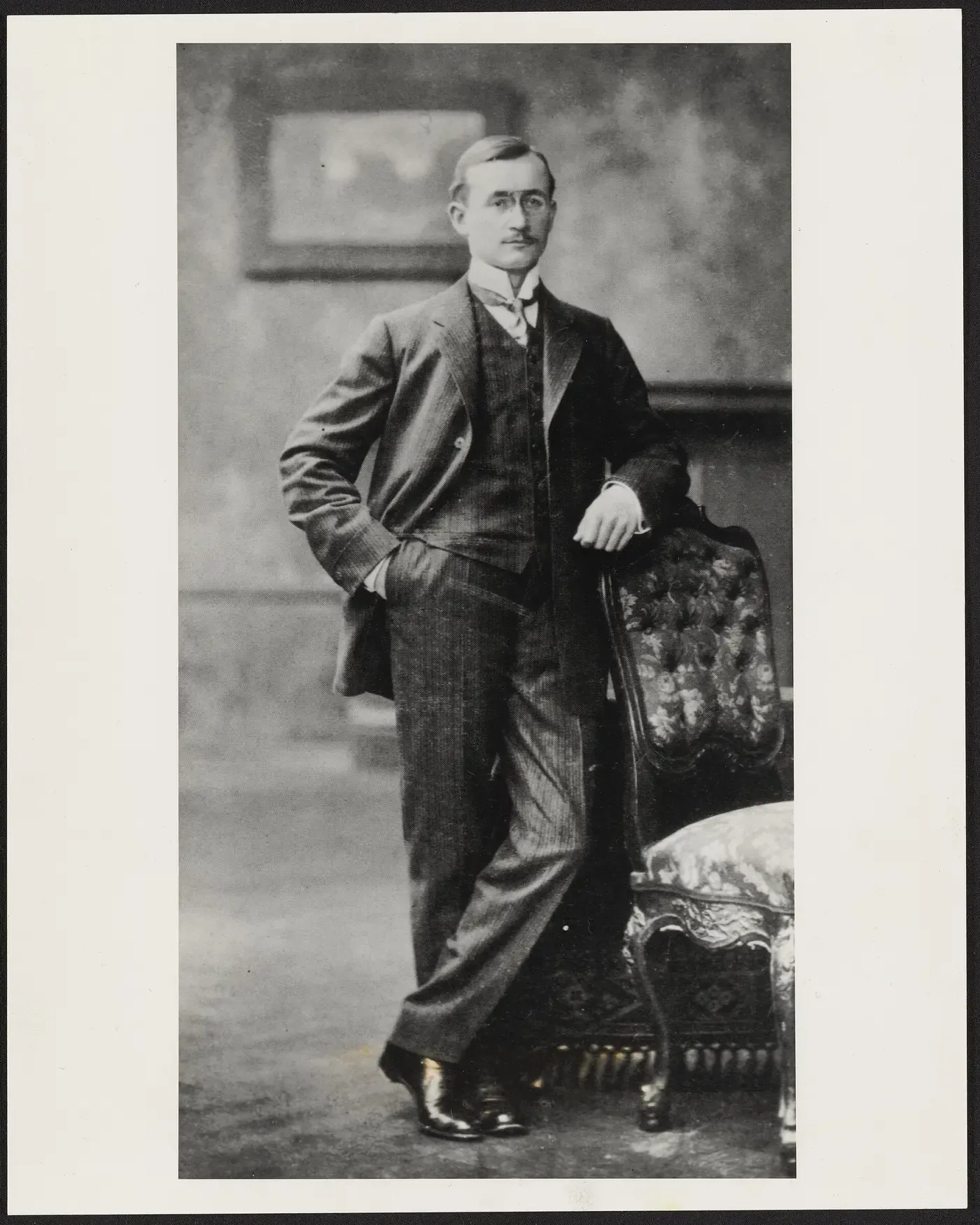
Both materials trace back to the same source: a doctoral dissertation. In 1901, a young pharmacist named Otto Röhm submitted a thesis in Tübingen on the polymerization products of acrylic acid, years before anyone had found a use for them. He and the banker Otto Haas founded Röhm & Haas in 1907, and for the next two decades the firm’s chemists patiently worked through the whole family of acrylic acids and esters, patenting one narrow application after another (leather treatments, paint binders) while they waited for something the market actually wanted.
Plate II
.jpg)
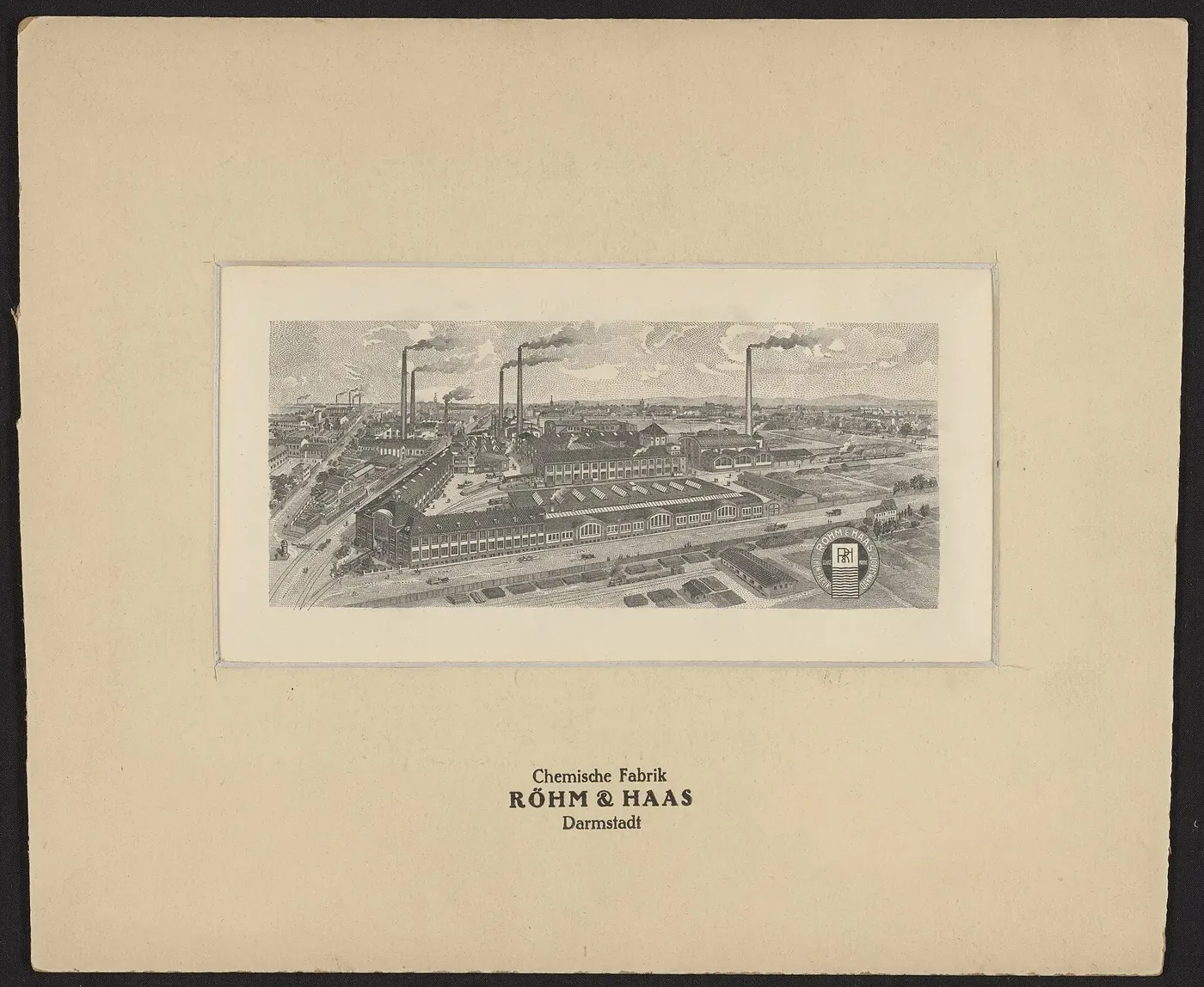
That research happened at the firm’s works in Darmstadt, a site that by the late 1920s employed hundreds of chemists chasing exactly this kind of long-shot patent. It was a strange business model to be running in the middle of an economic collapse (years of salaries staked on a molecule nobody could yet sell), but Röhm & Haas had just proved, with Luglas, that the bet could pay off. Plain polyacrylic acid would have to wait its own turn.
Plate III
.jpg)
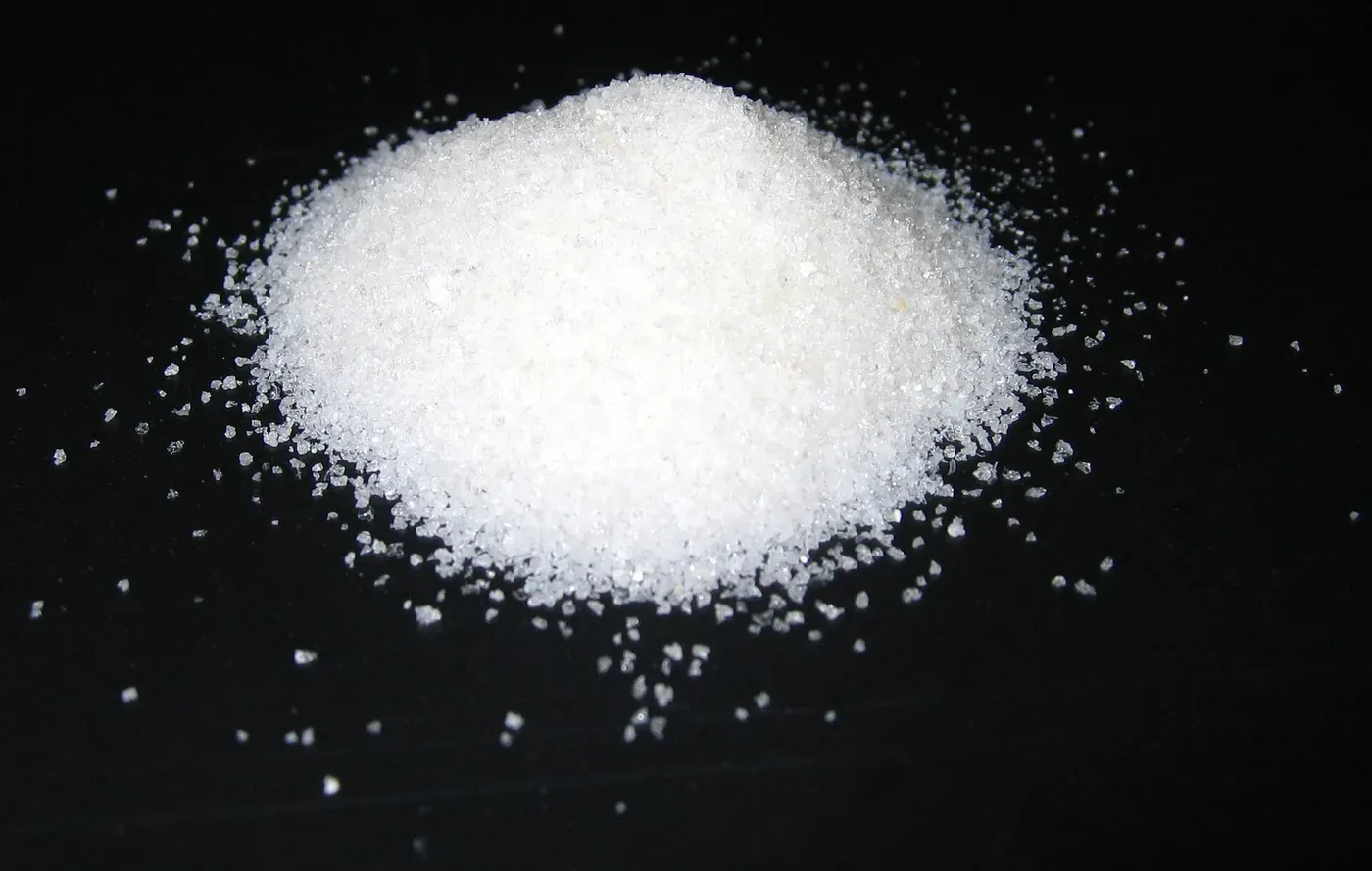
It took another decade for polyacrylic acid’s own peculiar habit (that refusal to stop drinking water) to turn from a liability into an asset. In 1938 the German chemist Werner Kern, who had completed his own doctorate under Hermann Staudinger only eight years earlier, copolymerized acrylic acid with a touch of divinylbenzene and produced a lightly crosslinked network: still thirsty for water, but now tied together just enough that it swelled into a gel instead of dissolving into a solution. That single change (crosslink the water-loving chain just enough to trap it) is the idea inside every disposable diaper’s absorbent core and every tub of hair gel sold today under names like Carbomer.
Plate IV

A Chain Built to Hold Water
Strip away the history and polyacrylic acid’s structure is simple: a carbon backbone with one carboxylic acid group hanging off every other carbon. In water, those -COOH groups can give up a proton and turn into negatively charged -COO⁻ ions, and that single fact governs almost everything the polymer does. A chain covered in identical negative charges repels itself at every point along its length, so the whole molecule unwinds and stretches out; take the charge away, by adding acid or by drying the polymer down, and the chain collapses back into a compact coil, its charged groups now free to hydrogen-bond with each other instead of pushing each other away.
The Switch Inside Every Carboxyl Group
At low pH, the acid groups hold onto their protons and the chain behaves like any ordinary uncharged polymer, curling into a tight coil. Raise the pH and those groups begin giving up protons, and the resulting -COO⁻ ions repel their neighbors hard enough to force the chain open. Where that switch happens (at what pH, over how narrow a range) can be tuned by the chain’s molecular weight, the ionic strength of the solution, and whatever else has been copolymerized in alongside it, which is what makes this one property so useful across such different jobs: a water-treatment additive that grabs positively charged scale ions only once it has unfolded, or a drug-capsule coating built to stay coiled shut in the acid of the stomach and only open once it reaches the near-neutral pH further down the gut.
Properties: What the Water Does
Dry polyacrylic acid is a hard, glassy solid, denser than water, that only turns rubbery a little above the temperature at which water boils, high enough that it holds its shape through anything an ordinary kitchen or dashboard will throw at it. In its common, atactic form it has no true melting point; pushed hard enough, it decomposes before it ever flows. None of that dry-solid behavior is really how the material gets used, though. In practice polyacrylic acid is almost always encountered wet, dissolved or swollen in water, and water changes it completely: a hydrated film is soft and weak, nowhere near as stiff as the dry pellet, because the same charges that make it dissolve also keep it from holding together under load.
Its solvent resistance follows the same logic. It shrugs off hydrocarbons and ketones well enough, but alcohols and alkalis defeat it outright: an alkaline solution simply finishes what water started, neutralizing every acid group along the chain until the whole thing disperses. None of this makes it hazardous to handle: by the standard hazard scales it registers as barely more than a mild irritant, with little fire risk and no listed reactivity concern.
From Monomer to Polymer
Modern production starts with acrylic acid itself, made industrially by the catalytic oxidation of propylene. Free-radical polymerization in aqueous solution, initiated with persulfates and run under carefully controlled temperature and pH, builds the chains; solution, emulsion, and inverse-emulsion routes each give a different molecular weight and a different grade for a different job. Because the reaction is strongly exothermic, plant operators manage the process as closely as the chemistry itself: an ordinary batch can run away if the heat isn’t carried off as fast as the reaction produces it. Where the material needs to swell rather than dissolve, a small amount of a crosslinking agent (Kern’s basic idea, essentially unchanged) goes into the mix before the reaction is allowed to run to completion.
Applications: A Long List Built on One Property
Nearly everything polyacrylic acid is used for traces back to that same water-hungry carboxyl group. Lightly crosslinked into a superabsorbent network, it is the material inside a diaper’s absorbent core and a growing share of wound-care dressings, holding many times its own weight in fluid without releasing it under a light squeeze. Left uncrosslinked and at lower molecular weight, it plays almost the opposite role in water treatment, dispersing and inhibiting the mineral scale that would otherwise cake industrial pipework, and it turns up as the thickening, stabilizing polymer behind a good share of modern paints, cosmetics, and lithium-ion battery electrode binders. In emulsion polymerization it plays a smaller supporting role too: added in small amounts, its charged chains keep growing latex particles from clumping together, which shows up later as better freeze-thaw stability and adhesion in the paints and coatings that latex becomes.
What’s Left to Discover
Polyacrylic acid is a mature industrial material, but its water-loving chemistry keeps finding new jobs. Researchers are testing biodegradable variants and studying it as a soil conditioner for agriculture, chasing the same idea, nearly a century old now, that a molecule’s greatest weakness in one context can be exactly what another context needs.
values with [n] cite the numbered references·estimates are flagged·“not yet available” and “N/A” are honest states, not gaps
fetching the model…
Polyacrylic Acid repeat unit
- Abbreviation
- PAA
- Type
- polymer family (hub)
- CAS number
- 9003-01-4
- Resin ID code
- none assigned
- Formula
- (C3H4O2)n[-CH2-CH(COOH)-]nShown as the un-ionized homopolymer. Commercial superabsorbent grades are lightly crosslinked (originally with divinylbenzene, following Werner Kern's 1938 work) and cosmetic carbomer grades with allyl sucrose or allyl pentaerythritol, often as the partly neutralized sodium or potassium salt; the chain repeat above leaves out that crosslinking.
- Repeat unit (BigSMILES)
{[][$]CC(C(=O)O)[$][]}- IUPAC name
- Poly(acrylic acid)
- Synonyms
- Carbomer; Acrysol; Acumer; Sokalan
- Also known as
- CarbomerPAA
- Chemical family
- acrylic
- Backbone class
- carbon-chain
- Polymerization mechanism
- free-radical
- Constitutional monomer
- Acrylic acid
- Polymer class
- thermoplastic
- Year of origin
- 1929
- Era
- The Birth of Synthetic Polymers (1907-1938): The Bakelite Revolution
- Key figures
- Otto Röhm · Werner Kern
- Events referenced
- Röhm & Haas registers the Luglas laminated-glass trademark (26 October 1929) · Wall Street Crash / Black Tuesday (29 October 1929)
- Polymerization type
- free-radical chain-growth
- Common monomers (feedstocks)
- acrylic acid
- Catalysts
- potassium persulfate; AIBN
Acrylic acid undergoes free-radical polymerization, initiated by agents such as potassium persulfate or AIBN, to give linear or (for superabsorbents) lightly crosslinked PAA networks.
- Tacticity
- Predominantly atactic (commercial); isotactic PAA can be produced by hydrolyzing the isotactic butyl ester.
- Crystal structure
- Isotactic PAA can crystallize, with a crystallite spacing of 0.287–0.479 nm; commercial atactic PAA is amorphous.
- Typical crystallinity
- 0 %[3]Commercial (atactic) PAA is amorphous; isotactic PAA can crystallize.
Molecular weight
- Number average (Mn)
- 45000–3000000 g/mol[2]Range across commercial grades
- Mass average (Mw)
- not yet available
- Dispersity (Mw/Mn)
- not yet available
| Solvent | T | M range | K | a |
|---|---|---|---|---|
| 1,4-dioxane[3] | 303 K | 130–820 kg/mol | 0.085 mL/g | 0.5 |
Highly hydrophilic due to pendant carboxylic acid groups; crosslinked variants swell dramatically in water (superabsorbent behavior).
- Density
- 1.22–1.44 g/cm³[2]20 °C
- Melt flow index
- Not applicable
- Refractive index
- 1.5095 (1.492–1.527)[2]Experimental (exp.=), 20 °C
- Transmittance
- not yet available
- Haze
- not yet available
- Gloss
- not yet available
- Water absorption
- not yet available
- Dielectric constant
- not yet available
- Dielectric strength
- not yet available
- Electrical conductivity
- not yet available
- Glass transition (Tg)
- 105.5 (105–106) °C[2]Experimental (exp.=)
- Melting temperature (Tm)
- 179 °C[2]DSC; reported for the crystallizable isotactic form. Commercial atactic PAA is amorphous.
- Crystallization (Tc)
- Not applicable
- Heat deflection (HDT)
- Not applicable
- Decomposition onset
- not yet available
- Thermal conductivity
- not yet available
- Tensile modulus
- 1.09 MPa[2]Single literature value from a controlled-release film study; likely a hydrated/plasticized sample, not dry bulk polymer.
- Yield strength
- not yet available
- Tensile strength at break
- 0.084 MPa[2]Single literature value from a controlled-release film study; likely a hydrated/plasticized sample, not dry bulk polymer.
- Elongation at break
- not yet available
- Impact strength (Izod)
- Not applicable
- Impact strength (Charpy)
- Not applicable
- Hardness
- Not applicable
- Flexural modulus
- not yet available
- Poisson's ratio
- 0.4[2]
- Coefficient of friction
- not yet available
- Solvent: water
- Highly hydrophilic; crosslinked forms absorb >100x own weight[1]
- Solvent: alcohols
- poor[2]
- Solvent: alkalis
- poor[2]
- Solvent: aliphatic hydrocarbons
- good[2]
- Solvent: aromatic hydrocarbons
- good[2]
- Solvent: ketones
- good[2]
- Weathering / UV
- not yet available
- Hydrolysis resistance
- not yet available
- Flammability (UL94)
- Not applicable
- Limiting oxygen index
- not yet available
- Solubility parameter (δ)
- not yet available
Gas permeability
not yet available
Polymer-solvent interaction parameter (χ)
- Processing methods
- solution/emulsion polymerizationcrosslinking (for superabsorbent grades)
- Drying required
- not yet determined
- Processing temperature
- Not applicable
- Shrinkage rate
- Not applicable
- Superabsorbent polymersdisposable diapers · wound-healing bandagesCrosslinked PAA can absorb over 100x its own weight in liquid.
- Water treatment & detergentsdispersants · scale inhibitors~25% of PAA production.
- Emerginglithium-ion battery binders
- Recyclable
- No
- Biodegradable
- No
- Degradation pathway
- not yet available
Aquatic toxicity: Daphnia magna LC50 (48 h) 168–280 mg/L; bluegill sunfish LC50 (48 h) 580–2,000 mg/L.
- LD50 (oral, rat)
- 2500 mg/kg[2]
- NFPA health
- 1[2]HMIS rating, 0–4 scale
- NFPA flammability
- 1[2]HMIS rating, 0–4 scale
- NFPA reactivity
- 0[2]HMIS rating, 0–4 scale
- Carcinogenic classification
- not listed by ACGIH, NIOSH, NTP[2]
Workplace exposure limits: TLV (ACGIH) 1 mg/m³; NIOSH 1 mg/m³; MAK/TRK 0.05 mg/m³ (Netherlands).
- [1]Polyacrylic acidWikipediaAccessed 2026-07-14https://en.wikipedia.org/wiki/Polyacrylic_acid[wiki-polyacrylic-acid]
- [2]Handbook of PolymersChemTec Publishinghttps://www.worldcat.org/isbn/9781895198928[handbook-wypych-2016]
- [3]Polymer Data HandbookOxford University Presshttps://search.worldcat.org/search?q=Polymer+Data+Handbook+Mark+1999[handbook-mark-1999]
Illustrations
- Plate ICrowds outside the New York Stock Exchange on 29 October 1929, weeks after Röhm & Haas had been celebrating a production record for its acrylic-cored safety glass.Wikimedia Commons
- Plate IIOtto Röhm, whose 1901 doctoral thesis on the polymerization products of acrylic acid started the whole family of research that would eventually include this polymer.Wikimedia Commons
- Plate IIIRöhm & Haas's works at Darmstadt, where two decades of patient research into acrylic acids and esters finally produced a marketable product in 1929.Wikimedia Commons
- Plate IVSodium polyacrylate granules, the lightly crosslinked, water-swelling form of the polymer that turned polyacrylic acid's least useful property into its greatest one.Wikimedia Commons