The Birth of Synthetic Polymers (1907-1938): The Bakelite Revolution
Melamine & Urea Formaldehyde (M/UF)
Unsung Heroes of Polymer World
By 1924 Bakelite had been on the market for seventeen years, and in that time it had taught the world exactly one color. Every switch plate, telephone earpiece and dashboard knob that came out of a phenolic mold arrived in some shade between amber and black, because the same chemistry that made the resin hard and permanent also darkened it: the leftover phenol in a cured moulding oxidizes into a family of dark compounds no manufacturer has ever found a way around. If a customer wanted a yellow picnic cup or a pale blue teacup, the material that had just reinvented the modern object could not give them one.
The fix came from a company that was not trying to compete with Bakelite at all. British Cyanides Company, in Oldbury near Birmingham, had built its business on thiourea, sold in bulk to the rubber trade and, in much greater volume, to the silk trade, which used it to “weight” cheap silk and give it the heavy drape and rustle a fashionable dress was expected to have. The 1920s were unkind to that market. As the straight, lightweight silhouette of the flapper displaced the elaborate, heavy-skirted fashion of the previous decade, demand for weighted silk collapsed, and British Cyanides was left holding a warehouse of thiourea nobody wanted while its other core trade, cyanide, shrank just as fast now that the war that had needed it was over. The company was heading for bankruptcy.
Plate I
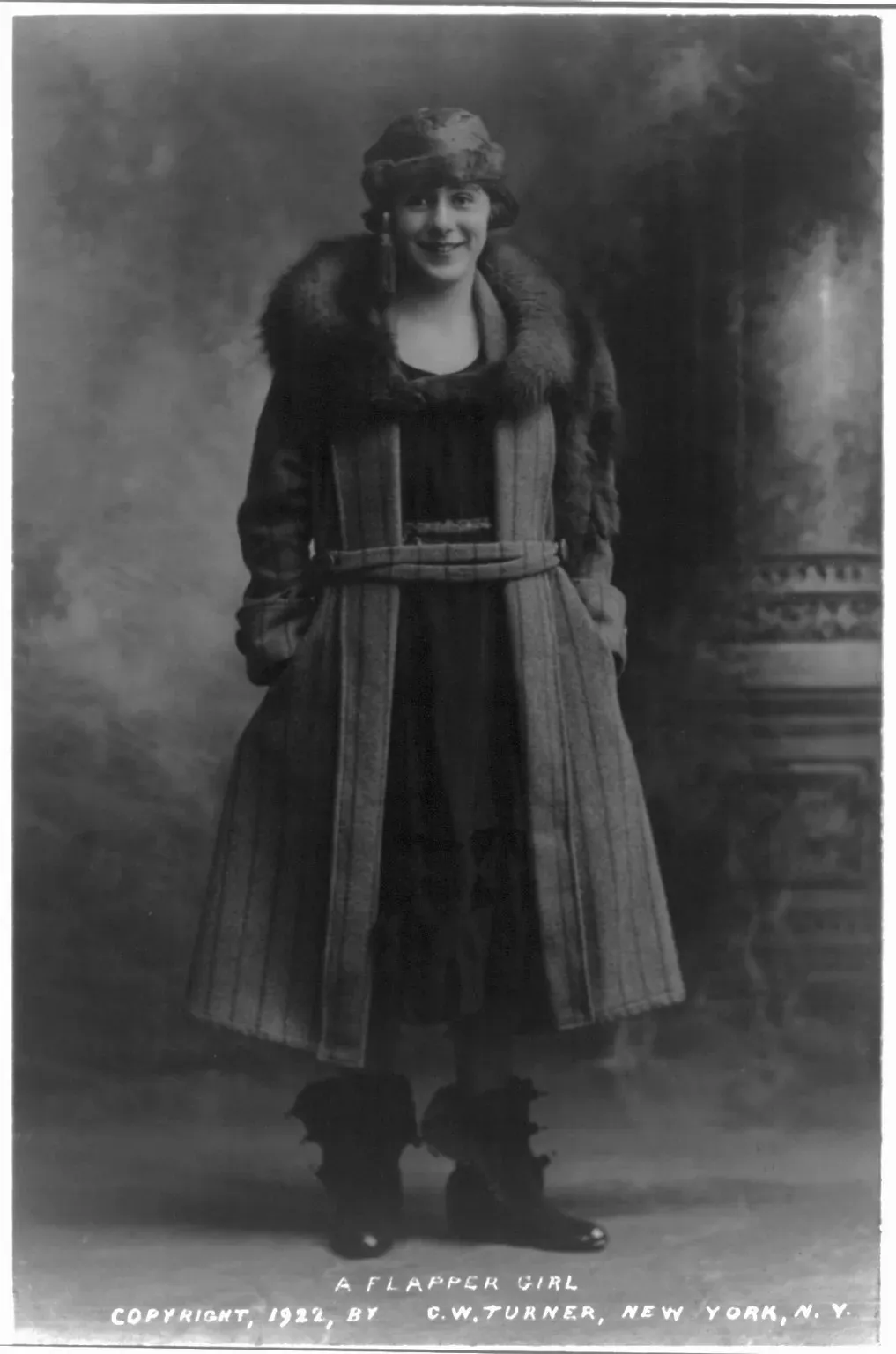

Its chief chemist, Edmund Rossiter, tried condensing the surplus thiourea with formaldehyde, Baekeland’s aldehyde, applied to a different amine entirely. What came out of the reaction vessel in 1924 was not a brown sludge. It cured water-white, and, unlike anything in the phenolic family, it took a dye and held the color: pink stayed pink, green stayed green. Rossiter and British Cyanides had gone looking for a way to empty a warehouse and instead found a resin family that Bakelite could never join. Urea formaldehyde, and a decade later melamine formaldehyde, are amino resins, built on nitrogen-bearing rings rather than phenol’s, and their curing chemistry produces none of the dark oxidation products a phenol ring leaves behind. Where Bakelite is dark by necessity, the amino resins are colorless by nature, and from 1924 onward the only question was which color to add.
Plate II
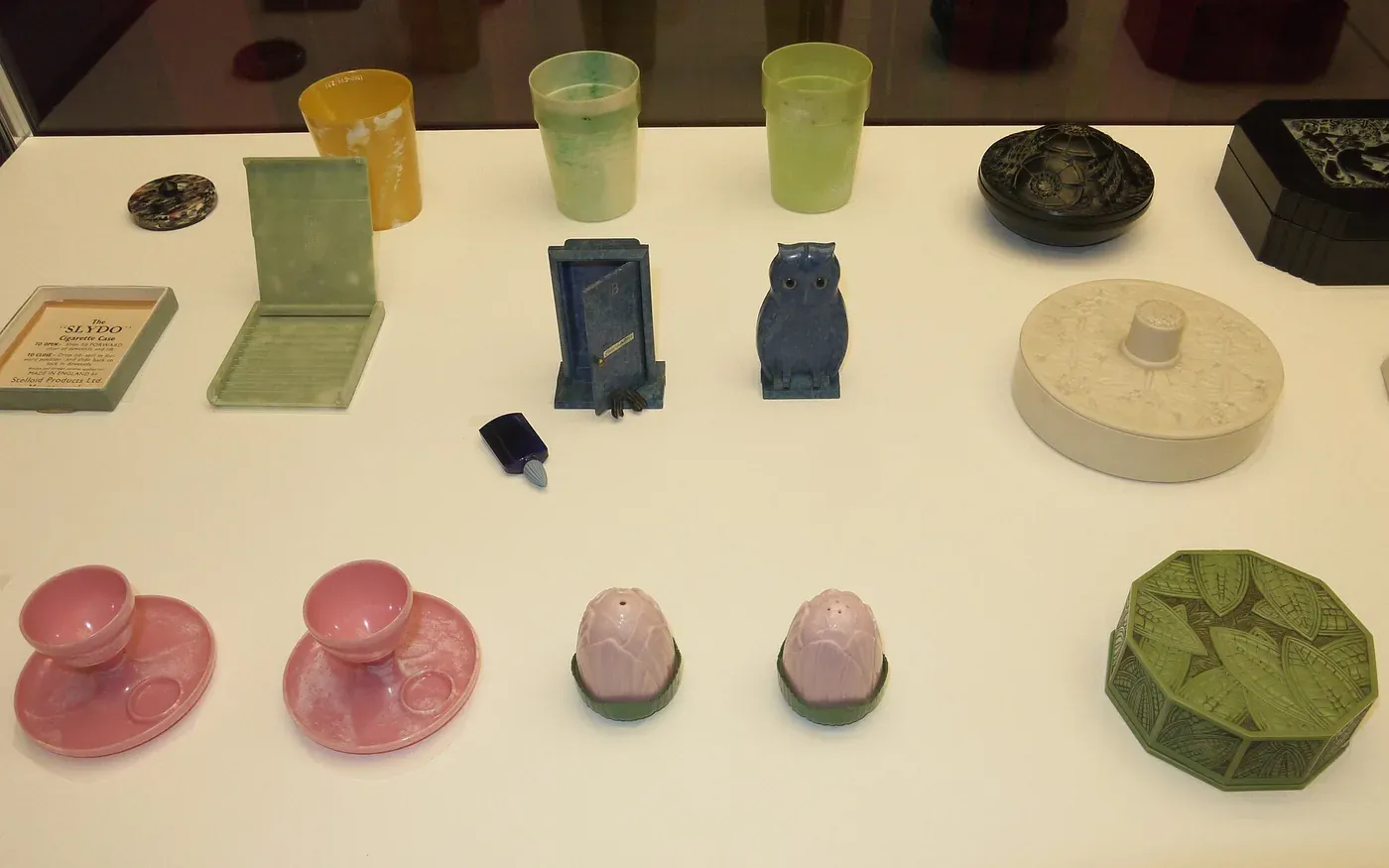

The new resin went into production under the name Beetle, borrowed from British Cyanides’ own trademark. Sample discs were shown at the Wembley Exhibition in 1925, and in 1926 the Oldbury works turned out what the firm’s own historians call the world’s first commercial batch of white moulding powder; cups, saucers and marbled trinket boxes went on display at Harrods that year to real public enthusiasm. Within two years American Cyanamid had bought the rights to make the material in the United States as Beetleware. A company that had invented a plastic to get rid of a warehouse full of thiourea had created the first mass-produced tableware that did not come in brown.
Plate III


Two Networks, One Method
Urea formaldehyde and melamine formaldehyde are built by the same two-step method Baekeland had already shown the world, applied to a different starting ring. Formaldehyde first attaches to a nitrogen-hydrogen bond, forming a methylol group; heat then links those methylol groups to one another, releasing water and building outward into a three-dimensional network. What differs between the two is the scaffold on offer. Urea contributes two nitrogen atoms and, at most, four reactive hydrogens; melamine’s six-membered ring carries three amino groups and six. A cured melamine network ends up far more heavily crosslinked than a cured urea network built from the same amount of formaldehyde, and that difference in crosslink density is most of what separates the two materials in practice: melamine resin cures harder and shrugs off heat and repeated washing better, while urea resin is cheaper, sets faster, and (because the overwhelming majority of it is never seen at all, buried inside a sheet of plywood) remains the one made and used by far the greater tonnage.
Hard, Light, and Nearly Impossible to Melt
Cured amino resin is close to water in density and lighter than the china it was styled to resemble, and it is genuinely hard, hard enough to rival a fired ceramic surface, harder than almost any thermoplastic on the market. It pays for that hardness with brittleness: elongation before failure is minimal, so an amino-resin plate cracks under a sharp knock rather than denting or flexing. Heat behaves the way it does in any thermoset: the uncured powder softens at a temperature you’d use to poach an egg, just enough to flow into the mold, and once the network finishes curing there is no melting point left to find; a moulded part holds its shape comfortably above the temperature of boiling water and only begins to decompose well beyond that. Electrically it remains a capable insulator, which was urea formaldehyde’s original selling point before color became its calling card, and a thin section withstands a considerable voltage before it breaks down. Both resins shrug off oils, greases, alcohols and most household solvents, and both are self-extinguishing rather than prone to sustained burning. The one place they part ways again is water: melamine’s tighter, more heavily crosslinked network tolerates boiling water and dishwasher cycles distinctly better than urea’s, which is the practical reason melamine ended up as the resin on the table while urea does its work out of sight, as glue.
From a Warehouse Problem to the Invisible Glue
Tableware and countertops are the amino resins’ visible legacy, but they are not where most of the material goes. More than seven in every ten tonnes of urea formaldehyde produced are never seen at all: they are the adhesive bonding wood fiber and veneer together inside particleboard, medium-density fiberboard and plywood, the invisible backbone of most flat-pack furniture. Urea formaldehyde foam was also sprayed into the wall cavities of houses and offices as loose-fill insulation from the 1930s through the 1970s, until off-gassing formaldehyde from poorly cured installations became a well-documented indoor-air-quality problem and the practice fell out of favor; melamine formaldehyde binds its formaldehyde more tightly and never carried the same reputation. A smaller, quieter application persists in agriculture, where urea-formaldehyde condensates are sold as a slow-release nitrogen fertilizer, the formaldehyde network releasing its nitrogen gradually as soil microbes break it down.
Melamine Finds Its Own Calling
Melamine itself is much older than 1924 (Justus von Liebig first prepared it in 1834), but for a century it stayed a laboratory curiosity with no industrial use. That changed in the 1930s, when German chemists at Henkel patented a process for condensing melamine with formaldehyde into a resin of its own, one step harder and more water-resistant than Rossiter’s urea chemistry. American Cyanamid brought melamine formaldehyde to the United States market in 1939, and by the following decade the company’s dinnerware line, sold under the name Melmac, had become a fixture of the American kitchen: pastel and speckled plates, cups and serving bowls that would not chip the way china did and did not care about a hot pan set down carelessly.
Plate IV
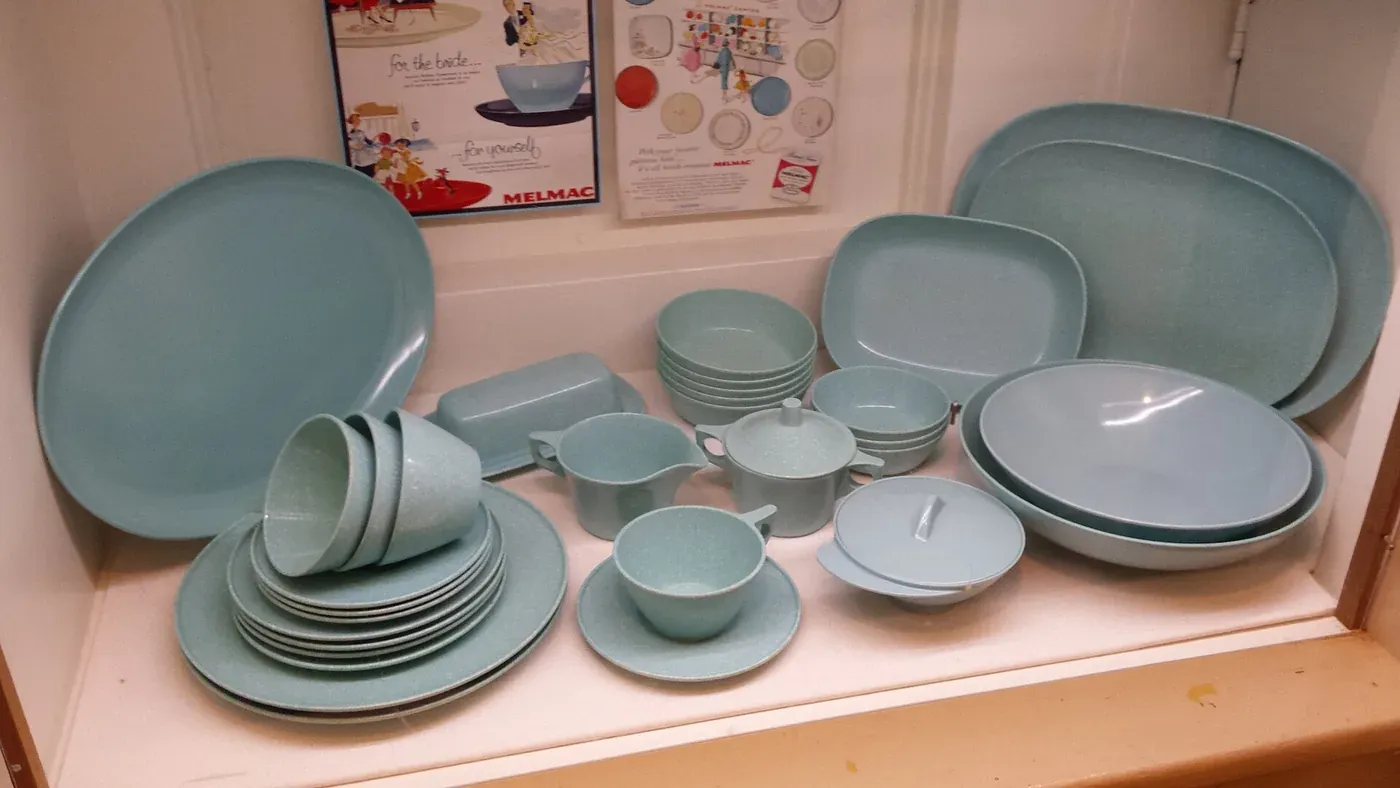

Melamine’s other great career is one most people touch daily without noticing: the decorative laminate sold under the Formica name and its many competitors. A sheet of laminate is built from layers of kraft paper soaked in phenolic resin for strength, topped with a printed decorative sheet sealed under a layer of clear melamine resin: the same colorlessness that got Rossiter’s material out of that Oldbury warehouse now doing the job of a varnish, letting whatever pattern is printed beneath it show through unclouded and resist stains, scorching and scratches for decades. It is, in effect, the two chemistries from this era finishing each other’s sentence: phenolic providing the strength nobody sees, melamine providing the face everybody does.
values with [n] cite the numbered references·estimates are flagged·“not yet available” and “N/A” are honest states, not gaps
- Abbreviation
- MUF
- Type
- polymer family (hub)
- CAS number
- None (heterogeneous class or not assigned)
- Resin ID code
- none assigned
- Formula
- This entry covers two related aminoplast condensation resins, melamine-formaldehyde (MF) and urea-formaldehyde (UF), both crosslinked thermoset networks with no single linear repeat unit; UF's idealized repeat is [(O)CNHCH2NH]n before crosslinking.
- Repeat unit (BigSMILES)
- This entry covers two related aminoplast condensation resins, melamine-formaldehyde (MF) and urea-formaldehyde (UF), both crosslinked thermoset networks with no single linear repeat unit; UF's idealized repeat is [(O)CNHCH2NH]n before crosslinking.
- IUPAC name
- —
- Synonyms
- aminoplast resins
- Also known as
- melamine formaldehydeurea formaldehyde
- Chemical family
- phenolic-aminoplast
- Backbone class
- carbon-chain
- Polymerization mechanism
- step-growth-condensation
- Constitutional monomer
- MelamineUreaFormaldehyde
- Polymer class
- thermoset
- Year of origin
- 1924
- Era
- The Birth of Synthetic Polymers (1907-1938): The Bakelite Revolution
- Key figures
- Edmund Rossiter · American Cyanamid Company
- Events referenced
- British Cyanides Company converts surplus thiourea into Beetle resin (1924) · British Empire Exhibition, Wembley (1924-1925)
- Polymerization type
- step-growth condensation
- Common monomers (feedstocks)
- melamine, urea, formaldehyde
- Catalysts
- not yet available
Melamine or urea is condensed with formaldehyde (idealized MF product: hexa-hydroxymethyl melamine) to form a crosslinked thermoset. Formaldehyde is more tightly bound in MF than in UF, giving MF resins lower formaldehyde emissions. UF was first synthesized (unrecognized as a polymer) by Hölzer and Bernhard Tollens in 1884; Hanns John obtained the first Austrian patent for UF resin in 1919; Carl Goldschmidt patented UF as a disinfectant in 1897. ~20 million tonnes of UF produced annually, >70% for wood-composite bonding.
- Tacticity
- not yet available
- Crystal structure
- not yet available
- Typical crystallinity
- 0 %estimate[1]Amorphous crosslinked thermoset network.
Molecular weight
- Number average (Mn)
- 400–640 g/mol[3]UF resin, water-based dispersion; no MF value found
- Mass average (Mw)
- 2500–500000 g/mol[3]UF resin, water-based dispersion; no MF value found
- Dispersity (Mw/Mn)
- 5.2–7.3[3]UF resin, water-based dispersion; no MF value found
Mark-Houwink constants
not yet available
Hard, durable, and rigid once cured; prone to chipping under conventional saws; MF surfaces are not microwave-safe and can stain/scratch over time.
- Density
- 1–1.31 g/cm³[3]20 °C; MF resin 1–1.14 g/cm³, UF resin 1.2–1.31 g/cm³
- Melt flow index
- Not applicable
- Refractive index
- 1.43[3]UF resin, 20 °C; no MF value found
- Transmittance
- not yet available
- Haze
- not yet available
- Gloss
- not yet available
- Water absorption
- 3 %[3]UF resin, equilibrium immersion at 23 °C; alpha-cellulose-filled molding compounds are much lower (Mark): UF 0.4–0.8%, MF 0.1–0.6%, 24 h
- Dielectric constant
- 4.7–10.9[3]100 Hz unless noted; MF 4.7–10.9 (100 Hz), 7.9 (1 MHz); UF approx. 5
- Dielectric strength
- 11–16 kV/mm[3]MF resin, d = 0.6–0.8 mm, K20/P50 test; no UF value found
- Electrical conductivity
- 1 × 10⁻¹²–9.09 × 10⁻¹⁰ S/m[3]reciprocal of reported volume resistivity; UF 1.1×10⁹ Ω·m, MF 1×10¹⁰-1×10¹² Ω·m
- Glass transition (Tg)
- not yet available
- Melting temperature (Tm)
- 90–119 °C[3]uncured (B-stage) resin melting/softening range, DSC; MF 90–101 °C, UF 119 °C; once cured, the crosslinked network does not melt
- Crystallization (Tc)
- Not applicable
- Heat deflection (HDT)
- 130–182 °C[3]1.8 MPa; UF 130 °C (Wypych, resin; also 130 °C for alpha-cellulose-filled grade per Mark), MF 182 °C (Mark, alpha-cellulose-filled; no unfilled MF value found)
- Decomposition onset
- 185 °C[3]MF resin; no UF value found
- Thermal conductivity
- 0.293–0.423 W/(m·K)[4]alpha-cellulose-filled molding compounds: UF 0.423, MF 0.293–0.423; foam insulation (UFFI) is much lower, around 0.036 (tertiary source, not the solid resin).
- Tensile modulus
- 9000–9700 MPa[4]alpha-cellulose-filled molding compounds (Mark); UF 9,000–9,700 MPa, MF 9,300 MPa
- Yield strength
- 45–55 MPa[3]UF resin, tensile stress at yield; no distinct MF yield value found
- Tensile strength at break
- 45–55 MPa[3]MF 45–52 MPa, UF 55 MPa
- Elongation at break
- 0.5–1 %[4]alpha-cellulose-filled molding compounds (Mark); UF 0.5–1.0%, MF 0.6–0.9%
- Impact strength (Izod)
- 13–19 J/m[4]notched; alpha-cellulose-filled molding compounds (Mark); UF 14–18 J/m, MF 13–19 J/m
- Impact strength (Charpy)
- 1.1–1.6 kJ/m²[3]UF resin, notched, 23 °C; unnotched reported separately at 5–12 kJ/m²; no MF value found
- Hardness
- 110–125 Rockwell M[4]alpha-cellulose-filled molding compounds (Mark); UF M110-M120, MF M110-M125
- Flexural modulus
- 7600–10300 MPa[4]alpha-cellulose-filled molding compounds (Mark); UF 9,700–10,300 MPa, MF 7,600 MPa
- Poisson's ratio
- not yet available
- Coefficient of friction
- not yet available
- Solvent: alcohols
- good[3]MF resin
- Solvent: aliphatic hydrocarbons
- very good[3]MF resin
- Solvent: aromatic hydrocarbons
- very good[3]MF resin
- Solvent: esters
- good[3]MF resin
- Solvent: greases & oils
- very good[3]MF resin
- Solvent: ketones
- good[3]MF resin
- Weathering / UV
- not yet available
- Hydrolysis resistance
- not yet availableUF adhesive bonds are known to be more moisture-sensitive than phenolic (Bakelite-type) bonds, a real limitation in exterior wood-composite use, not independently confirmed with a source.
- Flammability (UL94)
- V-0[3]both MF and UF resins
- Limiting oxygen index
- 30–60 %[3]MF 30–60%, UF 30%
- Solubility parameter (δ)
- 25.74 MPa^0.5[3]Hildebrand parameter, UF resin; no MF value found
Gas permeability
not yet available
Polymer-solvent interaction parameter (χ)
not yet available
- Processing methods
- compression/injection molding (MF tableware, laminates)adhesive application (UF wood-composite bonding)foam-in-place insulation (UFFI)
- Drying required
- not yet determined
- Processing temperature
- 95–188 °C[3]UF (Wypych): 95–115 °C nozzle, 145–150 °C mold, injection molding; alpha-cellulose-filled compounds (Mark): UF 135–177 °C, MF 138–188 °C
- Shrinkage rate
- 0.6–1.8 %[3]MF (Wypych): 1.5–1.8% general, 0.6–0.8% as molded; UF (Mark, alpha-cellulose-filled): 0.6–1.4% mold shrinkage
- Laminates & surfaceshigh-pressure laminates (Formica, Arborite) · laminate flooring · whiteboard surfaces
- Tablewaremelamine dinnerware and utensils
- Wood productsparticleboard/MDF/plywood adhesive (UF)>70% of UF production.
- Insulationurea-formaldehyde foam insulation (UFFI), 1930s-1970s
- Agricultureslow-release nitrogen fertilizer (UF)
- Recyclable
- No
- Biodegradable
- No
- Degradation pathway
- not yet available
UF resins are a known formaldehyde-emission source in wood products and were historically associated with indoor air-quality concerns in UFFI installations; MF binds formaldehyde more tightly, reducing emissions.
- LD50 (oral, rat)
- 8394–10000 mg/kg[3]UF 8,394 mg/kg; MF >10,000 mg/kg
- NFPA health
- 1–2[3]MF resin; explicitly stated as NFPA 704 rating; no UF rating found
- NFPA flammability
- 0–1[3]MF resin; explicitly stated as NFPA 704 rating; no UF rating found
- NFPA reactivity
- 0[3]MF resin; explicitly stated as NFPA 704 rating; no UF rating found
- Carcinogenic classification
- not listed by ACGIH, NIOSH, NTP[3]MF resin
Skin (rabbit) LD50: UF >2,000 mg/kg; MF >10,000 mg/kg.
- [1]Melamine resinWikipediaAccessed 2026-07-14https://en.wikipedia.org/wiki/Melamine_resin[wiki-melamine-resin]
- [2]Urea-formaldehydeWikipediaAccessed 2026-07-14https://en.wikipedia.org/wiki/Urea-formaldehyde[wiki-urea-formaldehyde]
- [3]Handbook of PolymersChemTec Publishinghttps://www.worldcat.org/isbn/9781895198928[handbook-wypych-2016]
- [4]Polymer Data HandbookOxford University Presshttps://search.worldcat.org/search?q=Polymer+Data+Handbook+Mark+1999[handbook-mark-1999]
Illustrations
- Plate IThe flapper silhouette of the early 1920s: straight, light, and unweighted, the opposite of the heavy silk that had kept British Cyanides in the thiourea business.Wikimedia Commons
- Plate IIThe palette Bakelite could never offer: urea-formaldehyde objects on museum display, ranging across colors a phenolic mold could not hold.Wikimedia Commons
- Plate IIIThe Wembley grounds during the British Empire Exhibition. Beetle resin's sample discs were shown here in 1925, the exhibition's second season.Wikimedia Commons
- Plate IVA Melmac place setting on museum display. American Cyanamid's melamine tableware, sold from the 1940s onward, became the material's best-known consumer face.Wikimedia Commons