
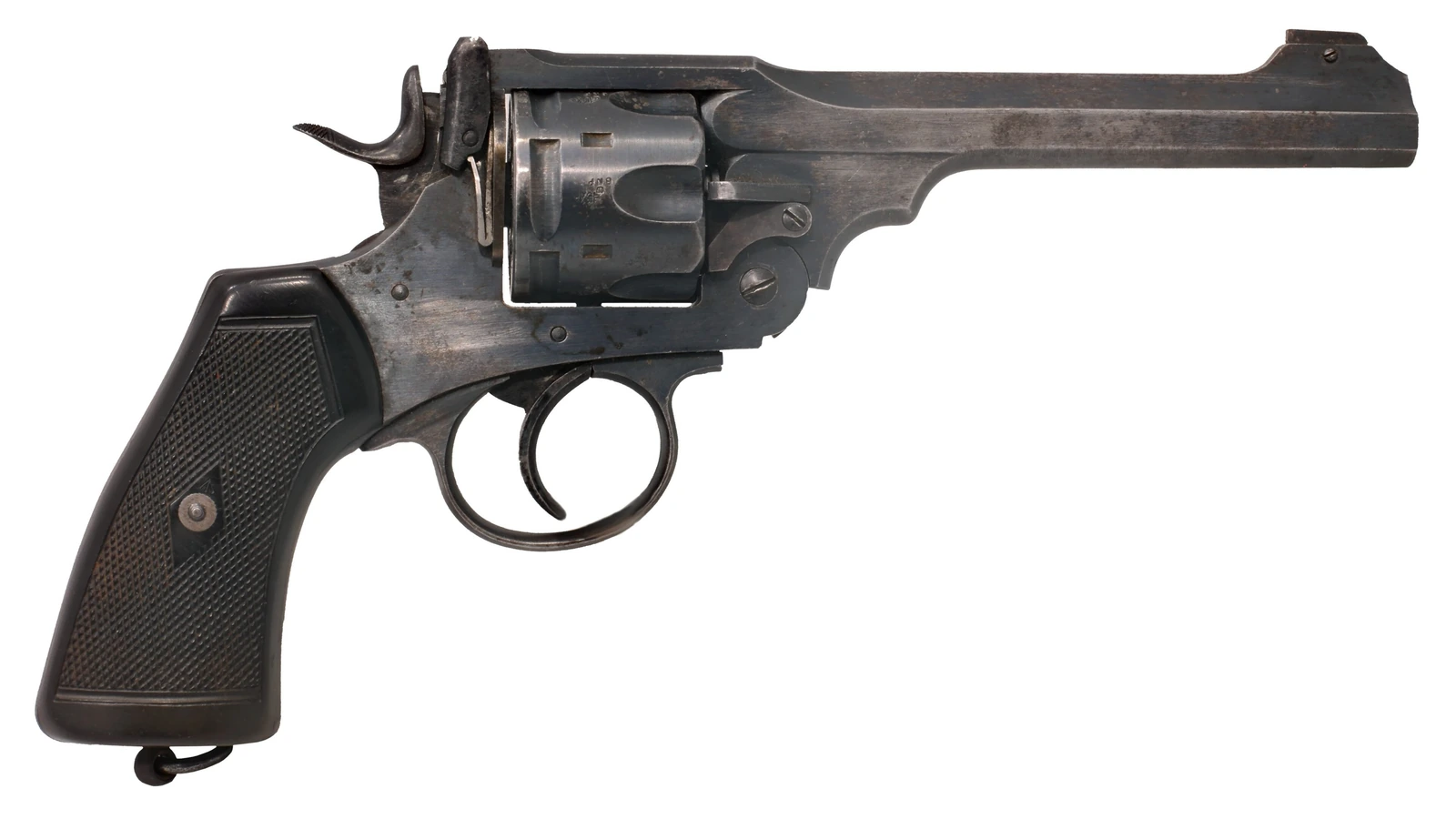
Image credit
- Title
- File:Webley IMG 6789.jpg
- Author
- Rama(attribution required)
- Licence
- CC BY-SA 2.0
- Source
- https://commons.wikimedia.org/wiki/File:Webley_IMG_6789.jpg

How Muzzle energy is calculated
E = ½ · m · v²
Not calculated: v has no sourced figure yet. Nothing is substituted for a missing input.
1 of 2 inputs link to their source.
How Muzzle velocity is calculated
no sourced velocity for this load
Not calculated: muzzle velocity has no sourced figure yet. Nothing is substituted for a missing input.
No input on this calculation carries a clickable source yet.
How Loaded mass is calculated
m_loaded = m_empty + m_magazine + n · m_cartridge
Not calculated: m_magazine has no sourced figure yet. Nothing is substituted for a missing input.
Assumptions
- One magazine, filled to the stated capacity. Spare magazines, optics, slings and lights are the owner’s, not the arm’s.
2 of 4 inputs link to their source.
How Free recoil is calculated
E_recoil = ½ · m_firearm · v_recoil²
Not calculated: v_recoil has no sourced figure yet. Nothing is substituted for a missing input.
Assumptions
- Propellant gas momentum is excluded: ARMAG does not record charge weights. This is therefore a lower bound on the real free recoil, consistent between entries but smaller than a figure that includes the gas term.
- Free recoil: the arm is unrestrained. Stock design, muzzle devices, stance and shooter mass are not modelled, because none of them is a property of the arm.
1 of 2 inputs link to their source.
How Capacity is calculated
as published for the primary chambering
Inputs
- capacity6estimatedsource6-round cylinder, from the infobox, uncited there.
1 of 1 inputs link to their source.
Derived figures
Computed from the sourced values above. Open ƒ on any figure for the formula, its inputs, and the assumptions it makes.
How Momentum is calculated
p = m · v
Not calculated: v has no sourced figure yet. Nothing is substituted for a missing input.
1 of 2 inputs link to their source.
How Sectional density is calculated
SD = mass(gr) / (7000 · diameter(in)²)
Inputs
- mass17.17 g265.0 grestimatedsourceCited article's ballistics table publishes 265 grains; converted here. No test barrel length is stated anywhere in the article for any load, so no velocity is recorded.
- diameter11.57 mm0.4555 inverifiedsourceC.I.P. G1, maximum bullet diameter.
Assumptions
- Reported in the conventional lb/in² so it is directly comparable with published figures.
2 of 2 inputs link to their source.
How Power factor is calculated
PF = mass(gr) · velocity(fps) / 1000
Not calculated: velocity has no sourced figure yet. Nothing is substituted for a missing input.
Assumptions
- A competition classification defined by the IPSC and USPSA rulebooks, stated in their units. It describes a scoring category, not an effect.
1 of 2 inputs link to their source.
How Magazine dump is calculated
t = (n − 1) / (rpm / 60)
Not calculated: rpm has no sourced figure yet. Nothing is substituted for a missing input.
Assumptions
- Cyclic rate held for the whole magazine, no stoppages, trigger held down. A theoretical figure for comparing mechanisms, not a measured one.
1 of 2 inputs link to their source.
How Sight error at 1 mm is calculated
θ = atan(misalignment / sight radius)
Not calculated: sight radius has no sourced figure yet. Nothing is substituted for a missing input.
Assumptions
- Shows what a stated aiming error costs. The misalignment is the reader’s figure; the site does not claim how well anyone aims.
No input on this calculation carries a clickable source yet.
Specifications
Every row here is generated from the schema, so a figure recorded on this entry cannot be missing from the table, and the same rows, read the same way, are what the comparison shows.
Identity
- Type
- Revolver
- Action
- Revolver action
- Fire modes
- Single shot
- Operating system
- Manually operated
- Feed
- Roles
- Designed in
- United Kingdom
- Produced in
- Introduced
- 1887
- Production
- not recorded
Dimensions and mass
- Mass, empty
Mk VI, unloaded, converted from 2.4 lb, from the infobox; no inline citation is given there.
- Magazine, empty
- not recorded
- Length
Mk VI, converted from 11.25 in, from the infobox, uncited there.
- Length, folded
- not recorded
- Width
- not recorded
- Height
- not recorded
- Barrel length
Mk VI, converted from 6 in, from the infobox, uncited there.
Sights and rifling
- Sight radius
- not recorded
- Sight height over bore
- not recorded
- Rifling twist
- not recorded
- Twist direction
- not recorded
- Grooves
- not recorded
- Sight graduation
- not recorded
Operation
- Cyclic rate
- not recorded
- Trigger pull
- not recorded
- Effective range
Converted from a published 50 yd figure, from the infobox, uncited there.
- Units produced
- not recorded
- Launch price
- not recorded
Chamberings
- .455 Webleyprimary6 rounds
Scale
A to-scale outline against family siblings. The dimensions are sourced; the shape is a representative outline for the type, and says so.
- Webley Revolver285.8 mm11.25 inheight not recorded
Representative outline: the dimensions are sourced, the shape is not. Overall length, and barrel length where recorded, are drawn from this entry's own figures; the profile is a generic one for the firearm type and says nothing about this arm's actual contours. Webley Revolver records no height, so its outline is drawn at the type's proportion. That height is part of the shape, not a measurement.
Gallery
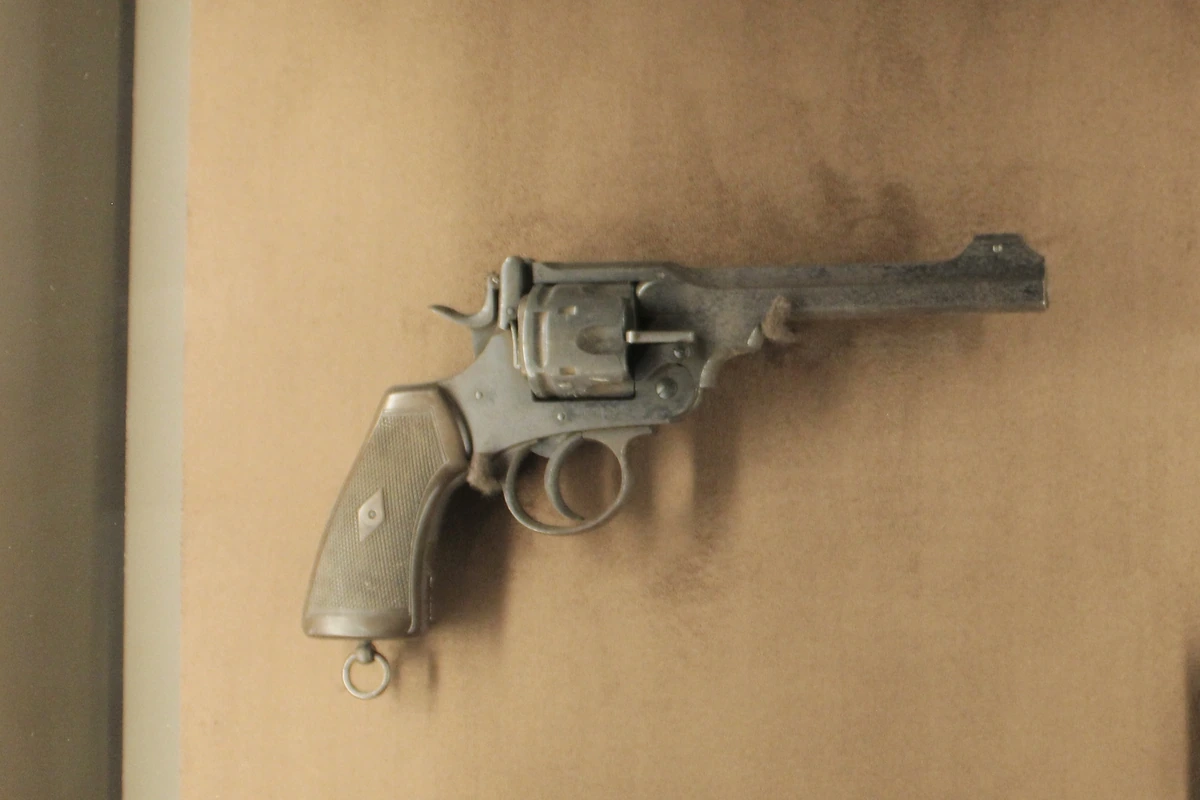
Image credit
- Title
- File:Officer's Webley Mark VI Revolver.jpg
- Author
- Qwexcxewq(attribution required)
- Licence
- CC BY 4.0
- Source
- https://commons.wikimedia.org/wiki/File:Officer's_Webley_Mark_VI_Revolver.jpg

Detail
The British Army adopted the Webley in 1887 to replace the .476 Enfield, whose American-designed extraction system had never worked reliably in service. What made the Webley an improvement was its top-break frame: pulling a catch and tipping the barrel down on a hinge simultaneously operates a star extractor that lifts every spent case out of the cylinder at once, rather than requiring each case to be picked out by hand or pushed free with a rod. For a soldier reloading under pressure, that difference (one motion to clear the cylinder rather than six) was the point of the design.
The revolver went through several Marks over three decades of British service, each a refinement of the same top-break mechanism, before the Mk VI was adopted in 1915 as the pattern that would carry the design through the First and Second World Wars. Its double-action trigger let it be fired either by a long, heavy pull that both cocks and releases the hammer, or by manually cocking the hammer first for a lighter, more precise single-action shot. The .455-calibre line was formally retired from British service in 1947, though the smaller-calibre Mk IV .38/200 descendant remained in official use until 1963, and enough wartime stock remained in circulation that Webleys turned up in British hands for years after their official retirement. Mk VI revolvers sold as surplus into the United States from the late 1950s were commonly altered rather than fed: with .455 ammunition scarce there, importers shaved the cylinders to take .45 ACP. That is a modification made to the gun after it left service, not a chambering Webley built, so it is recorded here as history rather than as one of the revolver’s cartridges.
This entry’s weight, length, barrel length and effective range all trace to the Wikipedia infobox without
an inline citation and are recorded as estimated. It records the Mk VI, the best-documented and
longest-serving of the family’s several Marks; earlier and later Marks of the same basic top-break design
are not modelled here as separate variants. No twist rate is published for the revolver.
References
This entry's own bibliography. Every citation key on this page resolves into this list.
- Webley Revolver · Wikipedia · 1365159846 · read 2026-09-09 · CC BY-SA 4.0
Last verified 2026-09-09 · review status: agent-populated