
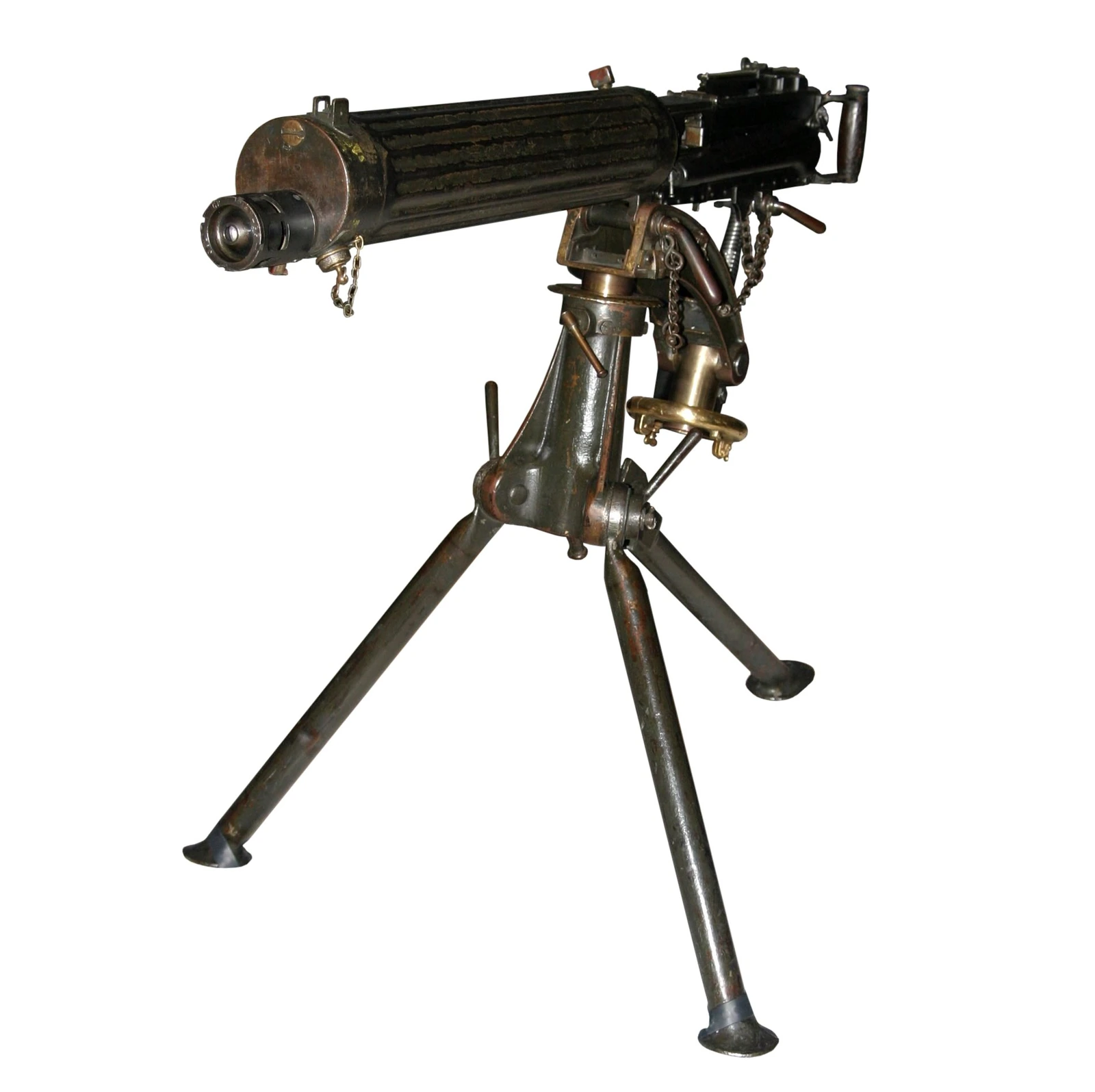
Image credit
- Title
- File:Vickers machine gun, Musée de l'Armée.jpg
- Author
- Rama .(attribution required)
- Licence
- CC BY-SA 2.0
- Source
- https://commons.wikimedia.org/wiki/File:Vickers_machine_gun,_Musée_de_l'Armée.jpg

How Muzzle energy is calculated
E = ½ · m · v²
Not calculated: m has no sourced figure yet. Nothing is substituted for a missing input.
No input on this calculation carries a clickable source yet.
How Muzzle velocity is calculated
no sourced velocity for this pairing
Not calculated: muzzle velocity has no sourced figure yet. Nothing is substituted for a missing input.
No input on this calculation carries a clickable source yet.
How Loaded mass is calculated
m_loaded = m_empty + m_magazine + n · m_cartridge
Not calculated: m_magazine has no sourced figure yet. Nothing is substituted for a missing input.
Assumptions
- One magazine, filled to the stated capacity. Spare magazines, optics, slings and lights are the owner’s, not the arm’s.
2 of 4 inputs link to their source.
How Free recoil is calculated
E_recoil = ½ · m_firearm · v_recoil²
Not calculated: v_recoil has no sourced figure yet. Nothing is substituted for a missing input.
Assumptions
- Propellant gas momentum is excluded: ARMAG does not record charge weights. This is therefore a lower bound on the real free recoil, consistent between entries but smaller than a figure that includes the gas term.
- Free recoil: the arm is unrestrained. Stock design, muzzle devices, stance and shooter mass are not modelled, because none of them is a property of the arm.
1 of 2 inputs link to their source.
How Capacity is calculated
as published for the primary chambering
Inputs
- capacity250estimatedsource250-round canvas belt, from the infobox, uncited on Wikipedia
1 of 1 inputs link to their source.
Derived figures
Computed from the sourced values above. Open ƒ on any figure for the formula, its inputs, and the assumptions it makes.
How Momentum is calculated
p = m · v
Not calculated: m has no sourced figure yet. Nothing is substituted for a missing input.
No input on this calculation carries a clickable source yet.
How Sectional density is calculated
SD = mass(gr) / (7000 · diameter(in)²)
Not calculated: mass has no sourced figure yet. Nothing is substituted for a missing input.
Assumptions
- Reported in the conventional lb/in² so it is directly comparable with published figures.
1 of 2 inputs link to their source.
How Power factor is calculated
PF = mass(gr) · velocity(fps) / 1000
Not calculated: mass has no sourced figure yet. Nothing is substituted for a missing input.
Assumptions
- A competition classification defined by the IPSC and USPSA rulebooks, stated in their units. It describes a scoring category, not an effect.
No input on this calculation carries a clickable source yet.
How Magazine dump is calculated
t = (n − 1) / (rpm / 60)
Inputs
- n250estimatedsource250-round canvas belt, from the infobox, uncited on Wikipedia
- rpm475 rpmestimatedsourcemidpoint of the published, uncited range of 450-500 rounds a minute
Assumptions
- Cyclic rate held for the whole magazine, no stoppages, trigger held down. A theoretical figure for comparing mechanisms, not a measured one.
2 of 2 inputs link to their source.
How Sight error at 1 mm is calculated
θ = atan(misalignment / sight radius)
Not calculated: sight radius has no sourced figure yet. Nothing is substituted for a missing input.
Assumptions
- Shows what a stated aiming error costs. The misalignment is the reader’s figure; the site does not claim how well anyone aims.
No input on this calculation carries a clickable source yet.
Specifications
Every row here is generated from the schema, so a figure recorded on this entry cannot be missing from the table, and the same rows, read the same way, are what the comparison shows.
Identity
- Type
- Machine gun
- Action
- Self-loading
- Fire modes
- Fully automatic
- Operating system
- Short recoil
- Feed
- Roles
- Designed in
- United Kingdom
- Produced in
- Introduced
- 1912
- Production
- 1912–1968
Dimensions and mass
- Mass, empty
midpoint of the published, uncited all-up range of 33-51 lb, which includes water, tripod or ammunition depending on configuration
- Magazine, empty
- not recorded
- Length
converted from the infobox's 3 ft, uncited on Wikipedia
- Length, folded
- not recorded
- Width
- not recorded
- Height
- not recorded
- Barrel length
converted from the infobox's 28 in, uncited on Wikipedia
Sights and rifling
- Sight radius
- not recorded
- Sight height over bore
- not recorded
- Rifling twist
- not recorded
- Twist direction
- not recorded
- Grooves
- not recorded
- Sight graduation
- not recorded
Chamberings
- .303 Britishprimary250 rounds
Scale
A to-scale outline against family siblings. The dimensions are sourced; the shape is a representative outline for the type, and says so.
- Vickers machine gun914 mm35.98 inheight not recorded
Representative outline: the dimensions are sourced, the shape is not. Overall length, and barrel length where recorded, are drawn from this entry's own figures; the profile is a generic one for the firearm type and says nothing about this arm's actual contours. Vickers machine gun records no height, so its outline is drawn at the type's proportion. That height is part of the shape, not a measurement.
Gallery
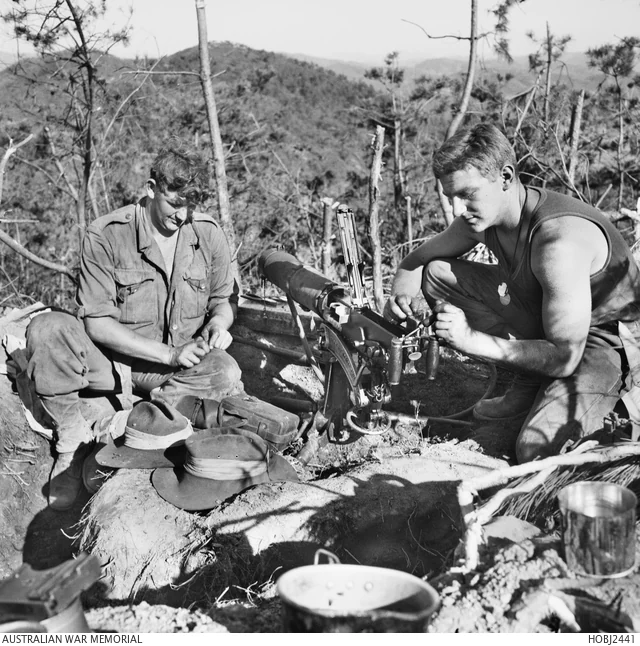
Image credit
- Title
- File:3RAR soldiers clean their Vickers machine gun after five days of fighting.jpg
- Author
- Hobson, Phillip Oliver
- Licence
- Public domain
- Source
- https://commons.wikimedia.org/wiki/File:3RAR_soldiers_clean_their_Vickers_machine_gun_after_five_days_of_fighting.jpg

Detail
The Vickers machine gun was introduced by Vickers Limited in 1912 as a lighter, refined development of Hiram Maxim’s original recoil-operated design, and it became the British Army’s standard heavy machine gun through both World Wars, remaining in front-line service until 1968, an unusually long service life for a weapon of its type. It differed from Maxim’s own gun chiefly in construction: Vickers inverted the toggle-lock mechanism and used higher-strength materials to cut the gun’s weight substantially while keeping the same basic recoil-operated action.
Water-cooled and mounted on a tripod, it was built for sustained fire rather than mobility, and crews became known for keeping a Vickers firing continuously for hours at a time, feeding it from 250-round canvas belts and topping up its water jacket as needed. This was a role suited to defensive and barrage fire rather than the fast-moving infantry support later machine guns were built around. Its recoil-operated action was assisted by a muzzle booster that used residual propellant gas to help drive the barrel rearward, an addition that gave the gun a notably reliable cycling action even as its ammunition and water supply ran hot.
The Vickers fired the standard British .303 service cartridge and equipped British and Commonwealth forces, alongside foreign-service variants chambered for other rounds; this entry describes the .303 British version most associated with British Army service rather than those foreign chamberings. Vickers Limited itself ceased to exist as an independent company in 1927, merging into Vickers-Armstrongs, but production of the gun that carried its name continued under related firms for decades afterward.
Every figure in this entry is transcribed from Wikipedia’s infobox, none of it individually cited on Wikipedia itself, so all figures here are recorded as estimated. Reported all-up weight varies with configuration (water, tripod and ammunition each add to the figure) and is published only as a range; the midpoint of that range is recorded here rather than either extreme.
References
This entry's own bibliography. Every citation key on this page resolves into this list.
- Vickers machine gun · Wikipedia · 1370440719 · read 2026-09-04 · CC BY-SA 4.0
Last verified 2026-09-04 · review status: draft