
.303 British
Introduced 1889CIP standard
Also known as 7.7×56mmR: the same cartridge under different names, all of which find this page.
Dimensions and pressure
Generated from the schema, like every specification table on this site, so a figure recorded on this entry cannot be missing from the table.
Identity
- Designed by
- not recorded
- Introduced
- 1889
- Production
- not recorded
- Standards body
- C.I.P.
- Case type
- Rimmed
- Case shape
- Bottleneck
Dimensions
- Bullet diameter
- 7.92 mm0.3118 insource
C.I.P. G1, maximum bullet diameter.
- Bore diameter
- not recorded
- Case length
- 56.44 mm2.222 insource
C.I.P. L3, maximum case length.
- Overall length
- 78.11 mm3.075 insource
C.I.P. L6, maximum cartridge overall length.
- Rim diameter
- 13.72 mm0.5402 insource
C.I.P. R1.
- Neck diameter
- 8.59 mm0.3382 insource
C.I.P. H2.
- Base diameter
- 11.68 mm0.4598 insource
C.I.P. P1.
Pressure
- Maximum pressure
- 365 MPa52,939 psisource
C.I.P. Pmax 3650 bar; 1 bar = 0.1 MPa exactly.
- Pressure standard
- C.I.P.
SAAMI and C.I.P. measure pressure differently and their figures are not interchangeable, which is why the body is always named beside the figure.
Loads
No load data recorded yet. Without a sourced bullet mass and velocity there is nothing honest to compute, so the ballistic figures on pages that chamber this cartridge stay blank rather than being estimated into existence.
Chambered in
Computed from every entry that lists this cartridge. Nothing here is hand-maintained.
- Lee–Enfield
Royal Small Arms Factory
- Pattern 1914 Enfield
Royal Small Arms Factory
- Vickers K machine gun
Vickers-Armstrongs
- Vickers machine gun
Vickers Limited
Gallery
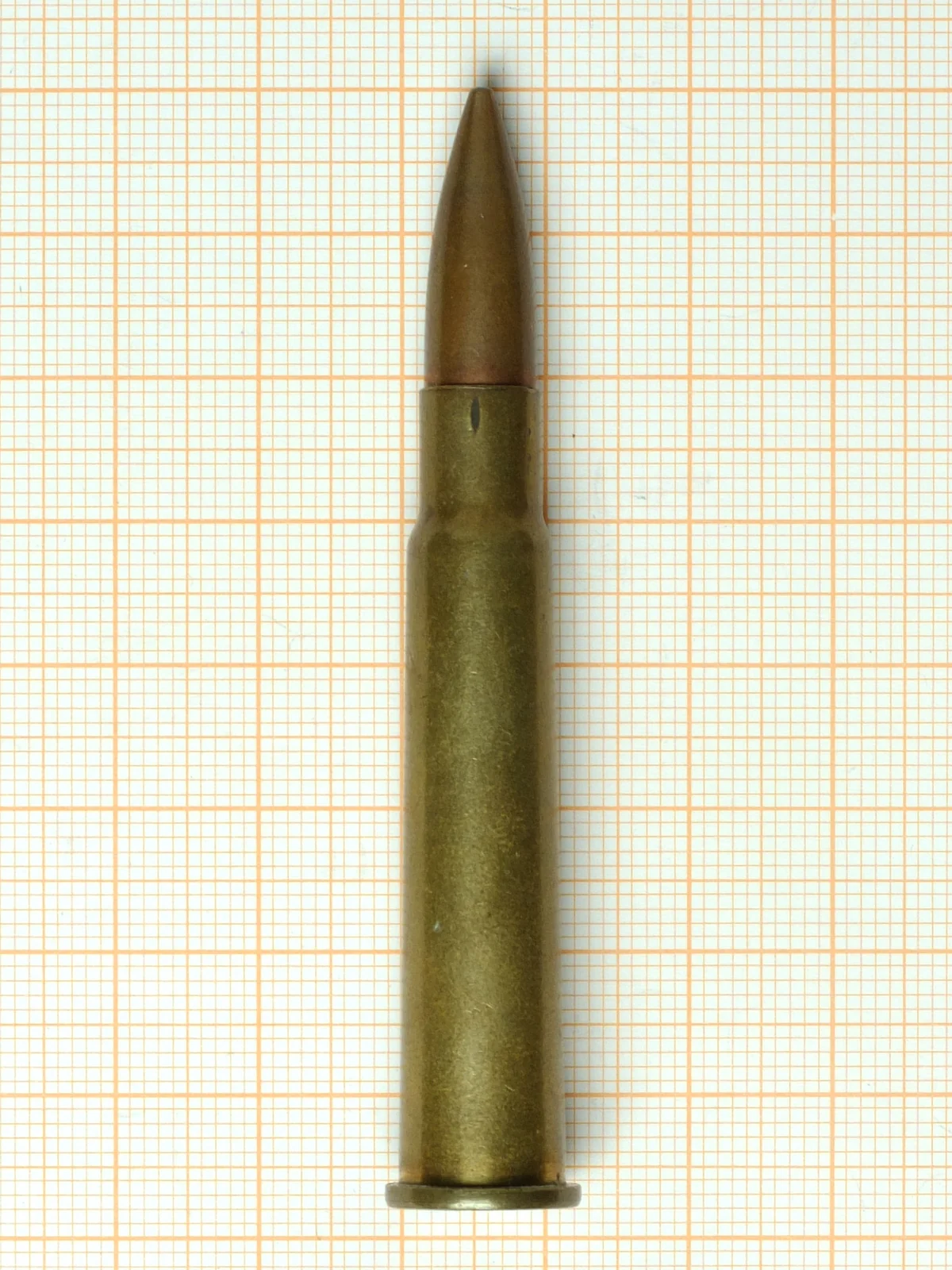
Image credit
- Title
- File:Cartridge .303 British CC BY-SA 4.0 by Grasyl.jpg
- Author
- Grasyl(attribution required)
- Licence
- CC BY-SA 4.0
- Source
- https://commons.wikimedia.org/wiki/File:Cartridge_.303_British_CC_BY-SA_4.0_by_Grasyl.jpg

Detail
Adopted in 1889 as a black-powder cartridge and converted to cordite within a decade, which is the reason for its most-discussed feature: a rim. A rimmed case headspaces on that rim rather than on a shoulder, so it tolerates the loose chamber dimensions a hurried wartime factory produces, and it is correspondingly awkward to stack in a box magazine: the Lee-Enfield’s ten rounds have to be loaded so each rim sits ahead of the one below it.
The 1910 Mark VII loading is the one that matters historically. Its 174-grain bullet has an aluminium or fibre filler in the nose, which moves the centre of mass rearwards.
No load rows appear here. The cited article’s ballistics table carries an editorial flag saying its figures do not appear in the source it names, and a figure whose own encyclopedia doubts it is not one to propagate.
References
- C.I.P. TDCC datasheet — 303 British · 2008-09-23 · read 2026-08-31
- .303 British · 1362890994 · read 2026-08-31
Last verified 2026-08-31 · review status: agent-populated