
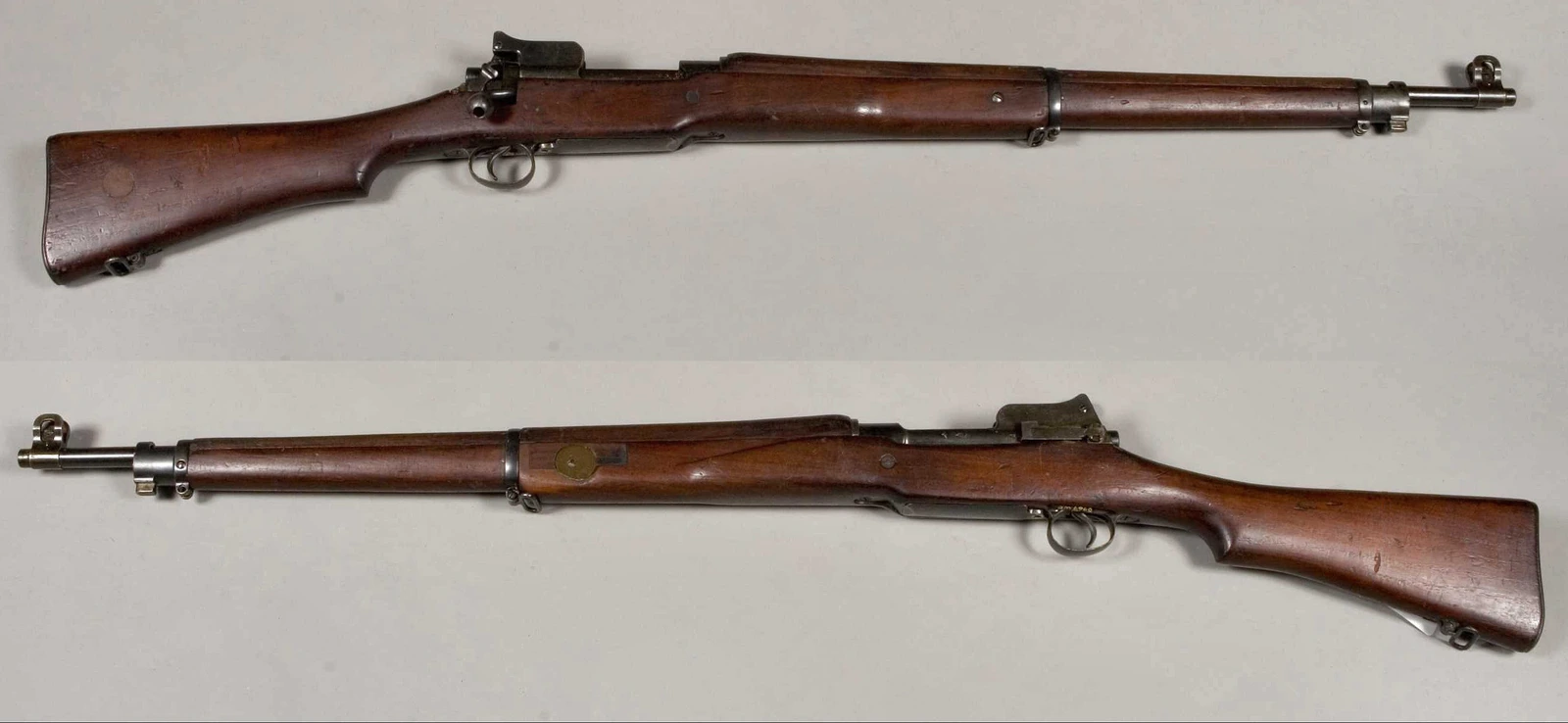
Image credit
- Title
- File:Rifle Pattern 1914 Enfield - AM.006960.jpg
- Author
- Armémuseum (The Swedish Army Museum)
- Licence
- Public domain
- Source
- https://commons.wikimedia.org/wiki/File:Rifle_Pattern_1914_Enfield_-_AM.006960.jpg

How Muzzle energy is calculated
E = ½ · m · v²
Not calculated: m has no sourced figure yet. Nothing is substituted for a missing input.
No input on this calculation carries a clickable source yet.
How Muzzle velocity is calculated
no sourced velocity for this pairing
Not calculated: muzzle velocity has no sourced figure yet. Nothing is substituted for a missing input.
No input on this calculation carries a clickable source yet.
How Loaded mass is calculated
m_loaded = m_empty + m_magazine + n · m_cartridge
Not calculated: m_magazine has no sourced figure yet. Nothing is substituted for a missing input.
Assumptions
- One magazine, filled to the stated capacity. Spare magazines, optics, slings and lights are the owner’s, not the arm’s.
2 of 4 inputs link to their source.
How Free recoil is calculated
E_recoil = ½ · m_firearm · v_recoil²
Not calculated: v_recoil has no sourced figure yet. Nothing is substituted for a missing input.
Assumptions
- Propellant gas momentum is excluded: ARMAG does not record charge weights. This is therefore a lower bound on the real free recoil, consistent between entries but smaller than a figure that includes the gas term.
- Free recoil: the arm is unrestrained. Stock design, muzzle devices, stance and shooter mass are not modelled, because none of them is a property of the arm.
1 of 2 inputs link to their source.
How Capacity is calculated
as published for the primary chambering
Inputs
- capacity5estimatedsource5-round internal magazine loaded from a stripper clip, from the infobox, uncited there.
1 of 1 inputs link to their source.
Derived figures
Computed from the sourced values above. Open ƒ on any figure for the formula, its inputs, and the assumptions it makes.
How Momentum is calculated
p = m · v
Not calculated: m has no sourced figure yet. Nothing is substituted for a missing input.
No input on this calculation carries a clickable source yet.
How Sectional density is calculated
SD = mass(gr) / (7000 · diameter(in)²)
Not calculated: mass has no sourced figure yet. Nothing is substituted for a missing input.
Assumptions
- Reported in the conventional lb/in² so it is directly comparable with published figures.
1 of 2 inputs link to their source.
How Power factor is calculated
PF = mass(gr) · velocity(fps) / 1000
Not calculated: mass has no sourced figure yet. Nothing is substituted for a missing input.
Assumptions
- A competition classification defined by the IPSC and USPSA rulebooks, stated in their units. It describes a scoring category, not an effect.
No input on this calculation carries a clickable source yet.
How Magazine dump is calculated
t = (n − 1) / (rpm / 60)
Not calculated: rpm has no sourced figure yet. Nothing is substituted for a missing input.
Assumptions
- Cyclic rate held for the whole magazine, no stoppages, trigger held down. A theoretical figure for comparing mechanisms, not a measured one.
1 of 2 inputs link to their source.
How Sight error at 1 mm is calculated
θ = atan(misalignment / sight radius)
Not calculated: sight radius has no sourced figure yet. Nothing is substituted for a missing input.
Assumptions
- Shows what a stated aiming error costs. The misalignment is the reader’s figure; the site does not claim how well anyone aims.
No input on this calculation carries a clickable source yet.
Specifications
Every row here is generated from the schema, so a figure recorded on this entry cannot be missing from the table, and the same rows, read the same way, are what the comparison shows.
Identity
- Type
- Rifle
- Action
- Bolt action
- Fire modes
- Single shot
- Operating system
- Manually operated
- Designed in
- United Kingdom
- Produced in
- Introduced
- 1916
- Production
- not recorded
Dimensions and mass
- Mass, empty
Converted from 9 lb, unloaded, from the infobox; no inline citation is given there.
- Magazine, empty
- not recorded
- Length
Converted from 46.25 in, from the infobox, uncited there.
- Length, folded
- not recorded
- Width
- not recorded
- Height
- not recorded
- Barrel length
Converted from 26 in, from the infobox, uncited there.
Sights and rifling
- Sight radius
- not recorded
- Sight height over bore
- not recorded
- Rifling twist
- not recorded
- Twist direction
- not recorded
- Grooves
- not recorded
- Sight graduation
- not recorded
Operation
- Cyclic rate
- not recorded
- Trigger pull
- not recorded
- Effective range
Converted from a published 800 yd figure, from the infobox, uncited there.
- Units produced
- not recorded
- Launch price
- not recorded
Chamberings
- .303 Britishprimary5 rounds
Scale
A to-scale outline against family siblings. The dimensions are sourced; the shape is a representative outline for the type, and says so.
- Pattern 1914 Enfield1,175 mm46.25 inheight not recorded
Representative outline: the dimensions are sourced, the shape is not. Overall length, and barrel length where recorded, are drawn from this entry's own figures; the profile is a generic one for the firearm type and says nothing about this arm's actual contours. Pattern 1914 Enfield records no height, so its outline is drawn at the type's proportion. That height is part of the shape, not a measurement.
Detail
This rifle began as an answer to a problem the Second Boer War exposed: British troops facing accurate long-range fire from Boer riflemen armed with 7×57mm Mausers. The War Office responded by developing its own high-velocity round, the .276 Enfield, and a new Mauser-derived bolt action to fire it, the Pattern 1913. War broke out before that rifle or its new cartridge reached mass production, and introducing an unfamiliar cartridge into a wartime supply chain was judged too disruptive, so the same action was adapted instead to fire the existing .303 British round already standard across the army. That was the change that turned the Pattern 1913 into the Pattern 1914.
Even then it never became Britain’s primary rifle. Vickers, the lead contractor, could not scale up production fast enough, so the Short Magazine Lee-Enfield remained standard issue and American firms (Winchester, Remington and Eddystone) were contracted to build P14s to supplement supply instead. What the design offered over the SMLE was its aperture sight, mounted with protective ears and a longer sight radius than the SMLE’s open sights, riding on a bolt action stronger than the SMLE’s own; that combination made the P14 a natural choice as Britain’s sniper rifle even while it never displaced the Lee-Enfield as the standard infantry arm.
Its most lasting legacy came through a cartridge change rather than a doctrine one. When the United States entered the war, American arsenals reworked the P14 to feed .30-06 Springfield instead of .303 British and built it as the Model of 1917, a rifle that, in total production, went on to outnumber the Springfield it was meant to supplement.
This entry’s weight, length, barrel length and effective range all trace to the Wikipedia infobox without
an inline citation and are recorded as estimated. No twist rate is published.
References
This entry's own bibliography. Every citation key on this page resolves into this list.
- Pattern 1914 Enfield · Wikipedia · 1370152805 · read 2026-09-09 · CC BY-SA 4.0
Last verified 2026-09-09 · review status: agent-populated