
Mauser C96
Mauser1896–1937Smokeless revolution
Also known as Broomhandle Mauser, Construktion 96
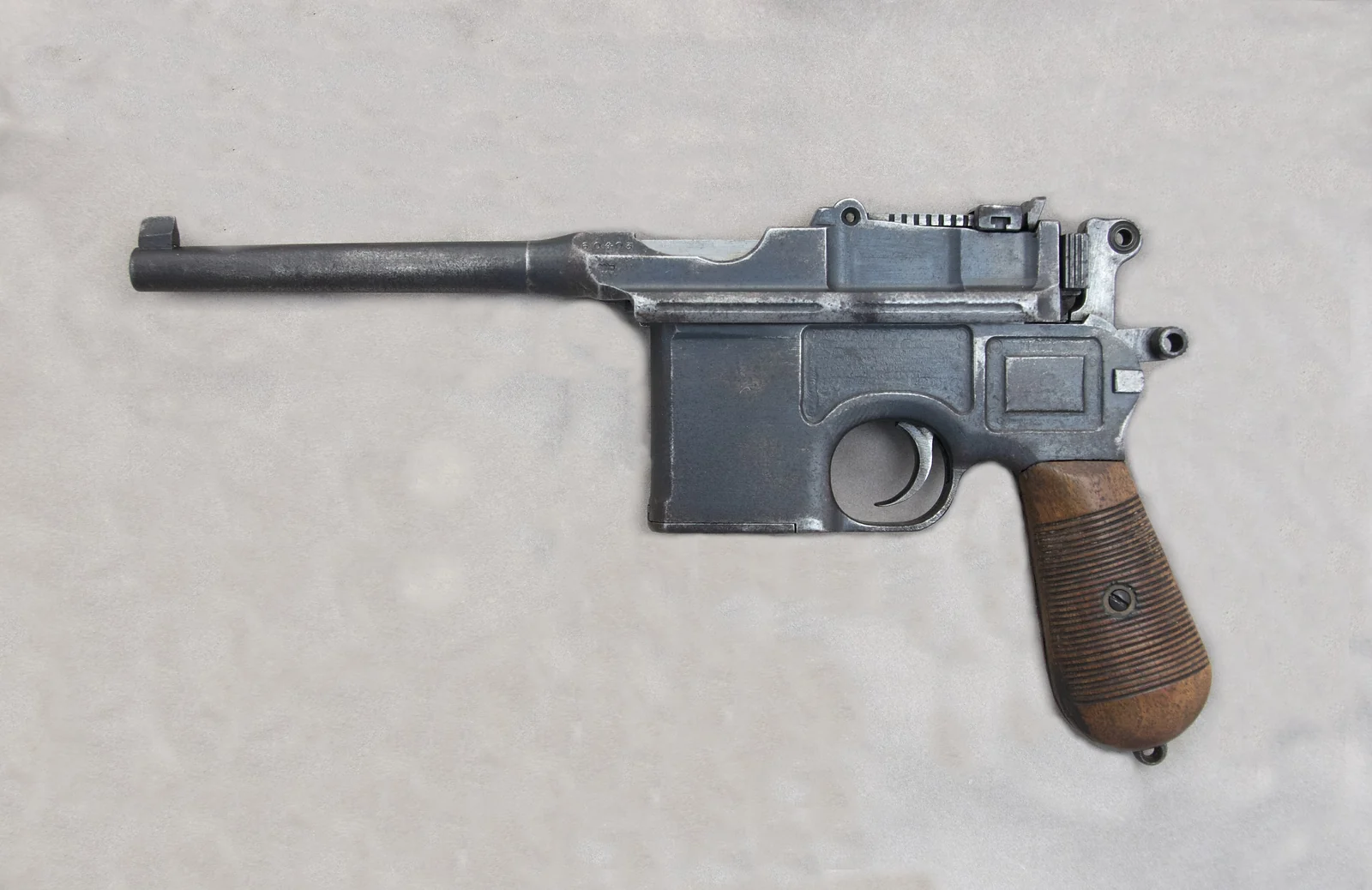
Image credit
- Title
- File:Mauser C96 7.63mm SN 60403 L DSC8581.jpg
- Author
- Self Loader(attribution required)
- Licence
- CC BY-SA 4.0
- Source
- https://commons.wikimedia.org/wiki/File:Mauser_C96_7.63mm_SN_60403_L_DSC8581.jpg

How Muzzle energy is calculated
E = ½ · m · v²
Not calculated: v has no sourced figure yet. Nothing is substituted for a missing input.
No input on this calculation carries a clickable source yet.
How Muzzle velocity is calculated
no sourced velocity for this load
Not calculated: muzzle velocity has no sourced figure yet. Nothing is substituted for a missing input.
No input on this calculation carries a clickable source yet.
How Loaded mass is calculated
m_loaded = m_empty + m_magazine + n · m_cartridge
Not calculated: m_magazine has no sourced figure yet. Nothing is substituted for a missing input.
Assumptions
- One magazine, filled to the stated capacity. Spare magazines, optics, slings and lights are the owner’s, not the arm’s.
2 of 4 inputs link to their source.
How Free recoil is calculated
E_recoil = ½ · m_firearm · v_recoil²
Not calculated: v_recoil has no sourced figure yet. Nothing is substituted for a missing input.
Assumptions
- Propellant gas momentum is excluded: ARMAG does not record charge weights. This is therefore a lower bound on the real free recoil, consistent between entries but smaller than a figure that includes the gas term.
- Free recoil: the arm is unrestrained. Stock design, muzzle devices, stance and shooter mass are not modelled, because none of them is a property of the arm.
1 of 2 inputs link to their source.
How Capacity is calculated
as published for the primary chambering
Inputs
- capacity10verifiedsource10-round fixed internal box magazine loaded by stripper clip; 6- and 20-round fixed magazines were also produced
1 of 1 inputs link to their source.
Derived figures
Computed from the sourced values above. Open ƒ on any figure for the formula, its inputs, and the assumptions it makes.
How Momentum is calculated
p = m · v
Not calculated: v has no sourced figure yet. Nothing is substituted for a missing input.
No input on this calculation carries a clickable source yet.
How Sectional density is calculated
SD = mass(gr) / (7000 · diameter(in)²)
Inputs
- mass5.6 g86.42 grestimatedWikipedia's infobox figure, no inline citation of its own.
- diameter7.86 mm0.3094 inverifiedsource
Assumptions
- Reported in the conventional lb/in² so it is directly comparable with published figures.
1 of 2 inputs link to their source.
How Power factor is calculated
PF = mass(gr) · velocity(fps) / 1000
Not calculated: velocity has no sourced figure yet. Nothing is substituted for a missing input.
Assumptions
- A competition classification defined by the IPSC and USPSA rulebooks, stated in their units. It describes a scoring category, not an effect.
No input on this calculation carries a clickable source yet.
How Magazine dump is calculated
t = (n − 1) / (rpm / 60)
Inputs
- n10verifiedsource10-round fixed internal box magazine loaded by stripper clip; 6- and 20-round fixed magazines were also produced
- rpm120 rpmestimatedsourcesemi-automatic practical rate of fire, from the infobox, uncited on Wikipedia
Assumptions
- Cyclic rate held for the whole magazine, no stoppages, trigger held down. A theoretical figure for comparing mechanisms, not a measured one.
2 of 2 inputs link to their source.
How Sight error at 1 mm is calculated
θ = atan(misalignment / sight radius)
Not calculated: sight radius has no sourced figure yet. Nothing is substituted for a missing input.
Assumptions
- Shows what a stated aiming error costs. The misalignment is the reader’s figure; the site does not claim how well anyone aims.
No input on this calculation carries a clickable source yet.
Variants
M712 Schnellfeuer
1932–1938
A selective-fire version built in the 1930s, feeding from a detachable box magazine, in response to selective-fire C96 copies already being sold from Spain.
- Cyclic rate
midpoint of the published 900-1000 rounds a minute
| Variant | Years | Changes |
|---|---|---|
| M712 Schnellfeuer | 1932–1938 | Cyclic rate, Chamberings, Fire modes, Feed |
Specifications
Every row here is generated from the schema, so a figure recorded on this entry cannot be missing from the table, and the same rows, read the same way, are what the comparison shows.
Identity
- Type
- Pistol
- Action
- Self-loading
- Fire modes
- Semi-automatic
- Operating system
- Short recoil
- Roles
- Designed in
- Germany
- Introduced
- 1896
- Production
- 1896–1937
Dimensions and mass
- Mass, empty
- 1.25 kg2.756 lbsource
unloaded; Wikipedia's own infobox instead gives an uncited 1.13 kg
- Magazine, empty
- not recorded
- Length
- 312 mm12.28 insource
with the standard 140 mm barrel; other barrel lengths were also made
- Length, folded
- not recorded
- Width
- not recorded
- Height
- not recorded
- Barrel length
- 140 mm5.512 insource
standard length; 99 mm and other barrel lengths were also produced
Sights and rifling
- Sight radius
- not recorded
- Sight height over bore
- not recorded
- Rifling twist
- not recorded
- Twist direction
- not recorded
- Grooves
- not recorded
- Sight graduation
tangent rear sight graduated to 1,000 m, from the infobox, uncited on Wikipedia
Operation
- Cyclic rate
semi-automatic practical rate of fire, from the infobox, uncited on Wikipedia
- Trigger pull
- not recorded
- Effective range
- 175 m191.4 ydsource
midpoint of the published 150-200 m range, reached particularly with the shoulder stock attached
- Units produced
published as '1,100,000+', so this is a floor rather than a count; uncited on Wikipedia
- Launch price
- not recorded
Chamberings
- 7.63×25mm Mauserprimary10 rounds
- 7.65×21mm Parabellumnot recorded rounds
- 9x19mm Parabellumnot recorded rounds
Scale
A to-scale outline against family siblings. The dimensions are sourced; the shape is a representative outline for the type, and says so.
- Mauser C96312 mm12.28 inheight not recorded
Representative outline: the dimensions are sourced, the shape is not. Overall length, and barrel length where recorded, are drawn from this entry's own figures; the profile is a generic one for the firearm type and says nothing about this arm's actual contours. Mauser C96 records no height, so its outline is drawn at the type's proportion. That height is part of the shape, not a measurement.
Gallery
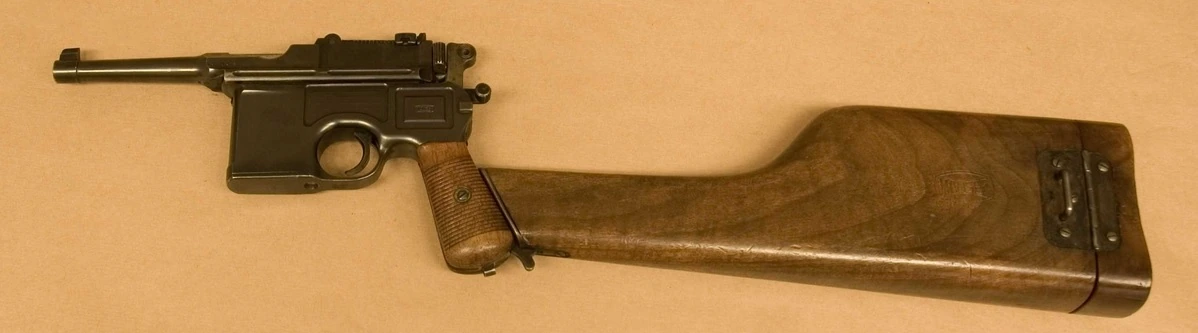
Image credit
- Title
- File:Mauser C96 004.jpg
- Author
- Armémuseum (Swedish Army Museum)(attribution required)
- Licence
- CC BY 4.0
- Source
- https://commons.wikimedia.org/wiki/File:Mauser_C96_004.jpg

Detail
The C96 was designed in 1895 by the Feederle brothers at Mauser’s Oberndorf works, building on Paul Mauser’s own patents, and it became one of the first commercially successful self-loading pistols to reach a wide market. Its most recognisable feature (a fixed magazine ahead of the trigger guard, loaded from above with a stripper clip, under a long, sweeping wooden grip) gave it the “broomhandle” nickname by which it is now often better known than by its own factory designation.
Mechanically it locks the barrel and bolt together under recoil, unlocking as they travel rearward together before the bolt continues alone to eject and reload. This is a short-recoil design distinct from the simpler blowback pistols common at the time, and one that let it handle a comparatively powerful bottlenecked cartridge, the 7.63×25mm Mauser, at a period when most self-loading pistols fired weaker rounds. Its detachable wooden shoulder stock, which doubled as a holster, extended its practical range well beyond that of a pistol fired one-handed, and variants and derivatives were chambered for cartridges as different as 9mm Parabellum and .45 ACP over its production life.
Its commercial success drew imitation and licensed production far beyond Mauser’s own factory: Spanish gunmakers including Astra-Unceta produced their own versions, some with selective fire long before Mauser offered it, and large numbers were built or assembled in China at arsenals including Hanyang and Taiyuan, where the design remained in local use long after it had left German service. Mauser’s own answer to the Spanish selective-fire copies was the M712 Schnellfeuer of the 1930s, which replaced the fixed magazine with a 10- or 20-round detachable box and added a fire selector, turning the pistol into what Mauser itself effectively marketed as a small, stocked submachine gun; it is recorded here as a variant rather than a separate entry because it kept the same short-recoil action as the semi-automatic C96.
Most figures in this entry come from a Modern Firearms specification page rather than Wikipedia’s own infobox, which gives a different, uncited weight of 1.13 kg against the 1.25 kg recorded here; that discrepancy is left visible rather than resolved. No barrel-length-linked muzzle velocity for this pistol lives on this page: cartridge ballistics are recorded on the cartridge’s own entry, not repeated here. Total production is published only as a floor (“1,100,000+”), uncited on Wikipedia, and is recorded as such.
References
This entry's own bibliography. Every citation key on this page resolves into this list.
- Mauser C96 · Wikipedia · 1371853738 · read 2026-09-04 · CC BY-SA 4.0
- Mauser C-96 · Modern Firearms · read 2026-09-04
- Mauser Schnellfeuer, or Model 712, Machine Pistol · Forgotten Weapons · read 2026-09-04
Last verified 2026-09-04 · review status: draft