
M50 Reising
Harrington & Richardson Arms CompanySecond World War
Also known as Reising Model 50
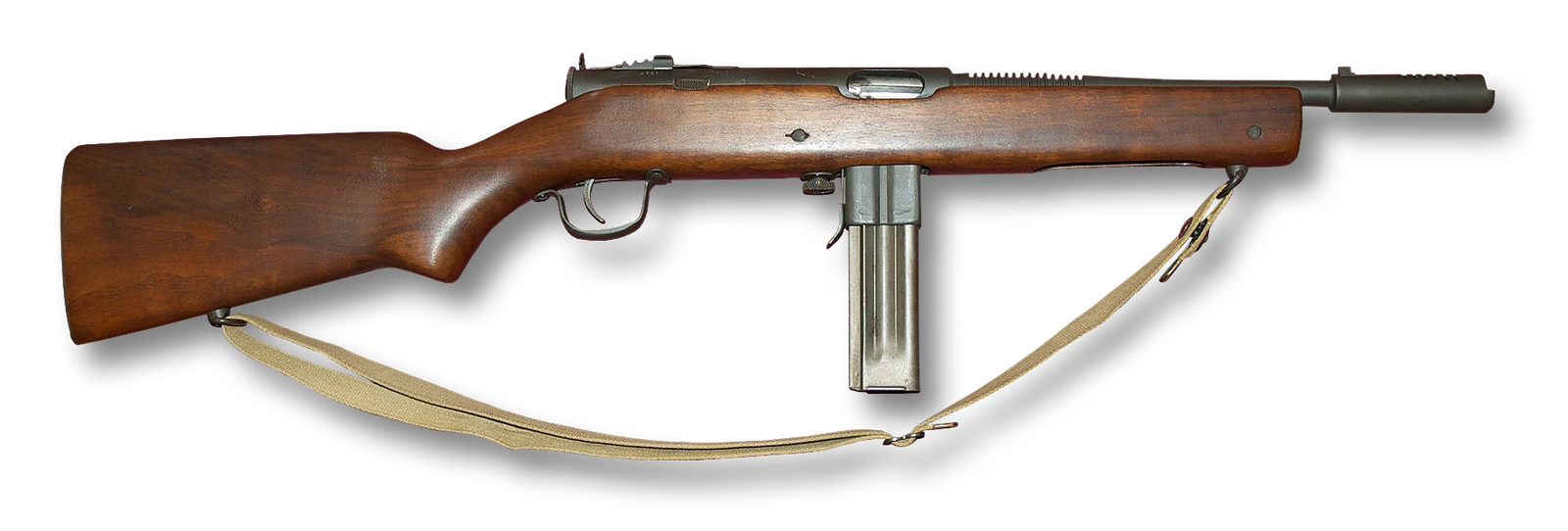
Image credit
- Title
- File:Reising SMG Model 50 noBG.png
- Author
- Curiosandrelics(attribution required)
- Licence
- CC BY-SA 3.0
- Source
- https://commons.wikimedia.org/wiki/File:Reising_SMG_Model_50_noBG.png

How Muzzle energy is calculated
E = ½ · m · v²
Inputs
- m14.90 g230.0 grverifiedsource230 gr as published, converted at 1 gr = 0.06479891 g.
- v271.3 m/s890.0 fpsverifiedMeasured with a 127 mm barrel, not this arm's 279 mm. Velocity outside the sourced range is not projected.
1 of 2 inputs link to their source.
How Muzzle velocity is calculated
nearest sourced barrel length, no extrapolation
Inputs
- v at 127 mm271.3 m/s890.0 fpsverifiedsource890 ft/s as published, converted at 1 ft/s = 0.3048 m/s.
Assumptions
- This figure belongs to a 127 mm barrel. It is shown because it is the closest measurement that exists, not because it applies here.
1 of 1 inputs link to their source.
How Loaded mass is calculated
m_loaded = m_empty + m_magazine + n · m_cartridge
Not calculated: m_magazine has no sourced figure yet. Nothing is substituted for a missing input.
Assumptions
- One magazine, filled to the stated capacity. Spare magazines, optics, slings and lights are the owner’s, not the arm’s.
2 of 4 inputs link to their source.
How Free recoil is calculated
E_recoil = ½ · m_firearm · v_recoil²
Inputs
- m_firearm3.1 kg6.834 lbestimatedsourceM50, from the infobox; no inline citation is given there.
- v_recoil1.304 m/s4.279 fpsestimated
Assumptions
- Propellant gas momentum is excluded: ARMAG does not record charge weights. This is therefore a lower bound on the real free recoil, consistent between entries but smaller than a figure that includes the gas term.
- Free recoil: the arm is unrestrained. Stock design, muzzle devices, stance and shooter mass are not modelled, because none of them is a property of the arm.
1 of 2 inputs link to their source.
How Capacity is calculated
as published for the primary chambering
Inputs
- capacity20estimatedsourcepublished as a 12- or 20-round detachable box magazine, with a 30-round aftermarket magazine also produced, from the infobox, uncited there.
1 of 1 inputs link to their source.
Derived figures
Computed from the sourced values above. Open ƒ on any figure for the formula, its inputs, and the assumptions it makes.
How Momentum is calculated
p = m · v
Inputs
- m14.90 g230.0 grverifiedsource230 gr as published, converted at 1 gr = 0.06479891 g.
- v271.3 m/s890.0 fpsverifiedMeasured with a 127 mm barrel, not this arm's 279 mm. Velocity outside the sourced range is not projected.
1 of 2 inputs link to their source.
How Sectional density is calculated
SD = mass(gr) / (7000 · diameter(in)²)
Inputs
- mass14.90 g230.0 grverifiedsource230 gr as published, converted at 1 gr = 0.06479891 g.
- diameter11.48 mm0.4520 inverifiedsourceC.I.P. G1, maximum bullet diameter.
Assumptions
- Reported in the conventional lb/in² so it is directly comparable with published figures.
2 of 2 inputs link to their source.
How Power factor is calculated
PF = mass(gr) · velocity(fps) / 1000
Inputs
- mass14.90 g230.0 grverifiedsource230 gr as published, converted at 1 gr = 0.06479891 g.
- velocity271.3 m/s890.0 fpsverifiedMeasured with a 127 mm barrel, not this arm's 279 mm. Velocity outside the sourced range is not projected.
Assumptions
- A competition classification defined by the IPSC and USPSA rulebooks, stated in their units. It describes a scoring category, not an effect.
1 of 2 inputs link to their source.
How Magazine dump is calculated
t = (n − 1) / (rpm / 60)
Inputs
- n20estimatedsourcepublished as a 12- or 20-round detachable box magazine, with a 30-round aftermarket magazine also produced, from the infobox, uncited there.
- rpm550 rpmestimatedsourceM50, from the infobox, uncited there.
Assumptions
- Cyclic rate held for the whole magazine, no stoppages, trigger held down. A theoretical figure for comparing mechanisms, not a measured one.
2 of 2 inputs link to their source.
How Sight error at 1 mm is calculated
θ = atan(misalignment / sight radius)
Not calculated: sight radius has no sourced figure yet. Nothing is substituted for a missing input.
Assumptions
- Shows what a stated aiming error costs. The misalignment is the reader’s figure; the site does not claim how well anyone aims.
No input on this calculation carries a clickable source yet.
Variants
M55
A lighter M50 with a folding wire stock intended for paratroopers, sharing the same delayed-blowback action and .45 ACP chambering but built shorter for jump use.
- Mass, empty
from the infobox, uncited there.
- Length, folded
stock retracted, from the infobox; an extended-stock length is not separately published for the M55.
- Cyclic rate
from the infobox, uncited there.
| Variant | Years | Changes |
|---|---|---|
| M55 | — | Mass, empty, Length, folded, Cyclic rate |
Specifications
Every row here is generated from the schema, so a figure recorded on this entry cannot be missing from the table, and the same rows, read the same way, are what the comparison shows.
Identity
- Type
- Submachine gun
- Action
- Self-loading
- Fire modes
- Semi-automatic
- Fully automatic
- Operating system
- Blowback, lever-delayed
- Roles
- Designed in
- United States
- Produced in
- Introduced
- 1941
- Production
- not recorded
Dimensions and mass
- Mass, empty
M50, from the infobox; no inline citation is given there.
- Magazine, empty
- not recorded
- Length
M50, from the infobox, uncited there.
- Length, folded
- not recorded
- Width
- not recorded
- Height
- not recorded
- Barrel length
M50, from the infobox, uncited there.
Sights and rifling
- Sight radius
- not recorded
- Sight height over bore
- not recorded
- Rifling twist
- not recorded
- Twist direction
- not recorded
- Grooves
- not recorded
- Sight graduation
- not recorded
Chamberings
- .45 ACPprimary20 rounds
Scale
A to-scale outline against family siblings. The dimensions are sourced; the shape is a representative outline for the type, and says so.
- M50 Reising895.4 mm35.25 inheight not recorded
Representative outline: the dimensions are sourced, the shape is not. Overall length, and barrel length where recorded, are drawn from this entry's own figures; the profile is a generic one for the firearm type and says nothing about this arm's actual contours. M50 Reising records no height, so its outline is drawn at the type's proportion. That height is part of the shape, not a measurement.
Gallery
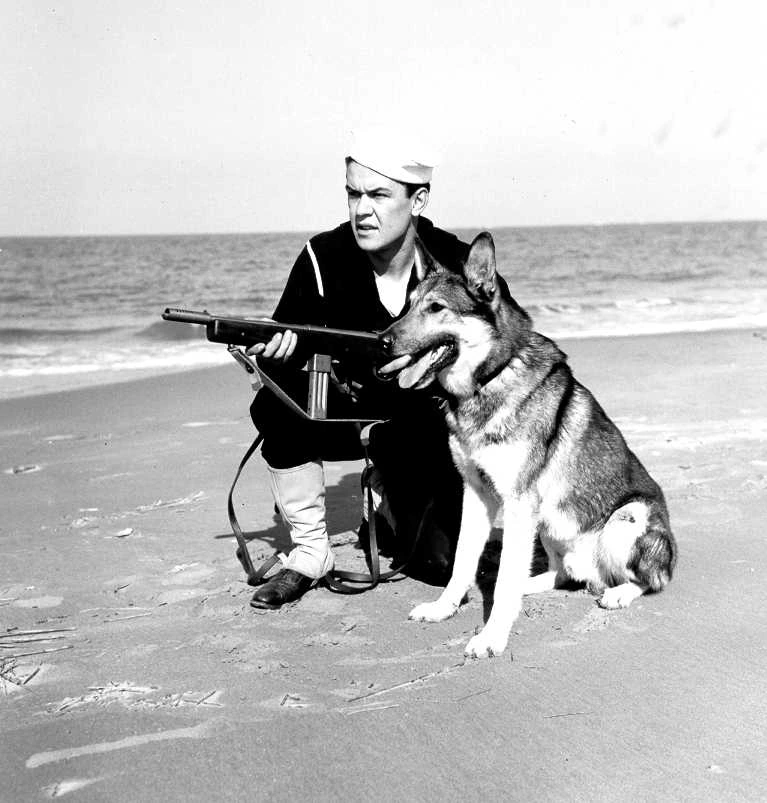
Image credit
- Title
- File:USCG Beach Patrol.jpg
- Licence
- Public domain
- Source
- https://commons.wikimedia.org/wiki/File:USCG_Beach_Patrol.jpg

Detail
Harrington & Richardson brought the Reising into production in 1941 because the US military could not get enough Thompson submachine guns to go around: the Reising cost a fraction of the Thompson’s price and was lighter and more accurate, so the Marine Corps adopted it as a stopgap while Thompson production caught up with wartime demand. Its delayed-blowback action works by a tilting bolt rather than a simple mass-and-spring blowback: the rear of the bolt seats into a curved recess machined into the receiver, and firing pressure has to push that curved surface back to horizontal before the bolt can travel rearward, buying the fraction of a second a closed-bolt, delayed design needs to keep chamber pressure safe.
That mechanism, and the close manufacturing tolerances it needed, turned out to be the Reising’s undoing in the field. In the sand, mud and humidity of the Solomon Islands campaign the action fouled easily, and minor damage to a magazine’s feed lips, or grit worked into one, could put it out of action entirely, in a design where interchangeable parts and field maintenance had not been given the same priority as cost. Marines came to distrust the gun badly enough that some discarded it for the bolt-action M1903 Springfield rather than carry a Reising into combat. The folding-stock M55 variant made for paratroopers made an already troubled design worse: its stock was flimsy enough to fold under recoil while firing.
Two further derivatives are not modelled here. The M60 was a semi-automatic-only carbine built for training and police sales rather than combat use, which this site’s taxonomy classes as a carbine rather than a submachine gun; and the M65 was a .22 Long Rifle training version built from 1944 to 1946, a different cartridge family from the M50’s .45 ACP. Both are separate designs built on the same action rather than variants of this entry.
Every figure in this entry traces to the Wikipedia infobox without an inline citation and is recorded as
estimated. No twist rate is published, and the M55’s extended-stock length is not separately published,
so only its folded length is recorded.
References
This entry's own bibliography. Every citation key on this page resolves into this list.
- M50 Reising · Wikipedia · 1358530557 · read 2026-09-09 · CC BY-SA 4.0
Last verified 2026-09-09 · review status: agent-populated