
De Lisle carbine
Sterling Armaments Company1942–1945Second World War
Also known as De Lisle commando carbine
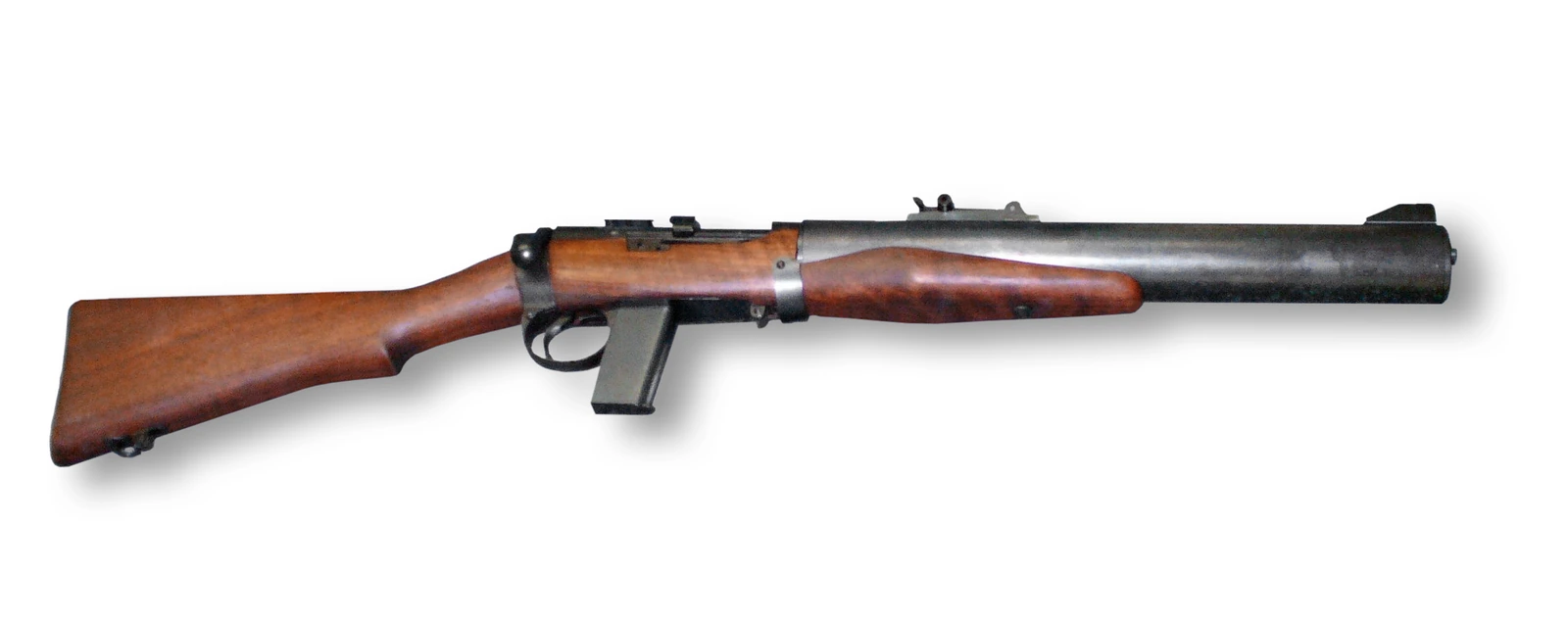
Image credit
- Title
- File:De Lisle Rifle.jpg
- Author
- Atirador(attribution required)
- Licence
- CC BY-SA 3.0
- Source
- https://commons.wikimedia.org/wiki/File:De_Lisle_Rifle.jpg

How Muzzle energy is calculated
E = ½ · m · v²
Inputs
- m14.90 g230.0 grverifiedsource230 gr as published, converted at 1 gr = 0.06479891 g.
- v271.3 m/s890.0 fpsverifiedMeasured with a 127 mm barrel, not this arm's 210 mm. Velocity outside the sourced range is not projected.
1 of 2 inputs link to their source.
How Muzzle velocity is calculated
nearest sourced barrel length, no extrapolation
Inputs
- v at 127 mm271.3 m/s890.0 fpsverifiedsource890 ft/s as published, converted at 1 ft/s = 0.3048 m/s.
Assumptions
- This figure belongs to a 127 mm barrel. It is shown because it is the closest measurement that exists, not because it applies here.
1 of 1 inputs link to their source.
How Loaded mass is calculated
m_loaded = m_empty + m_magazine + n · m_cartridge
Not calculated: m_magazine has no sourced figure yet. Nothing is substituted for a missing input.
Assumptions
- One magazine, filled to the stated capacity. Spare magazines, optics, slings and lights are the owner’s, not the arm’s.
1 of 4 inputs link to their source.
How Free recoil is calculated
E_recoil = ½ · m_firearm · v_recoil²
Inputs
- m_firearm3.74 kg8.245 lbestimatedFrom Philip Peterson, Standard Catalog of Military Firearms (2011), p. 220. The source is a book, so the figure is recorded as estimated rather than verified per this site's sourcing rule. Given unloaded.
- v_recoil1.081 m/s3.547 fpsestimated
Assumptions
- Propellant gas momentum is excluded: ARMAG does not record charge weights. This is therefore a lower bound on the real free recoil, consistent between entries but smaller than a figure that includes the gas term.
- Free recoil: the arm is unrestrained. Stock design, muzzle devices, stance and shooter mass are not modelled, because none of them is a property of the arm.
No input on this calculation carries a clickable source yet.
How Capacity is calculated
as published for the primary chambering
Inputs
- capacity7verifiedsourceStandard modified M1911-pattern magazine held 7 rounds; an 11-round magazine was also fielded.
1 of 1 inputs link to their source.
Derived figures
Computed from the sourced values above. Open ƒ on any figure for the formula, its inputs, and the assumptions it makes.
How Momentum is calculated
p = m · v
Inputs
- m14.90 g230.0 grverifiedsource230 gr as published, converted at 1 gr = 0.06479891 g.
- v271.3 m/s890.0 fpsverifiedMeasured with a 127 mm barrel, not this arm's 210 mm. Velocity outside the sourced range is not projected.
1 of 2 inputs link to their source.
How Sectional density is calculated
SD = mass(gr) / (7000 · diameter(in)²)
Inputs
- mass14.90 g230.0 grverifiedsource230 gr as published, converted at 1 gr = 0.06479891 g.
- diameter11.48 mm0.4520 inverifiedsourceC.I.P. G1, maximum bullet diameter.
Assumptions
- Reported in the conventional lb/in² so it is directly comparable with published figures.
2 of 2 inputs link to their source.
How Power factor is calculated
PF = mass(gr) · velocity(fps) / 1000
Inputs
- mass14.90 g230.0 grverifiedsource230 gr as published, converted at 1 gr = 0.06479891 g.
- velocity271.3 m/s890.0 fpsverifiedMeasured with a 127 mm barrel, not this arm's 210 mm. Velocity outside the sourced range is not projected.
Assumptions
- A competition classification defined by the IPSC and USPSA rulebooks, stated in their units. It describes a scoring category, not an effect.
1 of 2 inputs link to their source.
How Magazine dump is calculated
t = (n − 1) / (rpm / 60)
Not calculated: rpm has no sourced figure yet. Nothing is substituted for a missing input.
Assumptions
- Cyclic rate held for the whole magazine, no stoppages, trigger held down. A theoretical figure for comparing mechanisms, not a measured one.
1 of 2 inputs link to their source.
How Sight error at 1 mm is calculated
θ = atan(misalignment / sight radius)
Not calculated: sight radius has no sourced figure yet. Nothing is substituted for a missing input.
Assumptions
- Shows what a stated aiming error costs. The misalignment is the reader’s figure; the site does not claim how well anyone aims.
No input on this calculation carries a clickable source yet.
Specifications
Every row here is generated from the schema, so a figure recorded on this entry cannot be missing from the table, and the same rows, read the same way, are what the comparison shows.
Identity
- Type
- Carbine
- Action
- Bolt action
- Fire modes
- Single shot
- Operating system
- Manually operated
- Roles
- not recorded
- Designed in
- United Kingdom
- Produced in
- Introduced
- 1943
- Production
- 1942–1945
Dimensions and mass
- Mass, empty
- 3.74 kg8.245 lbestimated
From Philip Peterson, Standard Catalog of Military Firearms (2011), p. 220. The source is a book, so the figure is recorded as estimated rather than verified per this site's sourcing rule. Given unloaded.
- Magazine, empty
- not recorded
- Length
- 902 mm35.51 inestimated
From David Rome's 1984 history of the carbine (p. 28), cited on Wikipedia without a clickable link; a book, so recorded as estimated.
- Length, folded
- not recorded
- Width
- not recorded
- Height
- not recorded
- Barrel length
- 210 mm8.268 inestimated
From Philip Peterson, Standard Catalog of Military Firearms (2011). The source is a book, so the figure is recorded as estimated rather than verified.
Sights and rifling
- Sight radius
- not recorded
- Sight height over bore
- not recorded
- Rifling twist
- not recorded
- Twist direction
- not recorded
- Grooves
- not recorded
- Sight graduation
- not recorded
Operation
- Cyclic rate
- not recorded
- Trigger pull
- not recorded
- Effective range
- 185 m202.3 ydestimated
From the Wikipedia infobox, uncited there (200 yd).
- Units produced
- not recorded
- Launch price
- not recorded
Chamberings
- .45 ACPprimary7 rounds
Scale
A to-scale outline against family siblings. The dimensions are sourced; the shape is a representative outline for the type, and says so.
- De Lisle carbine902 mm35.51 inheight not recorded
Representative outline: the dimensions are sourced, the shape is not. Overall length, and barrel length where recorded, are drawn from this entry's own figures; the profile is a generic one for the firearm type and says nothing about this arm's actual contours. De Lisle carbine records no height, so its outline is drawn at the type's proportion. That height is part of the shape, not a measurement.
Lineage
This design
- Derived from Lee–Enfield
Detail
The De Lisle carbine is a converted Short Magazine Lee–Enfield Mk III* rather than a rifle designed from a blank sheet: its receiver and bolt were reworked to feed .45 ACP, its barrel is a modified Thompson submachine gun barrel, and its magazine housing was built to take a reshaped M1911 pistol magazine. William Godfray de Lisle, an Air Ministry engineer, built the first prototype in .22 calibre as a private venture and tested it on small game near his home; a later 9mm version failed, and the .45 ACP conversion that followed became the design that entered limited production. De Lisle chose .45 ACP specifically because typical loadings of it travel at a subsonic speed, meaning the carbine could use ordinary ammunition without the bullet itself producing a sonic crack; a rifle round travelling above the speed of sound does, regardless of any suppressor fitted to the barrel.
The carbine’s defining feature is a suppressor built as an integral part of the weapon rather than an add-on: a two-inch-diameter tube runs from behind the barrel to well past the muzzle, more than half the gun’s overall length, giving the expanding propellant gas a large volume to lose pressure in before it reaches open air. The Thompson barrel was drilled with ports along its length to bleed gas into this volume progressively rather than all at once. Official wartime testing recorded the weapon at 85.5 decibels when fired, and its manual bolt action meant a user did not have to work the action and produce the noise of cycling unless another shot was needed immediately; a semi-automatic design would have cycled regardless.
Ford Dagenham hand-built an initial batch of 17 for the Combined Operations units that requested it, after which the Sterling Armaments Company took an order for 500 in 1944 but delivered only around 130. A small number of examples with a folding stock borrowed from the Sterling submachine gun were also built for airborne troops. The carbine saw use with British Commandos and the Special Operations Executive during the Second World War, and later with British and Commonwealth forces during the Korean War and the Malayan Emergency.
No clickable primary source states the carbine’s overall length, mass or barrel length independently of the print sources (Peterson’s Standard Catalog of Military Firearms and David Rome’s 1984 history) that Wikipedia cites for them, so those figures are recorded here as estimated rather than verified. No source gives a rifling twist rate, and cyclic rate is not recorded because the De Lisle is a manually operated bolt-action arm rather than a self-loading one.
References
This entry's own bibliography. Every citation key on this page resolves into this list.
- De Lisle carbine · Wikipedia · 1361696572 · read 2026-09-24 · CC BY-SA 4.0
- The de Lisle Carbine: Forgotten Reaper · SOFREP · read 2026-09-24
Last verified 2026-09-24 · review status: agent-populated