
Krag-Jorgensen
Krag–Jørgensen
Kongsberg VapenfabrikkSmokeless revolution
Also known as Krag, Gevær M/1894, M1894, Lang-Krag
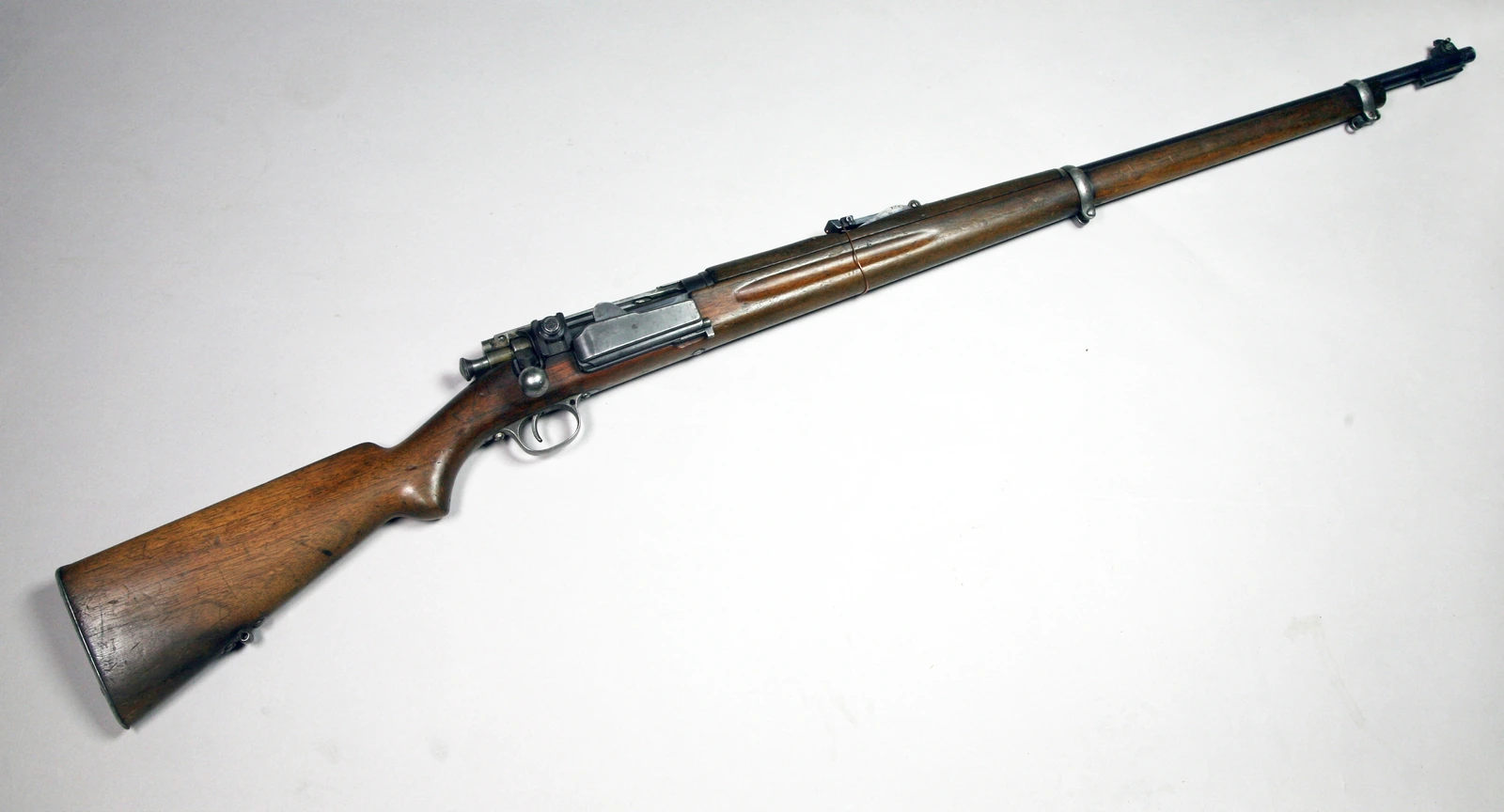
Image credit
- Title
- File:Krag Jørgensen rifle M 1894.jpg
- Author
- Digitalmuseum Norwegen(attribution required)
- Licence
- CC BY-SA 3.0
- Source
- https://commons.wikimedia.org/wiki/File:Krag_Jørgensen_rifle_M_1894.jpg

How Muzzle energy is calculated
E = ½ · m · v²
Inputs
- m10.1 g155.9 grverifiedsource10.1 g as published in the article's account of the 1894 service ball.
- v725 m/s2,379 fpsverifiedMeasured with a 739 mm barrel, not this arm's 760 mm. Velocity outside the sourced range is not projected.
1 of 2 inputs link to their source.
How Muzzle velocity is calculated
nearest sourced barrel length, no extrapolation
Inputs
- v at 739 mm725 m/s2,379 fpsverifiedsource725 m/s as published, from a 739 mm barrel.
Assumptions
- This figure belongs to a 739 mm barrel. It is shown because it is the closest measurement that exists, not because it applies here.
1 of 1 inputs link to their source.
How Loaded mass is calculated
m_loaded = m_empty + m_magazine + n · m_cartridge
Not calculated: m_magazine has no sourced figure yet. Nothing is substituted for a missing input.
Assumptions
- One magazine, filled to the stated capacity. Spare magazines, optics, slings and lights are the owner’s, not the arm’s.
3 of 4 inputs link to their source.
How Free recoil is calculated
E_recoil = ½ · m_firearm · v_recoil²
Inputs
- m_firearm4 kg8.818 lbestimatedsource4.0 kg without bayonet for the M/1894 long rifle, from the Norwegian encyclopedia's per-model list, which cites Hanevik's Norske Militaergeverer etter 1867 for the models but carries no inline citation on the figures themselves.
- v_recoil1.831 m/s6.006 fpsestimated
Assumptions
- Propellant gas momentum is excluded: ARMAG does not record charge weights. This is therefore a lower bound on the real free recoil, consistent between entries but smaller than a figure that includes the gas term.
- Free recoil: the arm is unrestrained. Stock design, muzzle devices, stance and shooter mass are not modelled, because none of them is a property of the arm.
1 of 2 inputs link to their source.
How Capacity is calculated
as published for the primary chambering
Inputs
- capacity5estimatedsourceFive rounds in the magazine and one in the chamber. Both encyclopedia articles state five throughout; neither cites a source for the figure.
1 of 1 inputs link to their source.
Derived figures
Computed from the sourced values above. Open ƒ on any figure for the formula, its inputs, and the assumptions it makes.
How Momentum is calculated
p = m · v
Inputs
- m10.1 g155.9 grverifiedsource10.1 g as published in the article's account of the 1894 service ball.
- v725 m/s2,379 fpsverifiedMeasured with a 739 mm barrel, not this arm's 760 mm. Velocity outside the sourced range is not projected.
1 of 2 inputs link to their source.
How Sectional density is calculated
SD = mass(gr) / (7000 · diameter(in)²)
Inputs
- mass10.1 g155.9 grverifiedsource10.1 g as published in the article's account of the 1894 service ball.
- diameter6.71 mm0.2642 inverifiedsourceCartridge maximum, dimension G1.
Assumptions
- Reported in the conventional lb/in² so it is directly comparable with published figures.
2 of 2 inputs link to their source.
How Power factor is calculated
PF = mass(gr) · velocity(fps) / 1000
Inputs
- mass10.1 g155.9 grverifiedsource10.1 g as published in the article's account of the 1894 service ball.
- velocity725 m/s2,379 fpsverifiedMeasured with a 739 mm barrel, not this arm's 760 mm. Velocity outside the sourced range is not projected.
Assumptions
- A competition classification defined by the IPSC and USPSA rulebooks, stated in their units. It describes a scoring category, not an effect.
1 of 2 inputs link to their source.
How Magazine dump is calculated
t = (n − 1) / (rpm / 60)
Not calculated: rpm has no sourced figure yet. Nothing is substituted for a missing input.
Assumptions
- Cyclic rate held for the whole magazine, no stoppages, trigger held down. A theoretical figure for comparing mechanisms, not a measured one.
1 of 2 inputs link to their source.
How Sight error at 1 mm is calculated
θ = atan(misalignment / sight radius)
Not calculated: sight radius has no sourced figure yet. Nothing is substituted for a missing input.
Assumptions
- Shows what a stated aiming error costs. The misalignment is the reader’s figure; the site does not claim how well anyone aims.
No input on this calculation carries a clickable source yet.
Variants
M/1895 cavalry carbine
The cavalry carbine of 1895, and with the near-identical M/1897 mountain-artillery and engineer carbine the shortest of the Norwegian Krags. The butt is halved in length and the wood between the receiver and the rear sight is cut away; there is no bayonet lug. The M/1897 differs from it only in where the rear sling swivel is fitted, and the two were issued in one serial series.
- Mass, empty
3.4 kg, from the Norwegian encyclopedia's per-model list.
- Length
Totallengde 102 cm, from the Norwegian encyclopedia's per-model list.
- Barrel length
Lopslengde 52 cm, from the Norwegian encyclopedia's per-model list.
M/1912 carbine
The short rifle of 1912, adopted after the long M/1894 was judged unwieldy. It is stocked to the muzzle in the manner of a Lee-Enfield, the bayonet lug moves from the barrel to the fore-end, and the rear sight is set back to just ahead of the receiver to lengthen the sight radius. The action is strengthened over the M/1894's at several points. Its nose cap proved weak, which produced the M/1912/16 and M/1912/18 reworks.
- Mass, empty
4.0 kg, from the Norwegian encyclopedia's per-model list.
- Length
Totallengde 110.7 cm, from the Norwegian encyclopedia's per-model list.
- Barrel length
Lopslengde 61 cm, from the Norwegian encyclopedia's per-model list.
M/1930 sharpshooter rifle
The last and best of three attempts at a sharpshooter's Krag, after the M/1923 and M/1925. It has a thick barrel, a shorter fore-end than the long rifle, a chequered pistol grip and a fine-tuned trigger; the barrel carries no rear sight at all, only a receiver-mounted aperture with interchangeable front-sight inserts. Pre-war rifles are built on the M/1894 action, the 1950-51 batch on the M/1912.
- Mass, empty
5.0 kg, from the Norwegian encyclopedia's per-model list.
- Length
Totallengde 125 cm, from the Norwegian encyclopedia's per-model list.
- Barrel length
Lopslengde 75 cm, from the Norwegian encyclopedia's per-model list.
| Variant | Years | Changes |
|---|---|---|
| M/1895 cavalry carbine | — | Mass, empty, Length, Barrel length |
| M/1912 carbine | — | Mass, empty, Length, Barrel length |
| M/1930 sharpshooter rifle | — | Mass, empty, Length, Barrel length |
Specifications
Every row here is generated from the schema, so a figure recorded on this entry cannot be missing from the table, and the same rows, read the same way, are what the comparison shows.
Identity
- Type
- Rifle
- Action
- Bolt action
- Fire modes
- Single shot
- Operating system
- Manually operated
- Designed in
- Norway
- Introduced
- 1894
- Production
- not recorded
Dimensions and mass
- Mass, empty
4.0 kg without bayonet for the M/1894 long rifle, from the Norwegian encyclopedia's per-model list, which cites Hanevik's Norske Militaergeverer etter 1867 for the models but carries no inline citation on the figures themselves.
- Magazine, empty
- not recorded
- Length
Totallengde 126 cm for the M/1894, from the Norwegian encyclopedia's per-model list. The English infobox gives only a band of 986 to 1328 mm across all three national families.
- Length, folded
- not recorded
- Width
- not recorded
- Height
- not recorded
- Barrel length
Lopslengde 76 cm for the M/1894, from the Norwegian encyclopedia's per-model list.
Sights and rifling
- Sight radius
- not recorded
- Sight height over bore
- not recorded
- Rifling twist
- not recorded
- Twist direction
- not recorded
- Grooves
- not recorded
- Sight graduation
The Norwegian encyclopedia states that the sight is graduated to 2200 m. The figure carries no inline citation.
Operation
- Cyclic rate
- not recorded
- Trigger pull
- not recorded
- Effective range
- not recorded
- Units produced
194,657 M/1894 rifles of all series, from the Norwegian encyclopedia's per-model list. This is the M/1894 alone; the English infobox gives more than 748,500 Krag-Jorgensens across the Norwegian, Danish and American families.
- Launch price
- not recorded
Chamberings
- 6.5x55mm Swedishprimary5 rounds
Scale
A to-scale outline against family siblings. The dimensions are sourced; the shape is a representative outline for the type, and says so.
- Krag-Jorgensen1,260 mm49.61 inheight not recorded
Representative outline: the dimensions are sourced, the shape is not. Overall length, and barrel length where recorded, are drawn from this entry's own figures; the profile is a generic one for the firearm type and says nothing about this arm's actual contours. Krag-Jorgensen records no height, so its outline is drawn at the type's proportion. That height is part of the shape, not a measurement.
Gallery
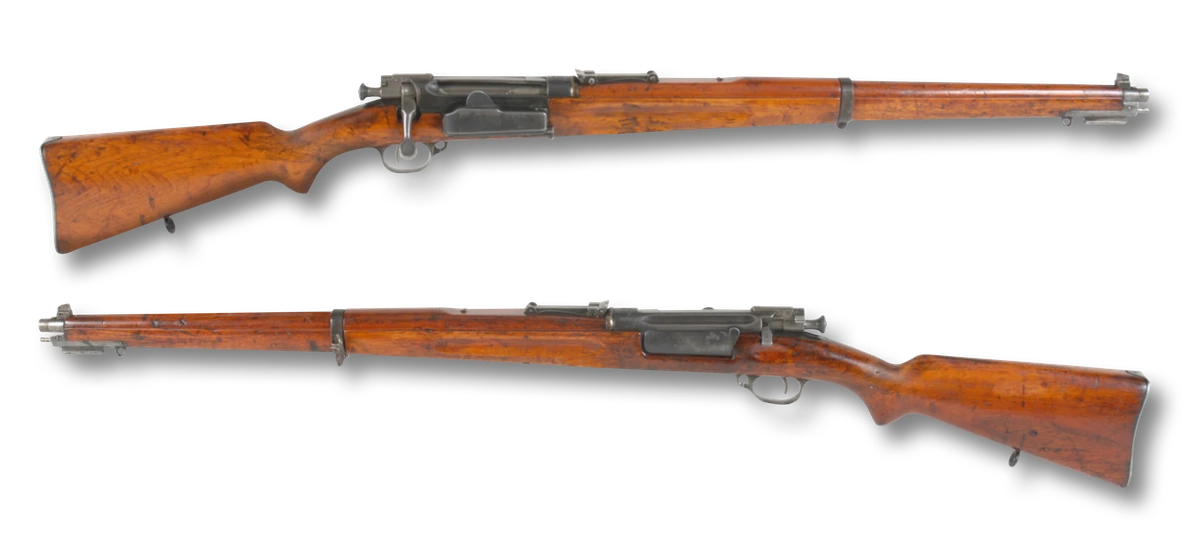
Image credit
- Title
- File:Repeterkarabin 6,5x55 Krag Jørgensen M1912 noBG.png
- Author
- https://digitaltmuseum.no(attribution required)
- Licence
- CC BY-SA 3.0
- Source
- https://commons.wikimedia.org/wiki/File:Repeterkarabin_6,5x55_Krag_Jørgensen_M1912_noBG.png

Detail
Ole Herman Krag ran the Norwegian state arms factory at Kongsberg and did not like tube magazines. With the gunsmith Erik Jørgensen he built an alternative: a horizontal box lying alongside the receiver, fed through a hinged door on the right, with a follower arm that sweeps the rounds up and across into the bolt’s path. Three countries adopted it (Denmark in 1889, the United States in 1892, Norway in 1894), and the figures on this page are the Norwegian M/1894 long rifle, because the Danish and American Krags fire cartridges this database does not yet hold.
The magazine is the whole argument. Because the door opens sideways rather than up through the action, the rifle can be topped up at any time without working the bolt and without disturbing a chambered round, and loose rounds can be thrown in by the handful rather than pressed down against a follower spring. The price is that they can only go in one at a time: no charger or clip was ever developed for it, and by 1900 every rival service rifle loaded five rounds in one motion. That trade was defensible in 1889 and indefensible by 1905, which is why the United States replaced the Krag with the Springfield M1903 after eleven years while Norway, whose doctrine assumed a rifleman had time between reloads, kept it until 1940.
The bolt is the other half of the design and the reason the Krag feels unlike a Mauser. It has a single forward locking lug with the bolt-guide rib acting as a safety shoulder, so the locking surfaces sit asymmetrically between roughly three and six o’clock; the result is a famously smooth, light bolt throw and an action that will not take a modern high-pressure cartridge. Kongsberg later chambered civilian Krags for a rimless 8 mm round made by opening the neck of the service case, precisely so that the pressure stayed where the action could hold it.
Norwegian production ran from 1895 to 1940 in a long rifle, four patterns of carbine, a boy’s carbine for school shooting and three sharpshooter models, with a further batch assembled under German occupation; the last rifle left Kongsberg in 1956. In Norway it long outlasted its service life as the standard weapon of civilian marksmanship clubs.
Gaps on this page: no free source publishes dimensions for the Norwegian Krags model by model except the Norwegian-language encyclopedia, whose per-model list carries no inline citations, so every length and weight here is recorded as an estimate rather than as a published figure. The English-language article gives only bands (986 to 1328 mm overall, 520 to 832 mm of barrel) that span three national families and are useless as a specification. Rifling twist and groove count for the Norwegian rifle are not recorded at all; the 1911 Encyclopaedia Britannica’s comparative table publishes both, but for the Danish M/89 in 8 mm, which is a different barrel. Production is given for the M/1894 alone, not for the design.
References
This entry's own bibliography. Every citation key on this page resolves into this list.
- Krag-Jørgensen · Wikipedia · 25742887 · read 2026-08-31 · CC BY-SA 4.0
- Krag–Jørgensen · Wikipedia · 1371346464 · read 2026-08-31 · CC BY-SA 4.0
- Rifle, in the Encyclopaedia Britannica, eleventh edition, volume 23 · Cambridge University Press · 1911 · read 2026-08-31 · public domain
Last verified 2026-08-31 · review status: agent-populated