
6.5x55mm Swedish
6,5 mm skarp patron m/94
Introduced 1894Joint Norwegian and Swedish rifle commissionCIP standard
Also known as 6.5x55mm, 6.5 x 55 SE, 6.5x55 SKAN, 6.5x55mm Swedish Mauser, 6.5x55mm Krag, 6.5 mm skarp patron m/94: the same cartridge under different names, all of which find this page.
Dimensions and pressure
Generated from the schema, like every specification table on this site, so a figure recorded on this entry cannot be missing from the table.
Identity
- Designed by
- Joint Norwegian and Swedish rifle commission
- Introduced
- 1894
- Production
- not recorded
- Standards body
- C.I.P.
- Case type
- Rimless
- Case shape
- Bottleneck
Dimensions
- Bullet diameter
- 6.71 mm0.2642 insource
Cartridge maximum, dimension G1.
- Bore diameter
- not recorded
- Case length
- 55 mm2.165 insource
Cartridge maximum, dimension L3.
- Overall length
- 80 mm3.150 insource
Cartridge maximum, dimension L6.
- Rim diameter
- 12.2 mm0.4803 insource
Dimension R1. Equal to the base diameter, because the case is rimless.
- Neck diameter
- 7.52 mm0.2961 insource
Dimension H2.
- Base diameter
- 12.2 mm0.4803 insource
Dimension P1.
Pressure
- Maximum pressure
- 380 MPa55,114 psisource
Pmax 3800 bar, transducer method. SAAMI rates the same chambering at 351.6 MPa, which is why a European hunting load is not a drop-in equivalent of an American one.
- Pressure standard
- C.I.P.
SAAMI and C.I.P. measure pressure differently and their figures are not interchangeable, which is why the body is always named beside the figure.
Loads
Velocity is recorded per barrel length as published. A gun page interpolates between these points and never projects beyond them.
6.5 mm sk ptr m/94 projektil m/94
Swedish armed forces
- Bullet mass
- 10.1 g155.9 grsource
10.1 g as published in the article's account of the 1894 service ball.
- Cartridge mass
23.45 g for the complete loaded round, from the Norwegian encyclopedia's article on the Krag-Jorgensen, which gives no citation for the figure.
- Bullet type
- Long round-nose ball
- G1 BC
- not recorded
- G7 BC
- not recorded
| Barrel | Velocity |
|---|---|
| 739 mm29.09 in | 725 m/s2,379 fps |
6.5 mm sk ptr m/94 projektil m/41
Swedish armed forces
- Bullet mass
- 9.1 g140.4 grsource
9.1 g as published for the D-projectile adopted in 1941.
- Cartridge mass
- not recorded
- Bullet type
- Spitzer boat tail ball
- G1 BC
- not recorded
- G7 BC
- not recorded
| Barrel | Velocity |
|---|---|
| 739 mm29.09 in | 800 m/s2,625 fps |
Chambered in
Computed from every entry that lists this cartridge. Nothing here is hand-maintained.
- Krag-Jorgensen
Kongsberg Vapenfabrikk
Gallery
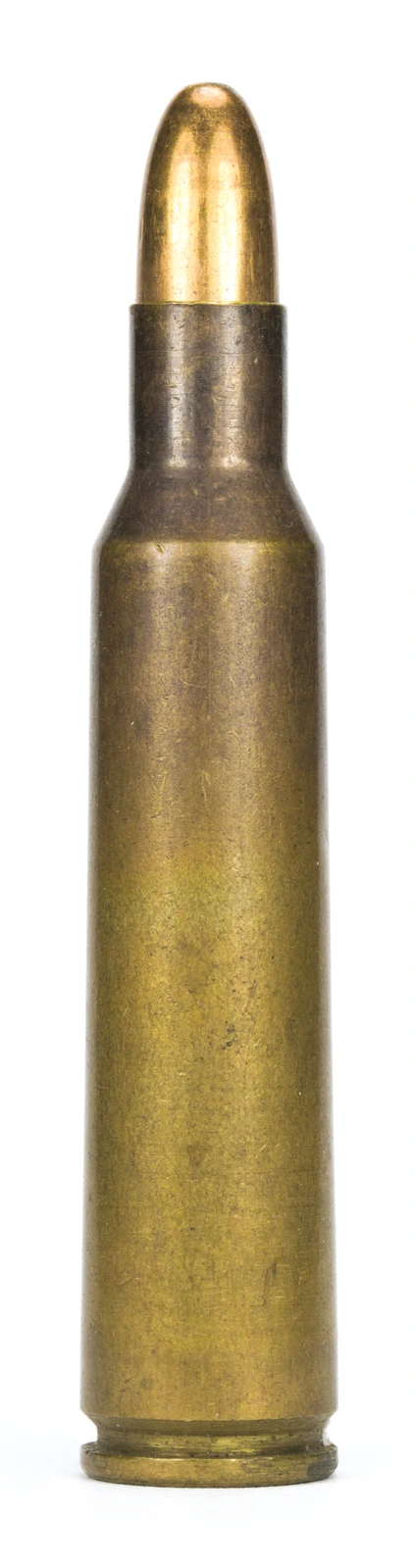
Image credit
- Title
- File:6.5 × 55mm Swedish ammunition cartridge.jpg
- Author
- 2331a3eb (OpenOrdnance)(attribution required)
- Licence
- CC BY-SA 1.0
- Source
- https://commons.wikimedia.org/wiki/File:6.5_×_55mm_Swedish_ammunition_cartridge.jpg

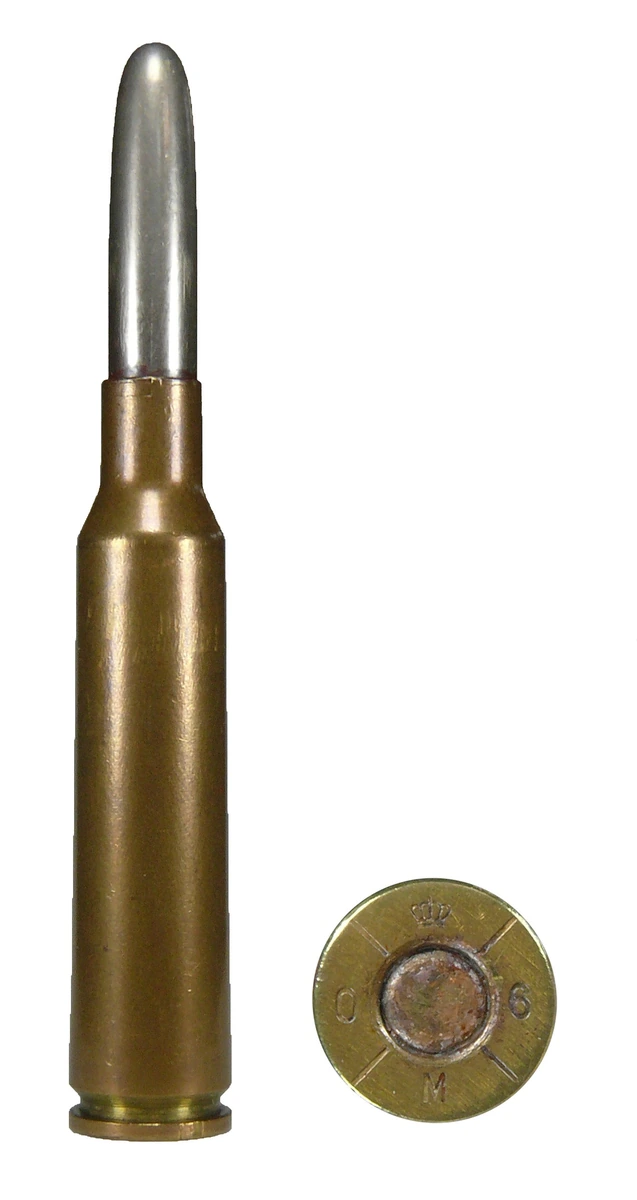
Image credit
- Title
- File:6.5×55mm Mauser-Swedish-01.jpg
- Author
- Jim Miles(attribution required)
- Licence
- CC BY-SA 4.0
- Source
- https://commons.wikimedia.org/wiki/File:6.5×55mm_Mauser-Swedish-01.jpg

Detail
Sweden and Norway were separate armies under one crown in 1891, and they set out to choose separate rifles firing one cartridge. The joint commission that resulted spent two years arguing calibre and case, and settled on a shallow-shouldered rimless 6.5 mm round that was standardised in 1893 and issued from 1894: the Norwegians in a Krag–Jørgensen, the Swedes in a Mauser. It outlived the union by ninety years and is still loaded commercially.
The design decision that matters is the case, not the bullet. At 55 mm it is short for a full-power military round of its generation, but it is nearly parallel-sided with only a slight shoulder and a long neck, so a very long bullet can be seated deep in the neck without stealing powder space. That is what made the 10.1-gram round-nose service ball possible: an unusually heavy projectile for a 6.71 mm bore, which gives the round a high sectional density and a flat enough retained-velocity curve that Scandinavian target shooters kept using it long after the army had moved on. The 12.2 mm base is also generous for the calibre, which is why a bolt face cut for it accepts the .30-06 family of case heads and why the chambering appears in so many post-war commercial actions.
The service load changed once. The 1894 round-nose projectile was replaced from 1941 by a 9.1-gram boat-tail spitzer, developed for the m/41 sniper rifle and immediately adopted as the general service ball; the two are recorded here as separate loads because they are separate projectiles in the same case, fired from the same 739 mm barrel to different velocities.
Gaps on this page: the two service-ball figures come from the encyclopedia’s account rather than from a Swedish ordnance manual, which is not online in a form that can be linked. The article also reports a 1960 Swedish service pressure of 3300 bar without saying how it was measured, so that figure is not recorded; the pressure here is the C.I.P. commercial maximum, and SAAMI’s figure for the same chambering is lower, which is noted with it rather than stored as a second value. The rifling twist rate Swedish barrels were cut to is a property of the rifle rather than the cartridge and is not a field here.
References
- C.I.P. TDCC datasheet, 6,5 x 55 SE · Tab. I, dated 1984-06-14, revision 2013-05-22 · read 2026-08-31
- 6.5x55 Swedish, 9.0 g (139 gr) Scenar, product 4316030 · read 2026-08-31
- 6.5x55 Swedish, 8.0 g (123 gr) Scenar, product 4316032 · read 2026-08-31
- 6.5×55mm Swedish · 1367932175 · read 2026-08-31
- Krag-Jørgensen · 25742887 · read 2026-08-31
Last verified 2026-08-31 · review status: agent-populated