Austrian · Main Course
Wiener Schnitzel
Veal escalope pounded thin, coated loosely in egg and breadcrumbs, and fried in clarified butter until the crust puffs away from the meat.
Not the same asSchnitzel Wiener Art (A breaded, fried cutlet made the same way but from pork rather than veal; by Austrian definition only the veal version may be called Wiener Schnitzel.)Milanesa (Argentina's breaded, fried cutlet, descended from the Milanese cotoletta rather than from Vienna, and usually made from beef rather than veal.)
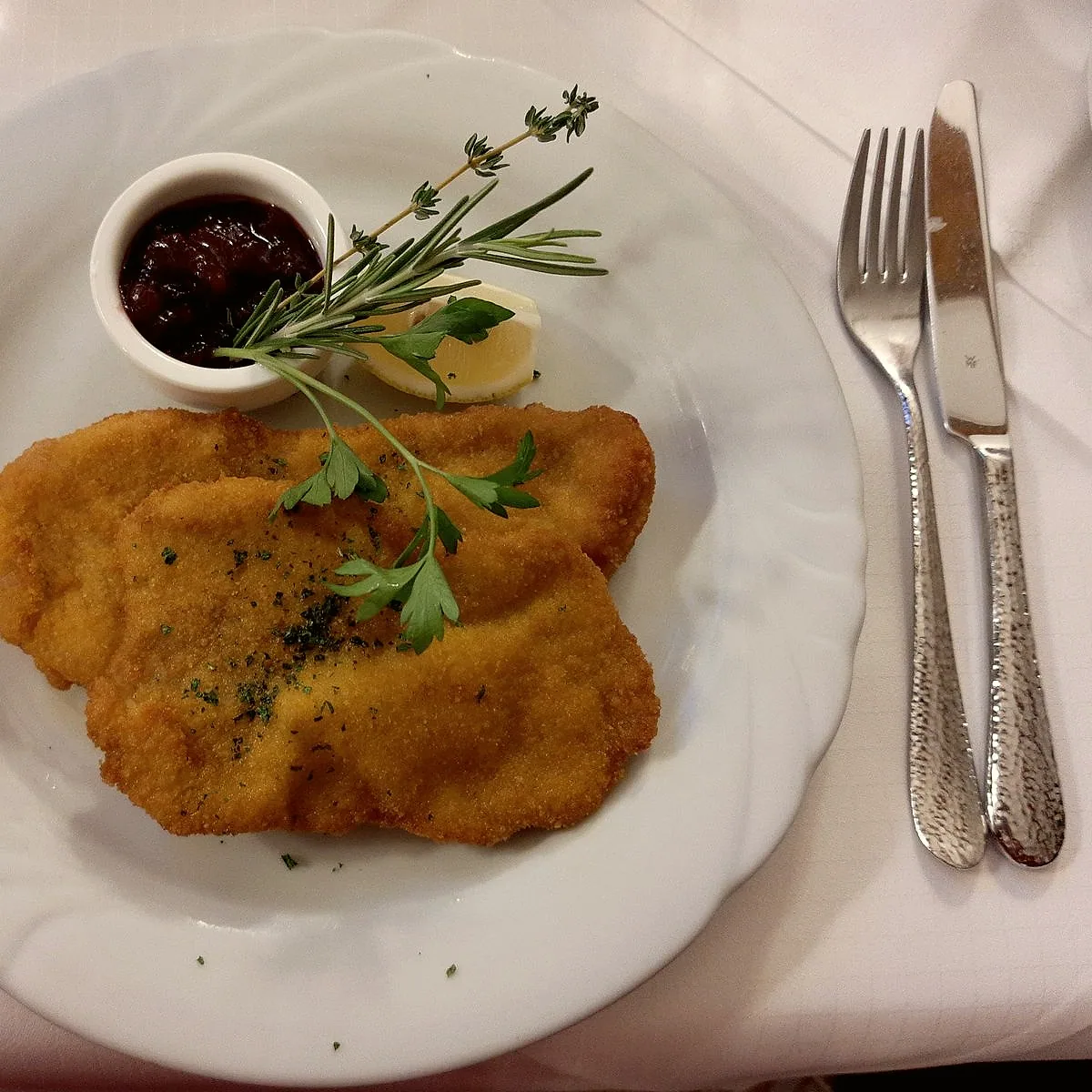

CC0. Cropped and colour-adjusted for this site.
Method
Pound the 600 g veal between sheets of baking paper to an even thickness of about half a centimetre.
Season the cutlets on both sides with the 5 g fine sea salt and the 2 g ground black pepper.
Dredge each cutlet in the 60 g plain flour, dip in the 2 eggs (100 g), and coat in the 100 g dried breadcrumbs without pressing the crumbs on.
Pressing the crumbs on firmly is exactly what a proper schnitzel avoids; a loose, un-pressed coating is what lets the crust puff away from the meat into the characteristic light, wavy crust, rather than fusing flat against it.
Heat the 150 g ghee in a wide pan until shimmering and fry the schnitzels for 12m in total, turning once and shaking the pan gently so the fat washes up over the crust, until golden on both sides. Drain briefly and serve with the 1 lemon (100 g).
Common pitfallA pan too crowded or too cool drops the fat's temperature and lets the coating soak up oil instead of crisping. The schnitzels need to float rather than sit on the base, which means shallow enough fat and a pan hot enough to keep it there.
The most repeated story about Wiener Schnitzel credits Field Marshal Joseph Radetzky with bringing the recipe back to Vienna from Habsburg territory in Italy in 1857, supposedly noting a "deliciously breaded veal cutlet" in a report to the emperor [2][1]. It is a tidy story about a real historical figure, and Austria's own federal ministry treats it as implausible: breaded cutlets, panierte Speisen, were already an established part of Viennese cooking well before Radetzky's time, with references reaching back to 1798, and the specific term "Wiener Schnitzel" is recorded in a cookbook from 1831, decades before the 1857 date the legend depends on [3][1].
What the dish does have is a legally settled identity, which is more than most historic recipes can claim. Austrian food law defines Wiener Schnitzel as consisting only of veal; a version made from pork must be labelled "Wiener Schnitzel vom Schwein" or "Schnitzel Wiener Art" so that a customer is never sold the cheaper meat under the protected name [3][1]. That legal precision sits oddly next to how loosely the dish's own history is usually told: a popular legend about a field marshal and an Italian campaign has done more to shape its reputation than the eighteenth- and nineteenth-century Viennese kitchens that actually produced it.
Sources
- Wiener schnitzel, WikipediaOn the 1831 cookbook reference predating the Radetzky legend, and Austrian law's veal-only definition.
- A Taste of Old World Europe — Wiener Schnitzel, National GeographicOn the popular telling of the Radetzky legend and the quoted "deliciously breaded veal cutlet."
- Wiener Schnitzel, Bundesministerium für Land- und Forstwirtschaft, Klima- und Umweltschutz, Regionen und Wasserwirtschaft (Austrian federal ministry)The Austrian government's own account, which dates breaded cutlets in Vienna to 1798, treats the Radetzky legend as implausible, and states the veal-only legal definition and the "Wiener Schnitzel vom Schwein" naming rule for pork.