Caribbean · Bread
Dhalpuri Roti
A soft, griddle-cooked flatbread rolled around a filling of ground, spiced yellow split peas; one roti is one serving, usually wrapped around a curry.
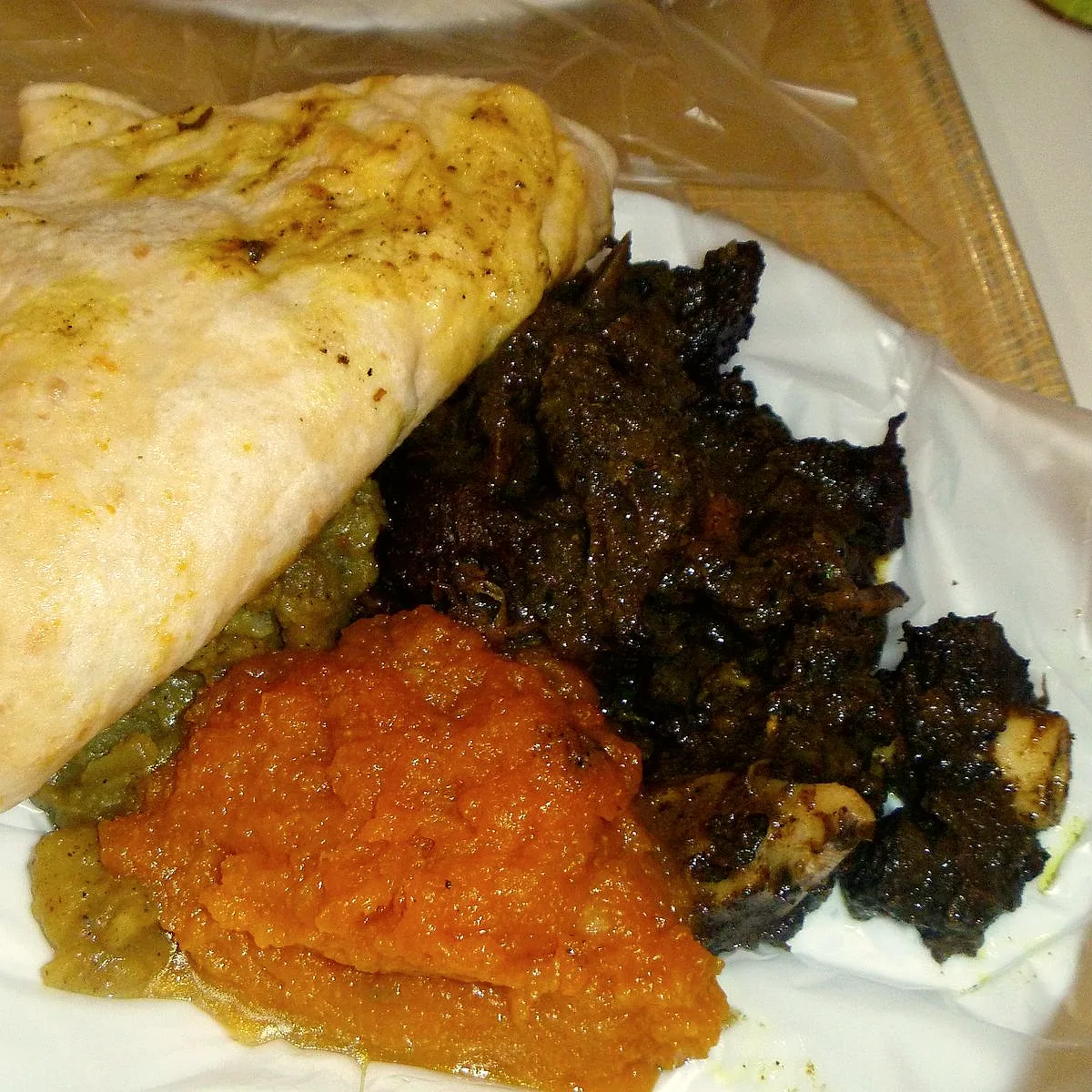

CC BY-SA 3.0. Cropped and colour-adjusted for this site.
Method
Rinse the 250 g dried yellow split peas and simmer in plenty of water for 35m, until completely soft, then drain well.
Combine the 500 g plain flour, 10 g baking powder and 5 g fine sea salt in a large bowl, then work in the 280 ml water and knead for 10m, until the dough is smooth and elastic.
Cover the dough and leave it to rest at room temperature for 20m.
Grind the drained split peas with the 2 garlic cloves (10 g), 6 g whole cumin and 3 g fine sea salt to a dry, fine paste, working in batches if needed; this takes about 8m.
Divide the dough into as many equal pieces as roti are being made. Flatten each piece into a cup, place a portion of the split pea filling in the centre, then draw the edges up and pinch them closed around it. Flatten each stuffed ball with the palm and roll it out gently into a thin, even round, taking care not to tear the dough or force filling out at the edges. This takes about 20m in total.
Common pitfallRolling a stuffed ball too thin, or with filling pushed too close to the edge, tears the dough and lets the split peas burst through onto the griddle.
Cook each round on a dry, very hot griddle for about a minute a side, until set and lightly spotted, then brush both sides with the 40 ml vegetable oil and press gently around the edges with a folded cloth to encourage it to puff. Stack the cooked roti under a clean cloth to keep them soft while the rest cook, in total about 24m.
Cooking the stuffed dough on a dry, very hot griddle before brushing with oil lets the surface set and seal around the loose filling, so the roti holds together when it is later oiled and pressed to encourage puffing.
Dhalpuri roti reached Trinidad with the indentured labourers brought from India over the second half of the nineteenth century and into the early twentieth, most of them Bhojpuri speakers from what is now Bihar and eastern Uttar Pradesh [1] [2]. Filmmaker Richard Fung's research into the dish's history found that it travelled with them as a marker of home even though, in Bihar itself, it is largely a festival food rather than one made day to day [2].
What Trinidad made of it departed from the dish those labourers had known. The Caribbean version is built on white flour rather than whole wheat, its split-pea filling is ground rather than left whole, it is cooked on a flat griddle rather than fried, and it is made larger than its Indian counterpart [1] [2]: differences substantial enough that dhalpuri is best understood as its own Caribbean dish rather than a regional recipe for the same bread.
In Trinidad, dhalpuri became the everyday wrapper for curry rather than a dish eaten on its own, folded around curried meat, seafood or vegetables to make roti a handheld meal, a use that has since carried the bread, and the word "roti" with it, to the wider Caribbean diaspora.
Sources
- Dal puri, WikipediaDescribes dal puri's spread with indentured labourers to the Caribbean and Mauritius, and the Caribbean dhalpuri's departure from the Indian original in using white flour, split peas, a tava and a larger size.
- Tracing the origins of dhal puri, The Caribbean CameraReports filmmaker Richard Fung's research tracing dhal puri to Bhojpuri-speaking indentured labourers from Bihar, and notes that it functions as a festival food in the Caribbean despite being little made outside home kitchens in Bihar itself.