British · Dessert
Sticky Toffee Pudding
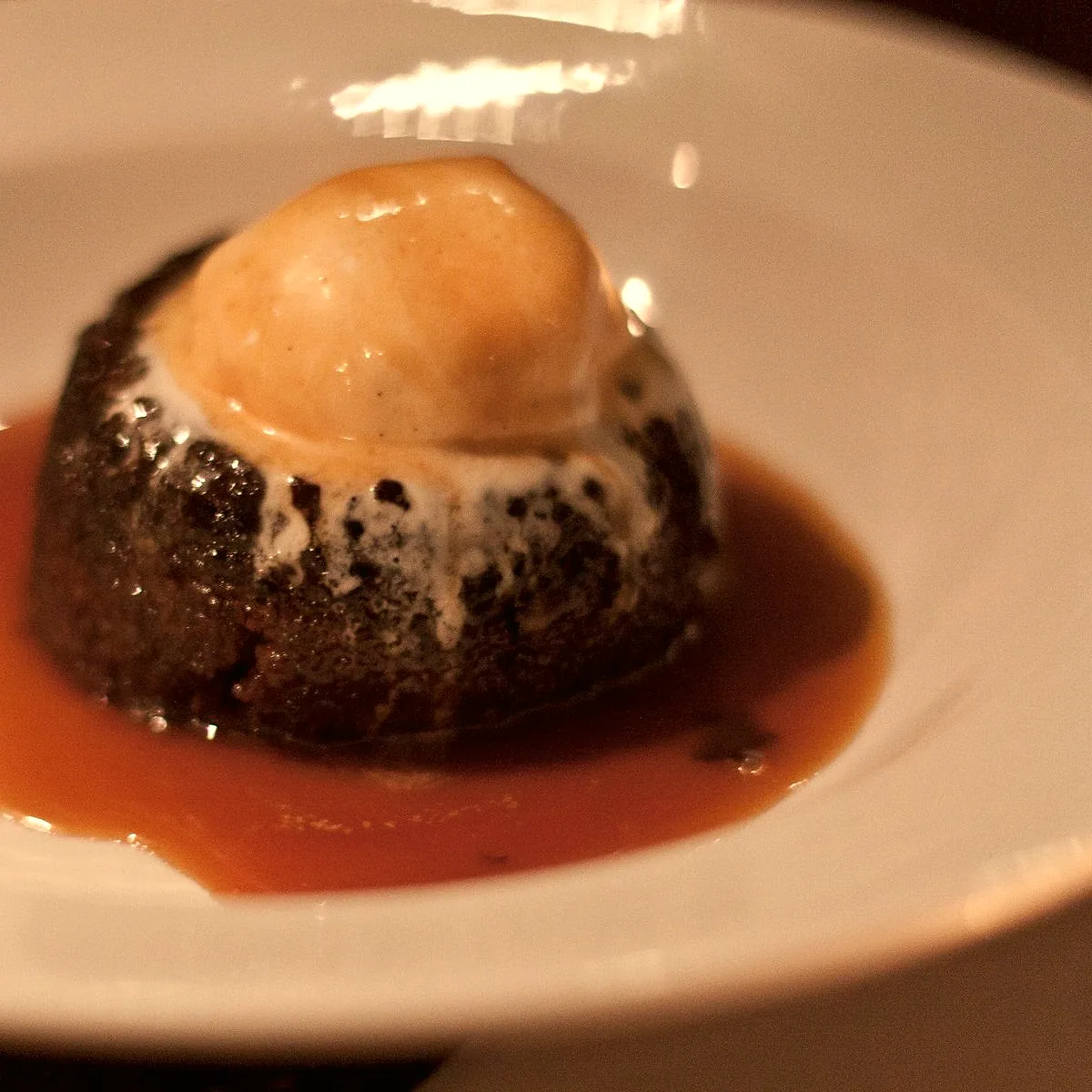
A moist date sponge, its sweetness and colour built into the batter itself, served warm under a hot butterscotch sauce.
.jpg)
CC BY 2.0. Cropped and colour-adjusted for this site.
Method
Put the 250 g dates and the 5 g bicarbonate of soda in a bowl, pour over the 250 g water and leave to stand for 15m, until softened.
The bicarbonate of soda softens the dates further and raises the soaking water's pH, which browns and breaks the dates down into the batter rather than leaving distinct chewy pieces.
Beat the 75 g unsalted butter and the 175 g light brown sugar together until pale and fluffy.
Beat the 3 eggs (150 g) and the 5 g vanilla extract into the creamed butter, then fold in the 225 g self-raising flour along with the soaked dates and their liquid until just combined. Pour into a lined baking dish.
Bake at 180 °C for 35m, until risen and a skewer pushed into the centre comes out clean.
Melt the 100 g unsalted butter with the 150 g light brown sugar in a saucepan over a medium heat, then stir in the 150 g double cream and simmer for 8m, until glossy and thickened enough to coat the back of a spoon.
Common pitfallBoiling the sauce hard rather than letting it simmer gently can split the cream out of the butter and sugar. It wants steady, moderate heat until it thickens, not a hard boil.
Cut the warm sponge into portions and pour the hot sauce generously over each before serving.
Sticky toffee pudding has no agreed birthplace. The account repeated most often credits the Sharrow Bay Country House Hotel on Ullswater in Cumbria, where Francis Coulson and Robert Lee are said to have popularised the dish through the 1970s [1][2], but even this best-known version of the story is usually framed as an account of who popularised the pudding rather than who invented it; no source claims documentary proof that would settle the question of a single inventor.
What is better documented is what happened next. The pudding most people now buy ready-made traces not to any of those hotels but to the Cartmel Village Shop, a few miles from Sharrow Bay, where Howard and Jean Johns developed a take-home version after taking over the shop in 1989 [2]. Jean Johns has been direct about the distinction: "We didn't invent sticky toffee puddings but we found a way for them to be taken away" [2]; by her own account, the dish was already on the menu at both Sharrow Bay and another Lake District hotel, Miller Howe, before Cartmel's version existed [2]. From a production run of a few dozen puddings a week, the shop grew into a business selling roughly a million a year and supplying retailers including Fortnum & Mason [2].
So the pudding's fame and its invention are two separate stories that get told as one. Cartmel deserves the credit for turning a hotel dessert into a national grocery item; nobody has a comparably solid claim to having invented it in the first place, and the honest account is that a genuinely popular dish arrived at its now-standard form (date sponge, bicarbonate of soda, hot butterscotch sauce) by the separate efforts of several kitchens rather than one.
Sources
- Sticky toffee pudding, WikipediaOn the Sharrow Bay claim and the 1989 Cartmel Village Shop take-home version.
- Cartmel sticky toffee pudding celebrate twenty-five years, Great British LifeOn Howard and Jean Johns's 1989 take-home version at Cartmel Village Shop, and on the pudding having already been served at Sharrow Bay and Miller Howe before Cartmel's version existed.