Greek · Main Course
Souvlaki
Cubed pork shoulder marinated in olive oil, lemon juice, garlic and oregano, then threaded and grilled hard over charcoal.
Not the same asGyros (Meat cooked on a vertical rotating spit and shaved off in slices, rather than cubed and threaded onto individual skewers.)
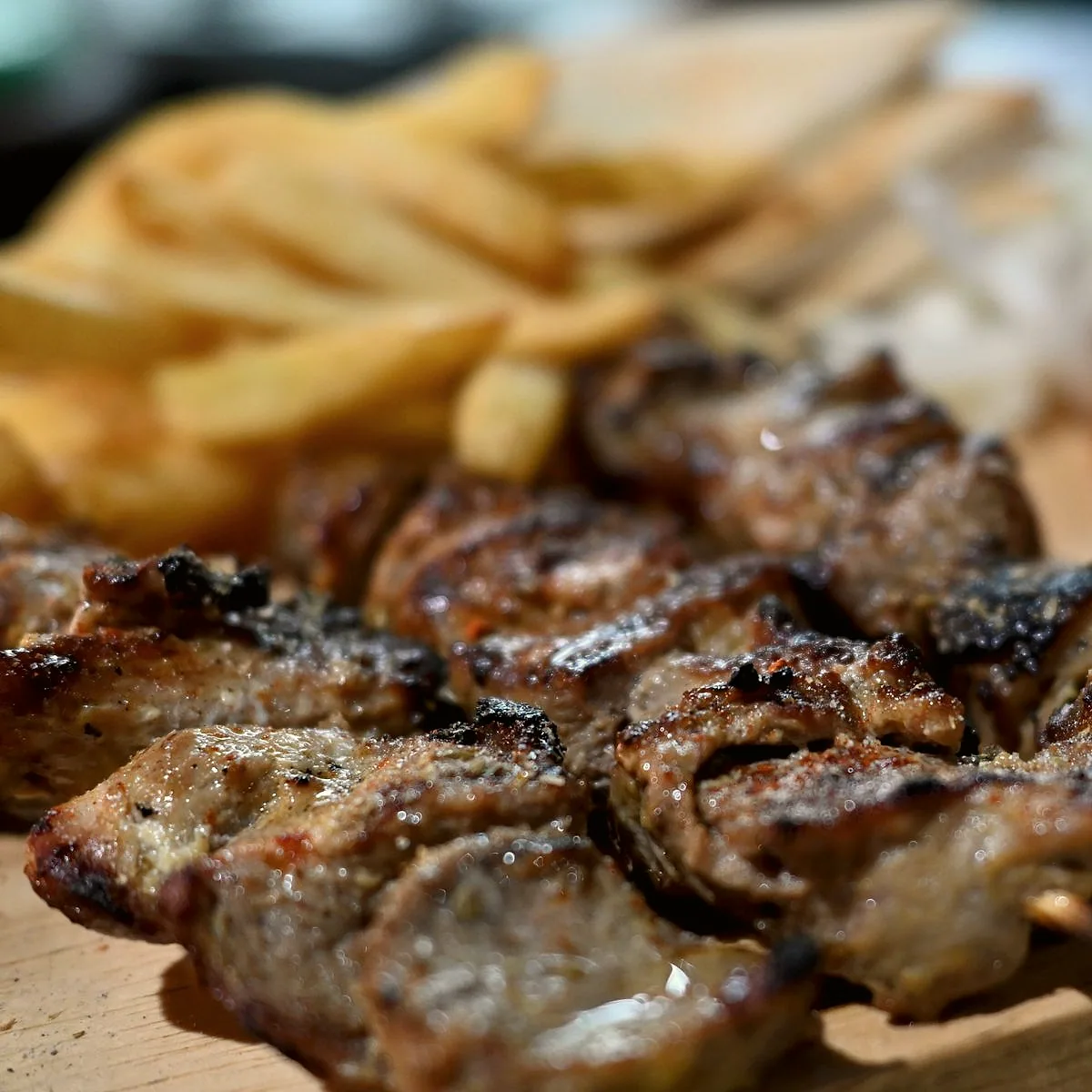

CC BY-SA 4.0. Cropped and colour-adjusted for this site.
Method
Trim the 600 g pork shoulder of any excess fat and cut it into even cubes.
Whisk the 25 ml extra-virgin olive oil, 30 ml freshly squeezed lemon juice, 2 garlic cloves (10 g), 4 g oregano, 6 g fine sea salt and 2 g ground black pepper together, add the pork and turn to coat every piece. Cover and marinate, refrigerated, for 3h.
Lift the pork from the marinade, shaking off the excess, and thread it tightly onto skewers.
Grill the skewers over direct charcoal heat, turning often, for 10m, until well charred outside and cooked through with no pink remaining at the centre.
The practice this dish belongs to is old even by the standards of Greek cuisine. Excavations on Santorini, led by the archaeologist Christos G. Doumas, uncovered stone skewer supports, known as krateutai, pre-dating the island's Bronze Age eruption, and archaeologists working at Mycenaean sites including Pylos and Mycenae have found fired-clay trays interpreted as portable stands for grilling skewered meat over coals [1][2]. Homer, Aristophanes, Xenophon and Aristotle all describe meat cooked this way, under the Classical Greek name obeliskos, a small spit [1], and the later writer Athenaeus describes a version wrapped in bread that reads as a close ancestor of souvlaki served in pita today [2].
The word souvlaki itself is more recent, descending from the medieval Greek souvla ("skewer"), which was in turn borrowed from Latin subula [1]. Byzantine sources describe hot meat shops in Constantinople selling something close to the modern dish, so the vendor-and-skewer format also has a long run behind it [1]. But the version sold on Greek street corners today is a twentieth-century thing: the nineteenth- century French writer Gustave Flaubert recorded Greeks grilling meat on bamboo sticks in 1850, and the dish did not become the ubiquitous fast food it is now until vendors, many from Boeotia, popularised it after the Second World War, through the 1960s [1]. Regional naming still splits the country: souvlaki in the north, kalamaki ("little reed") around Athens and the south [1].
Sources
- Souvlaki, WikipediaCovers the Santorini and Mycenaean archaeological evidence, the obeliskos/souvla etymology, and the mid-twentieth-century spread of the modern dish.
- The Ancient Roots of Greek Souvlaki, the World's First Fast Food, Danaos TravelIndependently names the Akrotiri excavator, Christos G. Doumas, and the stone skewer-holders (krateutai) he found, and adds the Athenaeus reference to bread-wrapped skewered meat.