American · Main Course
Southern Fried Chicken
Chicken pieces marinated in seasoned buttermilk, dredged in seasoned flour and shallow-fried in a heavy skillet until deeply crisp.
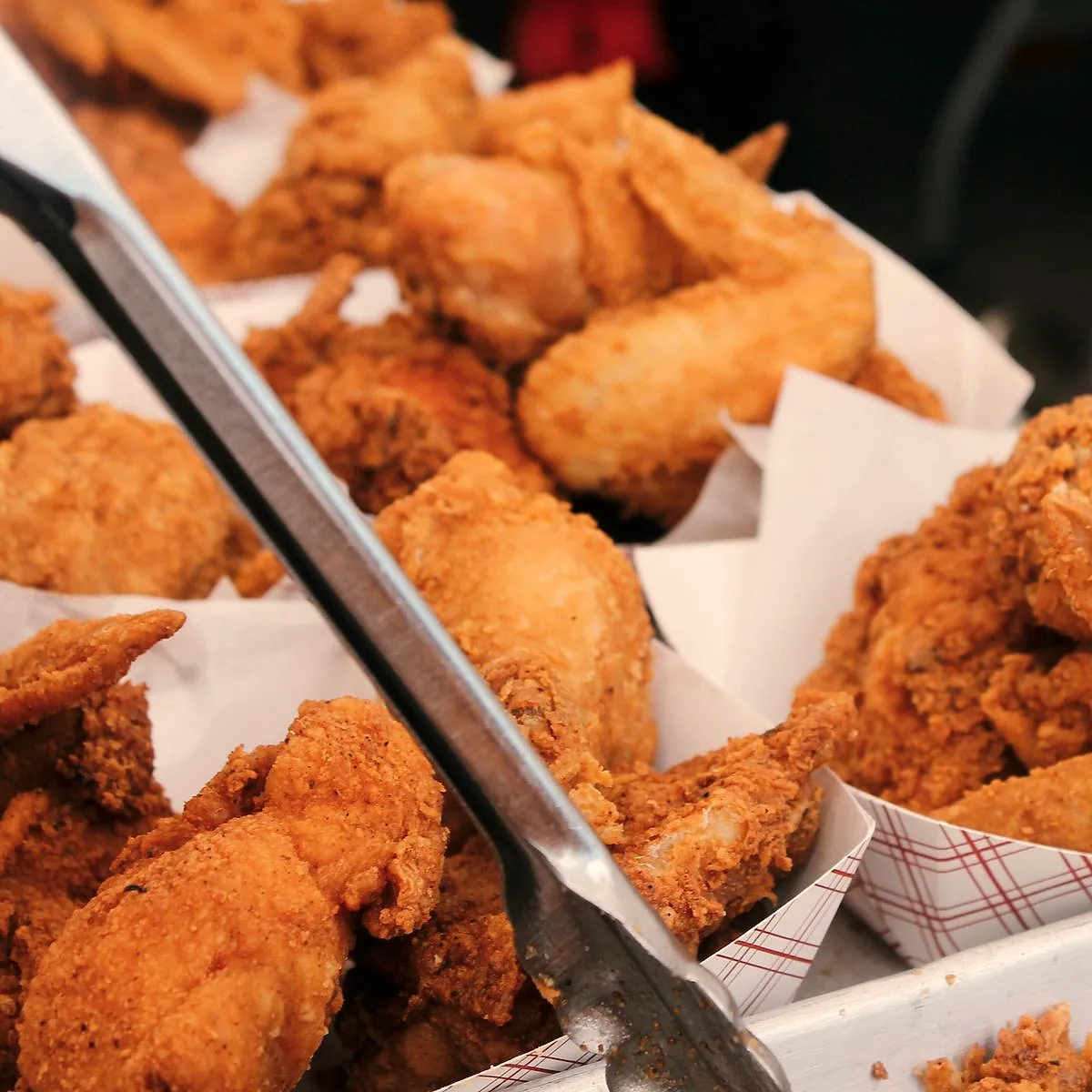
.jpg)
CC0. Cropped and colour-adjusted for this site.
The same dish, adapted. Every quantity, time and figure below changes with the version.
Method
Combine the 700 ml cultured buttermilk and 30 ml hot sauce in a large bowl or dish, submerge the 1.2 kg bone-in, skin-on chicken in it, cover, and refrigerate for 8h.
The buttermilk's acid and its cultured bacteria both tenderise the meat over the long soak, while its proteins help the seasoned flour cling far more evenly than a dry-brined piece of chicken would allow.
Whisk the 300 g plain flour, 3 g ground cayenne pepper, 4 g sweet paprika, 8 g fine sea salt and 3 g ground black pepper together in a wide shallow dish.
Lift each piece of chicken from the buttermilk, letting the excess drip off, and press it into the seasoned flour, turning to coat evenly on all sides. Set the dredged pieces on a rack.
Heat the 900 ml peanut oil in a heavy skillet over a medium heat until it reaches 165 °C.
Fry the chicken in batches for 24m, turning occasionally and adjusting the heat to hold the oil near 165 °C, until the crust is deep golden and the meat is cooked through to the bone.
Common pitfallCrowding the skillet or letting the oil temperature drift too high blisters the crust before the thick end of a thigh or breast is cooked through, so pieces are fried in batches with the temperature checked between them.
Drain the fried chicken on a wire rack and let it rest for 5m before serving, so the crust can set.
Method
Combine the 700 ml cultured buttermilk and 30 ml hot sauce in a large bowl or dish, submerge the 1.2 kg bone-in, skin-on chicken in it, cover, and refrigerate for 8h.
Whisk the 300 g plain flour, 8 g fine sea salt and 3 g ground black pepper together in a wide shallow dish.
Lift each piece of chicken from the buttermilk, letting the excess drip off, and press it into the seasoned flour, turning to coat evenly on all sides. Set the dredged pieces on a rack.
Heat the 900 ml peanut oil in a heavy skillet over a medium heat until it reaches 165 °C.
Fry the chicken in batches for 24m, turning occasionally and adjusting the heat to hold the oil near 165 °C, until the crust is deep golden and the meat is cooked through to the bone.
While the chicken fries, ladle the 120 ml peanut oil from the frying skillet into a heatproof bowl and whisk in the 15 g ground cayenne pepper, 15 g light brown sugar and 5 g sweet paprika until smooth.
Common pitfallWhisking the cayenne into oil that has cooled brings its raw, bitter edge forward; the oil needs to still be near frying temperature to bloom the spice properly.
Brush the hot paste generously over both sides of the fried chicken while it is still warm, then serve at once.
Two frying traditions are usually named as the parents of Southern fried chicken, and only one of them did much of the actual work later credited to the dish. Scottish settlers who reached the American South from the eighteenth century onward are said to have fried chicken in hog lard, a practice supported by a 1747 recipe in Hannah Glasse's English cookbook and a 1773 diary entry by the Scottish writer James Boswell describing fried chicken at table [1]. But that version was, by most accounts, plain and unseasoned, a secondary household food rather than anything close to what the name now describes [2].
The seasoning, the battering and the technique of frying in a well-spiced coating are credited instead to enslaved West African cooks working in Southern kitchens, who are said to have added cayenne, paprika, black pepper and garlic to the flour and drawn on their own tradition of deep-frying seasoned foods, such as the bean fritters known as akara [2]. Food historians Toni Tipton-Martin, Frederick Douglass Opie and Anne L. Bower are cited for this account, and it is presented as the more decisive influence on the dish that exists today [2].
The Scottish half of the story is the newer and shakier claim. It was first proposed by the food writer John F. Mariani in his 1983 encyclopedia of American food, and even the publications that repeat it are careful to call it "a fascinating theory rather than cold, hard fact" [1]. What is not contested is that the technique reached its modern form on Southern plantations, and that fried chicken went on to become, after emancipation, a genuine trade: Black women vendors at Gordonsville, Virginia's train station sold it to passengers as one of the few paths open to them toward economic independence [2].
Sources
- The Little-Known Scottish Origins Of Fried Chicken, Food RepublicTraces the Scottish-immigration theory to food writer John F. Mariani and names the historian who has since engaged with it, while calling it a theory rather than fact.
- Who Invented Southern Fried Chicken?, The Food That Shaped UsSets out the case that enslaved West African cooks, not Scottish settlers, are responsible for the dish's defining seasoning and frying technique, citing food historians Toni Tipton-Martin, Frederick Douglass Opie and Anne L. Bower.