American · Main Course
Thanksgiving Roast Turkey
A whole turkey, dry-salted a day ahead and roasted under foil before a final blast of heat browns the skin.
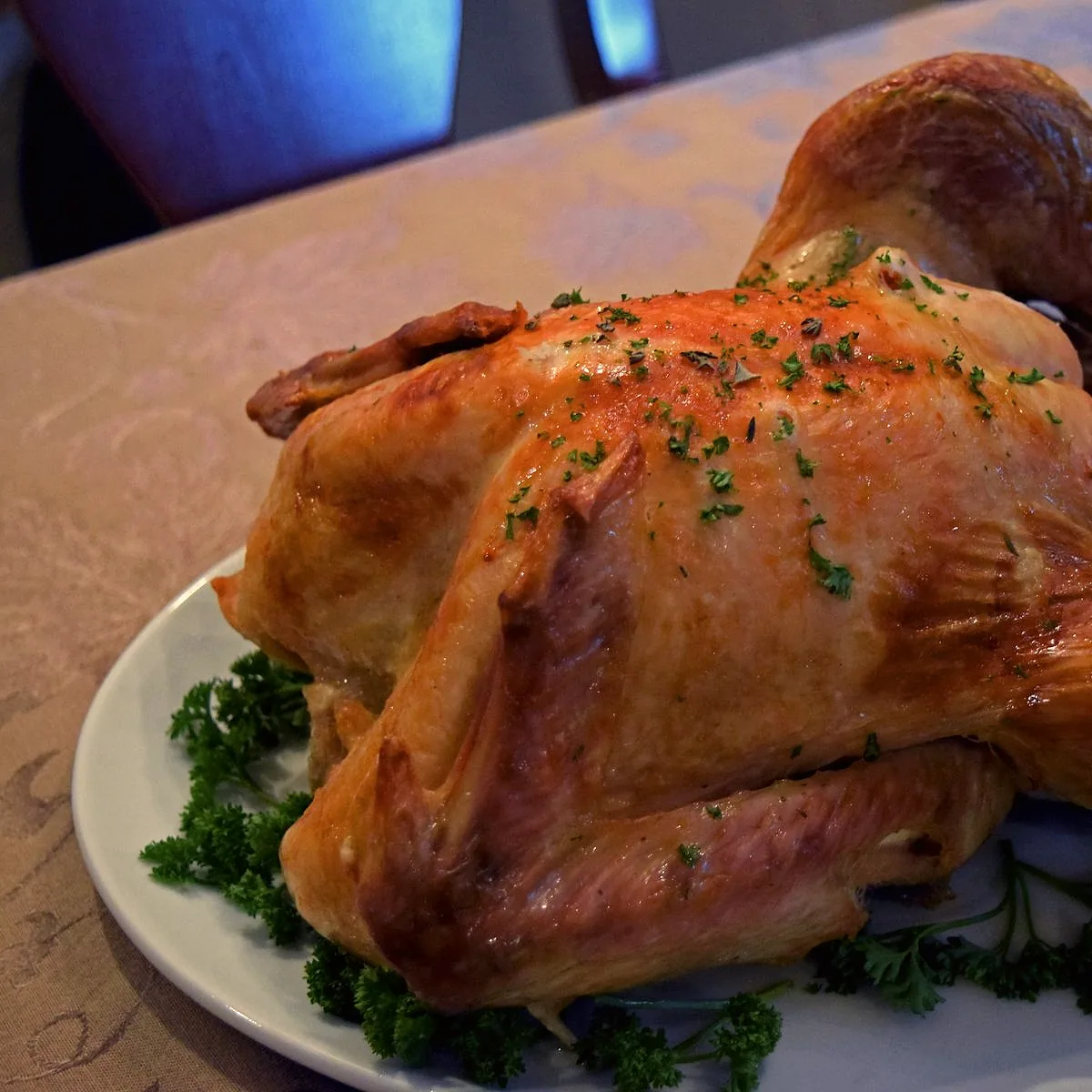

CC BY-SA 4.0. Cropped and colour-adjusted for this site.
The same dish, adapted. Every quantity, time and figure below changes with the version.
Method
Pat the 3.8 kg turkey completely dry and season it all over, including inside the cavity, with the 40 g fine sea salt.
Set the bird uncovered on a rack set in a tray and refrigerate for 12h.
Salting the bird a day ahead and leaving it uncovered in the refrigerator draws moisture to the surface and then reabsorbs it seasoned throughout the meat, while the dry surface it leaves behind is what lets the skin crisp rather than steam in the oven.
Mash the 150 g unsalted butter with the 4 garlic cloves (20 g), the 10 g fresh thyme and the 6 g ground black pepper until evenly combined.
Loosen the skin over the breast and legs and work most of the herb butter underneath it directly against the meat, then rub whatever remains over the outside of the skin.
Tent the bird loosely with foil and roast at 160 °C for 2h 30m.
Remove the foil and continue roasting for 45m at 220 °C, until the skin is deeply golden and a thermometer in the thickest part of the thigh, away from the bone, reads 74 °C.
Common pitfallLeaving the foil on for the whole roast keeps the meat moist but never lets the skin brown. It comes off only for the final stretch, once the meat is nearly cooked through, so the skin does not have time to dry out before the bird is done.
Transfer the bird to a board and rest, loosely tented, for 40m before carving.
Carve the breast and legs away from the carcass and slice.
Method
Turn the 3.8 kg turkey breast side down and cut along both sides of the backbone to remove it. Turn the bird over and press down firmly on the breastbone until it cracks and the bird lies flat.
Removing the backbone and pressing the bird flat puts the breast and legs at roughly the same thickness and the same distance from the heat, which is what lets both finish together in under a third of the whole bird's roasting time.
Pat the bird completely dry and season it all over, including under the legs, with the 40 g fine sea salt.
Set the bird uncovered, skin side up, on a rack set in a tray and refrigerate for 12h.
Mash the 150 g unsalted butter with the 4 garlic cloves (20 g), the 10 g fresh thyme and the 6 g ground black pepper until evenly combined.
Loosen the skin over the breast and legs and work most of the herb butter underneath it directly against the meat, then rub whatever remains over the outside of the skin.
Roast flat, skin side up, at 220 °C for 1h 20m, until the skin is deeply golden and a thermometer in the thickest part of the thigh, away from the bone, reads 74 °C.
Common pitfallRoasting a flattened bird at the same moderate heat used for a whole one leaves the skin pale, since there is no long covered stage to render the fat first. A single hotter roast is what browns it in the shorter time available.
Transfer to a board and rest for 25m before carving.
Carve the breast and legs away from the carcass and slice.
The only surviving contemporary account of the 1621 gathering at Plymouth Colony, written by the colonist Edward Winslow, records venison, fish and corn without ever mentioning turkey by name; wild "fowl" is mentioned, and that more plausibly meant duck or goose, which were hunted in far greater numbers at the time [2]. The idea that turkey was the meal's centrepiece is a later addition to the story rather than a detail recovered from it.
Turkey's fixed place at the holiday table is largely the achievement of one writer. Sarah Josepha Hale, editor of Godey's Lady's Book, began campaigning in 1827 for Thanksgiving to be declared a national holiday, writing letters to governors, senators and presidents for 36 years, and in laying out her vision of the ideal Thanksgiving dinner she placed turkey at its centre, long after 1621, and with no documented link to what was actually eaten there [1]. Abraham Lincoln proclaimed the national holiday in 1863, and the turkey Hale had promoted came with it [3].
Its practical popularity followed the same logic that keeps it in ovens today: a bird large enough to feed an extended family from a single roast, raised widely enough across the country to be affordable everywhere by the time the holiday became fixed on the calendar. The centrepiece is a nineteenth-century convention dressed as a colonial one. That does nothing to change how it is best roasted.
Sources
- Why We Eat Turkey on Thanksgiving, HISTORY (A+E Networks)On Sarah Josepha Hale's campaign and the turkey's rise as the holiday's central dish.
- Myth of the First Thanksgiving, WikipediaOn the 1621 Plymouth feast, its contemporary written account, and what it does and does not record about the food served.
- Thanksgiving: From Local Harvests to National Holiday, Smithsonian InstitutionOn Sarah Josepha Hale's decades-long campaign and the 1863 Lincoln proclamation that established the national holiday.