Central American · Main Course
Pupusas
Thick corn masa cakes griddled with a filling sealed inside. They are El Salvador's national dish, one pupusa to a serving, always served with pickled cabbage curtido.
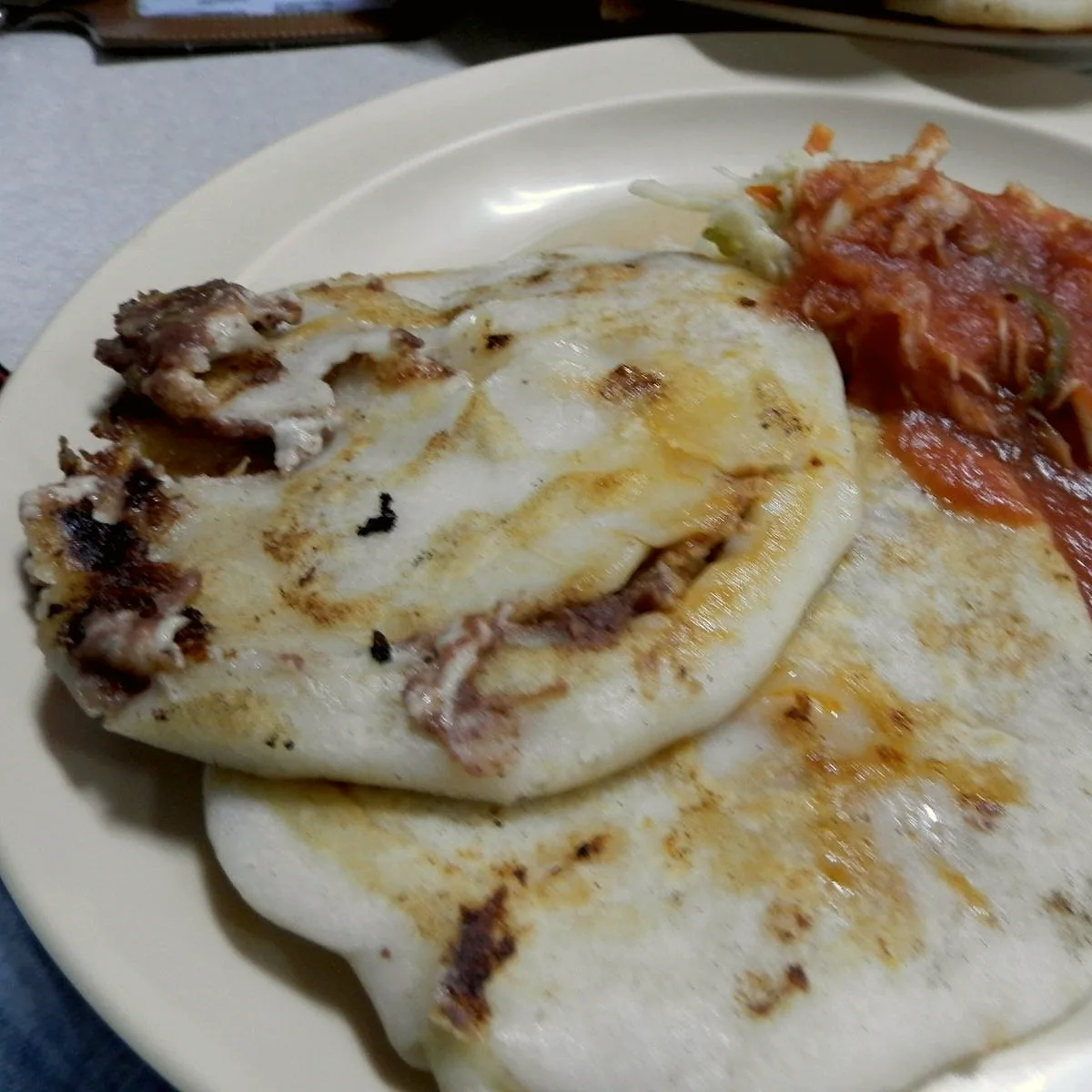

CC BY-SA 4.0. Cropped and colour-adjusted for this site.
The same dish, adapted. Every quantity, time and figure below changes with the version.
Method
Soak the 100 g dried black beans in plenty of cold water for 8h, then drain.
Simmer the soaked beans in the 400 ml water for 45m, until completely soft.
Drain the beans and mash them with the 2 g fine sea salt in a pan over a medium heat for 8m, until they form a thick paste.
Meanwhile, cook the 150 g pork mince and 30 g white onion in a separate pan over a medium heat for 10m, breaking the meat up finely, until browned and cooked through.
Combine the 400 g masa harina and 4 g fine sea salt, then work in the 320 ml water to form a soft, smooth dough. This takes about 10m.
Cover the dough and leave it to rest for 15m.
Divide the dough into as many equal balls as pupusas are being made. Flatten each into a cup, spoon in a little of the mashed beans, cooked pork and 150 g fresh mozzarella, then draw the edges up and pinch closed around the filling. Flatten each filled ball gently between the palms into a thick disc, taking care not to let the filling break through. This takes about 20m in total.
Sealing the filling completely inside the dough before flattening, rather than pressing it onto an already-flat disc, is what keeps the beans, pork and cheese from bursting out once the pupusa hits the hot griddle.
Cook the discs on a lightly oiled griddle with the 15 ml vegetable oil over a moderate heat for 16m in total, turning once or twice, until both sides are browned in spots and the dough is cooked through.
Common pitfallA griddle that is too hot browns the outside before the masa cooks through in the centre; a moderate, steady heat over the full time gives an evenly cooked pupusa rather than a raw-doughed one.
Method
Combine the 400 g masa harina and 4 g fine sea salt, then work in the 320 ml water to form a soft, smooth dough. This takes about 10m.
Cover the dough and leave it to rest for 15m.
Divide the dough into as many equal balls as pupusas are being made. Flatten each into a cup, fill generously with the 300 g fresh mozzarella, then draw the edges up and pinch closed around it. Flatten each filled ball gently between the palms into a thick disc, taking care not to let the cheese break through. This takes about 15m in total.
Cook the discs on a lightly oiled griddle with the 15 ml vegetable oil over a moderate heat for 16m in total, turning once or twice, until both sides are browned in spots, the dough is cooked through and the cheese has melted.
Pupusas are old enough that even their documented history reaches back centuries, and their pre-Columbian history further still. Historians trace the dish to the Pipil people, who are said to have called it kukumuzin rather than pupusa, and to the broader Mesoamerican tradition of filled corn dough that may be as much as two thousand years old [2]. Before the Spanish arrived, the filling was built from what indigenous cooks had to hand, without meat; contact with Spanish colonisation from the 1570s introduced pork into what had been a vegetarian dish, a shift a Franciscan friar's own writing from that decade appears to describe directly [1] [2].
The dish's written record begins later and more precisely than its culinary one: the earliest known mention of pupusas by name is said to come from a nineteenth-century Guatemalan traveller's account of a similar dish encountered in Nicaragua and linked, even then, to El Salvador specifically.
Even the name is not settled fact. The standard reference dictionary for Spanish traces "pupusa" to a Nawat word meaning "fluffy," but at least one Salvadoran linguist has argued against this, pointing to the Pipil's own, different name for the dish, kukumuzin, as evidence that the word's real origin remains an open question rather than a settled one [1] [2].
What is beyond dispute is the dish's official status. El Salvador's Legislative Assembly passed Decree 655 in 2005, declaring pupusas the national dish "by reason of its autochthonous origin and popular acceptance" and establishing the second Sunday of November as National Pupusa Day [3] [1].
Sources
- Pupusa, WikipediaCites the earliest recorded mention of pupusas in an 1837 account by Guatemalan poet José Batres Montúfar, friar Bernardino de Sahagún's 1570 description of a similar dough-bean-meat mixture, linguist Jorge Lemus's argument against the standard puxahua etymology, and El Salvador's Legislative Assembly Decree 655 of April 20, 2005, establishing National Pupusa Day.
- Pupusas, Solid GroundIndependently states the Pipil origin and their own name for the dish, kukumuzin, the claim that pupusas are roughly two thousand years old, and the introduction of meat into the filling from the 1570s onward.
- Decreto No. 655: Declárase Plato Nacional de El Salvador a las Pupusas, Asamblea Legislativa de El SalvadorThe official 2005 decree text declaring pupusas the national dish of El Salvador "by reason of its autochthonous origin and popular acceptance," and establishing the second Sunday of November as National Pupusa Day.