American · Main Course
Pulled Pork
A whole pork shoulder rubbed with spice, smoked until it shreds apart with a fork, and dressed with a thin, sharp vinegar sauce in the Eastern North Carolina style.
Not the same asLexington-style pulled pork (Dressed with a "dip" that adds tomato and a little sweetness to the vinegar base, rather than the tomato-free, sharply sour sauce used here.)
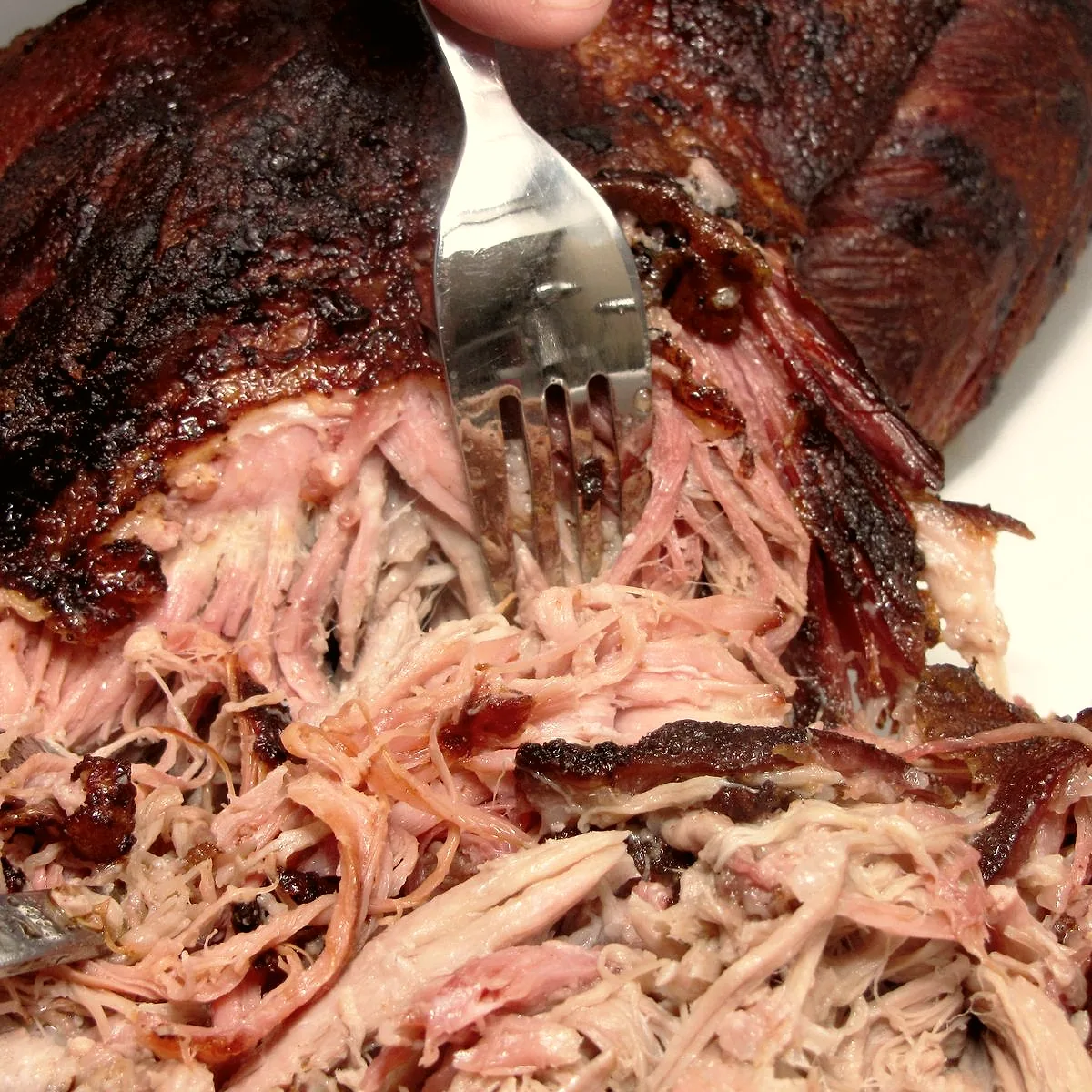

CC BY-SA 3.0. Cropped and colour-adjusted for this site.
The same dish, adapted. Every quantity, time and figure below changes with the version.
Method
Combine the 30 g fine sea salt, 22 g ground black pepper, the 45 g light brown sugar, 50 g sweet paprika, 13 g mustard powder and 13 g celery salt, then coat the 3.3 kg pork shoulder evenly all over.
Smoke the shoulder at a steady 110 °C for 10h, until a probe pushed into the thickest part meets no resistance and the internal temperature reads close to 95 °C.
Wrap the shoulder loosely and rest it for 30m, until it is cool enough to handle without burning your hands.
Pull the meat apart into shreds by hand or with two forks, discarding any large pieces of fat and the bone, for 15m.
Common pitfallPulling the pork before it has rested loses most of its juice to the board. It rests, still wrapped, until it is cool enough to handle rather than being torn apart straight from the smoker.
Whisk together the 250 ml cider vinegar, the 15 g light brown sugar, the 10 g fine sea salt, the 8 g ground black pepper and the 6 g chilli flakes, then toss it through the warm pork until it is evenly moistened.
The vinegar sauce is worked through the meat while it is still hot, so it is absorbed rather than sitting on the surface, and it re-seasons pork whose bark has otherwise gone unsalted since the rub.
Method
Combine the 30 g fine sea salt, 22 g ground black pepper, the 45 g light brown sugar, 50 g sweet paprika, 13 g mustard powder and 13 g celery salt, then coat the 3.3 kg pork shoulder evenly all over.
Smoke the shoulder at a steady 110 °C for 10h, until a probe pushed into the thickest part meets no resistance and the internal temperature reads close to 95 °C.
Wrap the shoulder loosely and rest it for 30m, until it is cool enough to handle without burning your hands.
Pull the meat apart into shreds by hand or with two forks, discarding any large pieces of fat and the bone, for 15m.
Common pitfallPulling the pork before it has rested loses most of its juice to the board. It rests, still wrapped, until it is cool enough to handle rather than being torn apart straight from the smoker.
Whisk together the 150 ml cider vinegar, the 80 g tomato ketchup, the 10 g light brown sugar, the 8 g fine sea salt, the 6 g ground black pepper and the 5 g chilli flakes, then toss it through the warm pork until it is evenly coated: a thin, sharp dip rather than a heavy glaze.
North Carolina's barbecue divide is usually described as a rivalry, but the two styles share a base and diverge only where the finishing sauce is concerned. In the east, the tradition holds closest to its early roots: a whole hog cooked over wood and dressed only with vinegar, pepper and salt, a sauce substituted early on for the lemon juice used to acid-cure meat elsewhere in the Caribbean-influenced barbecue tradition that reached the Carolinas by the early nineteenth century [1]. Whole-hog barbecue itself is old enough in the region to predate the sauce: George Washington's own diary records him attending "a Barbecue" in Virginia in 1769, and it was not until the early nineteenth century that the vinegar-and-cayenne finish became the standard [2]. Food writer John Shelton Reed, who has traced the region's barbecue history at length, calls the eastern style "the original, that's for sure" [1].
The Piedmont version usually credited to Lexington and Salisbury took shape later, during the First World War, when barbecue began to be sold from street stands rather than at the whole-hog pig-pickings of the east [1]. Cooking a whole hog for a cart-based stand was impractical, so Piedmont pitmasters (several accounts trace the style to a handful of cooks of German descent) worked with the pork shoulder alone, and lightened the vinegar base with a little tomato, producing the sauce known locally as "dip" [1]. It is thinner and less sweet than the sauces associated with Kansas City or Memphis, and Reed argues that the eastern and Piedmont sauces "are much more like each other than either one is like what you'd find" in those other regions [1]: a reminder that "Carolina barbecue" is closer to one tradition split in two than two unrelated cuisines that happen to share a state.
The rivalry has outlasted the sauce pot: North Carolina's first sit-down barbecue restaurant, Bob Melton's in Rocky Mount, opened serving the eastern style in 1924, and by the time Lexington pitmaster Wayne Monk was catering the Reagan administration's 1983 economic summit, both traditions were established enough that neither had displaced the other [2]. The version made here is the eastern one: a whole shoulder standing in for the whole hog most home cooks cannot manage, shredded and dressed in the sharp, tomato-free vinegar sauce that predates the Piedmont's sweeter dip.
Sources
- Why Are There Two Styles of NC Barbecue?, Our StateInterviews John Shelton Reed, co-author of "Holy Smoke," on the origins and relationship of the two styles.
- North Carolina BBQ, Southern Foodways AllianceDates the whole-hog, vinegar-and-cayenne eastern tradition to George Washington's 1769 diary entry, and gives Bob Melton's 1924 Rocky Mount restaurant as the state's first sit-down barbecue house.