Canadian · Main Course
Poutine
Twice-fried chips, fresh cheese curds and hot gravy, poured over at once so the curds soften without fully melting.
Not the same asDisco fries (An American diner dish of fries under gravy and melted mozzarella or cheddar; it uses a shredded, fully melting cheese rather than curds, which are meant to stay distinct and squeaky.)
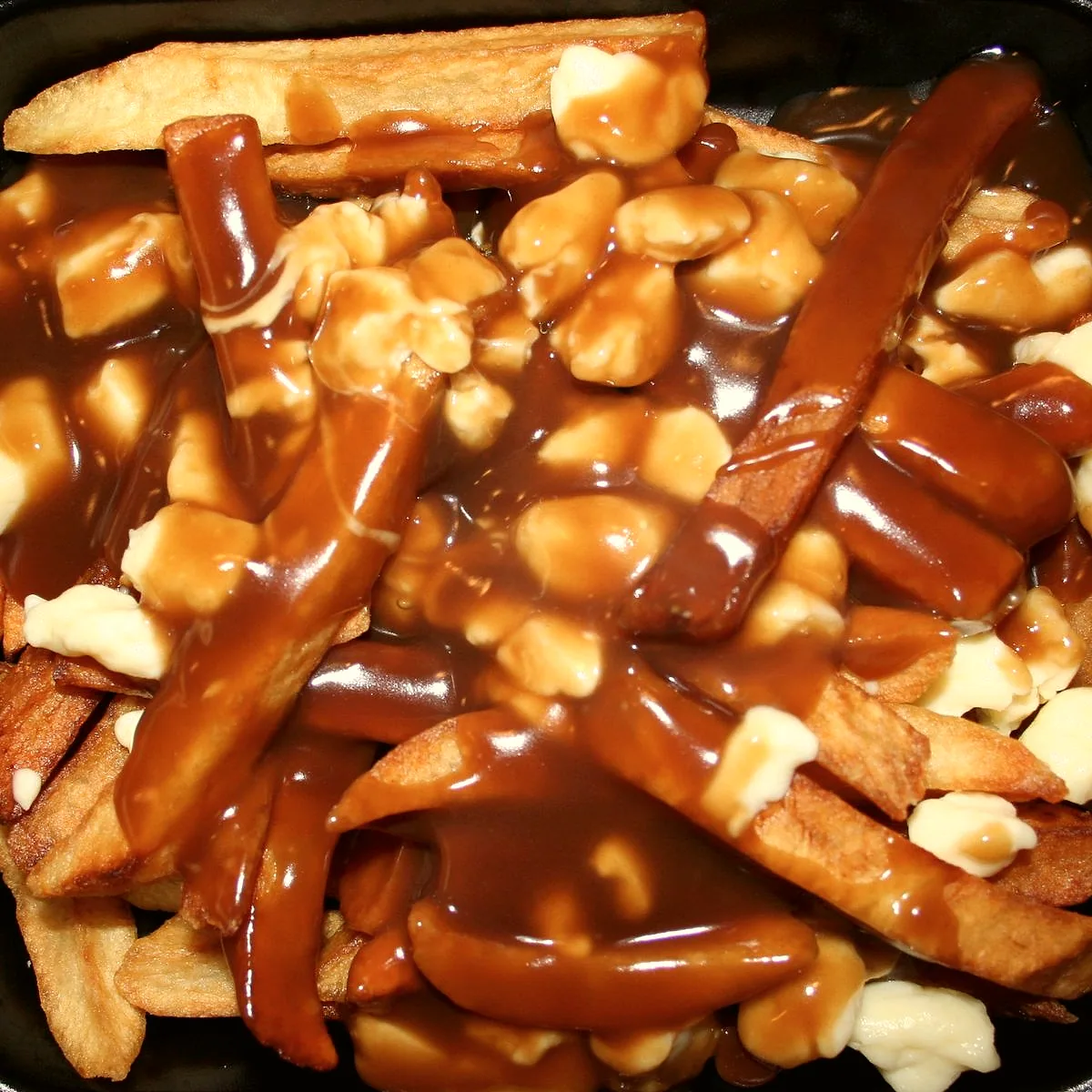

GFDL 1.2. Cropped and colour-adjusted for this site.
Method
Heat the 1.5 kg vegetable oil to a moderate 130 °C and fry the 800 g potato in batches for 8m, until soft through but still pale. Drain.
Leave the chips to cool and dry out on a wire rack for 15m.
Melt the 30 g unsalted butter in a saucepan, whisk in the 25 g plain flour and cook briefly, then whisk in the 400 g chicken stock, the 4 g fine sea salt and the 2 g ground black pepper. Simmer for 12m, until thickened enough to coat the back of a spoon.
Raise the oil to 190 °C and fry the chips again for 7m, until deep golden and crisp. Drain well.
Pile the chips into bowls, scatter over the 250 g cheese curds and pour the hot gravy over immediately. Serve at once.
The gravy has to be genuinely hot and poured on immediately before serving; it is what softens the curds' surface into a slight melt while the cold centre stays intact, which is the texture the dish is built around.
Common pitfallCold, fridge-hard curds refuse to soften properly even under hot gravy. They want to come up to room temperature first, so the gravy's heat is enough to reach a proper half-melt.
Poutine's origin is claimed by at least three small restaurants in Quebec's Centre-du-Québec region, all within a few years of one another, and none of them can be fully proven. At Le Lutin qui rit in Warwick, the owner Fernand Lachance is said to have added cheese curds to a regular customer's fries in 1957 and remarked that it would make "une maudite poutine", a damned mess. Gravy was added a few years later to keep the dish warm [1][2]. In Drummondville, Jean-Paul Roy of Le Roy Jucep says he began combining fries, curds and gravy around the same period and put it on his menu under the name by the mid-1960s, and the restaurant holds an official trademark registration for the word "poutine" [1][2]. A third establishment, La Petite Vache in Princeville, has its own version of the story. As one account puts it, nobody will ever know for certain who combined the three ingredients first [2].
What is not disputed is how poorly regarded the dish was for decades after it left its rural roots. Poutine carried a real stigma once it reached wider Quebec society: mocked and ridiculed as unsophisticated backwoods food or a late-night, post-drinking snack, it was something serious Montreal kitchens would cook for their own staff but keep off the menu [3]. That changed only when chefs began treating it as a dish worth refining rather than apologising for. Martin Picard opened Au Pied de Cochon in November 2001 and became known for dishes that mixed luxury ingredients with humble Quebec staples, chief among them a foie gras poutine that is generally credited with changing how fine-dining audiences saw the dish, after which upscale versions spread into restaurants across Canada [4][3].
The version worth cooking at home owes nothing to that later elevation. It is the plain original: hot fries, fresh curds, and gravy poured over both while everything is still hot enough to matter.
Sources
- Poutine, WikipediaOn the three competing restaurant claims from Warwick, Drummondville and Princeville.
- Dish Dive: The Greasy and Disputed History of Poutine in Quebec, Daily HiveOn the Fernand Lachance and Jean-Paul Roy claims and their respective dates, and on Le Roy Jucep's trademark registration for the name.
- Did Canada Steal Poutine from Quebec?, ViceOn poutine's 1950s rural Quebec origins and the decades of stigma attached to it as mocked, backwoods, junk food that serious kitchens kept off the menu.
- Martin Picard, The Canadian EncyclopediaOn Martin Picard opening Au Pied de Cochon in November 2001 and his foie gras poutine changing how fine-dining audiences perceived Quebec home cooking.