Chinese · Main Course
Peking Duck
A whole duck air-dried, glazed with maltose and roasted until the skin turns deep mahogany and crackling-crisp, carved and eaten wrapped in thin pancakes.
Also known asBeijing kaoya
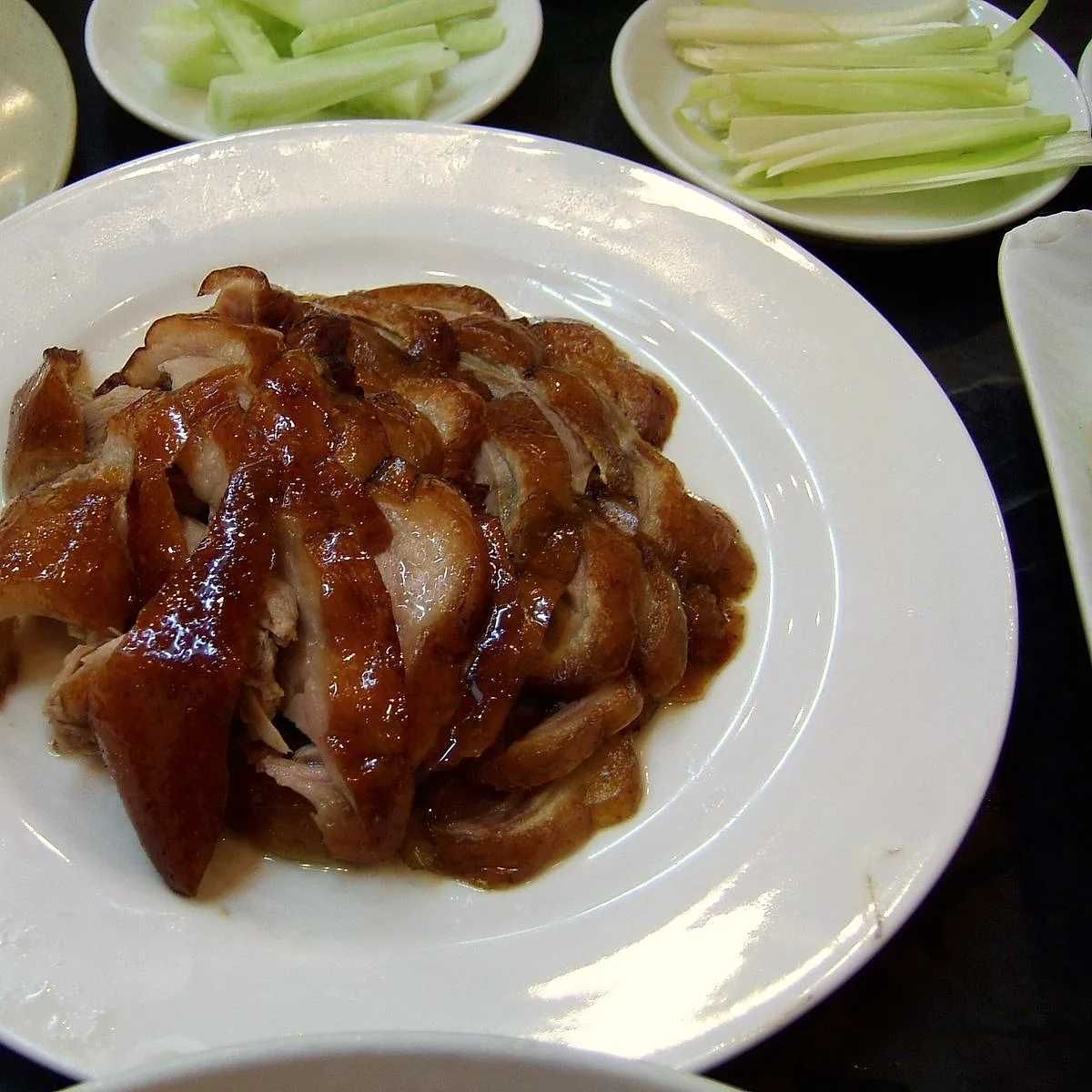

CC BY-SA 2.0. Cropped and colour-adjusted for this site.
Method
Set the 2.2 kg duck on a rack over a tray and pour the 2 L water slowly over the skin, working over the whole surface, for 5m, until the skin visibly tightens. Pat completely dry.
Scalding the skin with boiling water tightens it and helps separate it slightly from the fat beneath, which is what lets it blister and crisp cleanly in the oven rather than staying soft and pliable.
Rub the 8 g fine sea salt and 3 g five-spice powder inside the cavity only, taking 5m.
Warm the 40 g maltose syrup, 20 ml black vinegar and 40 ml water together until the maltose dissolves, then brush evenly over the outside of the duck, taking 5m.
Hang or rest the duck uncovered on a rack in a cold, airy spot, ideally in front of a fan, for 12h, until the skin feels completely dry and papery to the touch.
A long, uncovered dry in a cold, airy spot draws moisture out of the skin before it ever reaches the oven; a wet skin steams rather than crisps under heat, however hot the oven is set.
Roast the duck breast-side up on a rack over a tray at 180 °C for 1h in total, turning once partway through, until the skin is deep mahogany and crackling-crisp and the juices run clear.
Common pitfallOpening the oven repeatedly to check the duck lets heat escape and slows the skin's crisping. The duck is better judged by colour through the oven door and turned only at set intervals.
Meanwhile, pour the 130 ml water into the 200 g plain flour and stir into a shaggy dough, then knead briefly for 10m until smooth. Cover and rest.
Roll the dough into a log and divide into small, even pieces. Brush one side of each with the 10 ml toasted sesame oil and press two together, oiled sides in, then roll each pair out thin as one round. Cook each round in a dry pan over medium heat for 25m in total, until small bubbles appear and the surface sets, then peel the two layers apart while still warm and stack them, covered, until needed.
Rest the duck for 10m before carving.
Carve the skin and breast meat into thin slices, taking 10m. Serve with the warm pancakes, 5 ½ spring onions (80 g), 150 g cucumber and 80 g hoisin sauce, for wrapping at the table.
The name is less straightforward than it sounds. Roast duck is recorded in Chinese sources as far back as the Yuan dynasty, but food historians treat that early dish as an ancestor of the modern one rather than the same thing [2]. The specific duck now called Peking duck develops later and further south, as a Nanjing specialty that travelled north only after the Yongle Emperor moved the capital to Beijing in the early fifteenth century, carrying the dish and the cooks who made it along with the rest of the court [1].
Two distinct cooking methods grew up around it, and both still exist today. Nanjing cooks had developed the menlu, a squared, closed brick oven that roasted several ducks together over an internal fire; the gualu, an open hanging oven fired by fruitwood, developed later, inside the kitchens of the Qing court, and let a duck be roasted individually and to order rather than in a batch [1]. It is the hanging-oven method that defines the dish as it is known internationally today.
That international identity is largely the work of one restaurant. In 1864, a former poultry trader named Yang Quanren opened Quanjude in Beijing and staffed it with cooks trained in the former imperial kitchens, bringing the hanging-oven technique out of the palace and into a restaurant the public could actually eat at [1]. Quanjude's duck found favour first with Beijing's own upper classes, and much later found a different kind of fame: Peking duck was the dish Premier Zhou Enlai served to Henry Kissinger and Richard Nixon during the diplomatic visits of the 1970s, cementing its status as China's best-known dish abroad [1].
Sources
- Peking Duck: The Complex History of a Chinese Classic, National GeographicOn the dish's Nanjing origins under the Ming, its journey north with the Yongle Emperor's court, the two competing oven traditions, and Quanjude's 1864 founding.
- Is Peking Duck Really From Beijing? We Go in Search of Its Origins, South China Morning PostOn the distinction between the Yuan-dynasty roast duck recorded in early sources and the substantially later dish now called Peking duck.