American · Main Course
New York Pizza
A wide, thin, hand-stretched pizza given a long cold ferment for flavour, baked hot enough to blister but sturdy enough to fold.
Not the same asNeapolitan pizza (Smaller, wetter and baked in under two minutes at far higher heat. New York pizza is a distinct, sturdier descendant built for slicing and folding rather than eating with a knife and fork.)
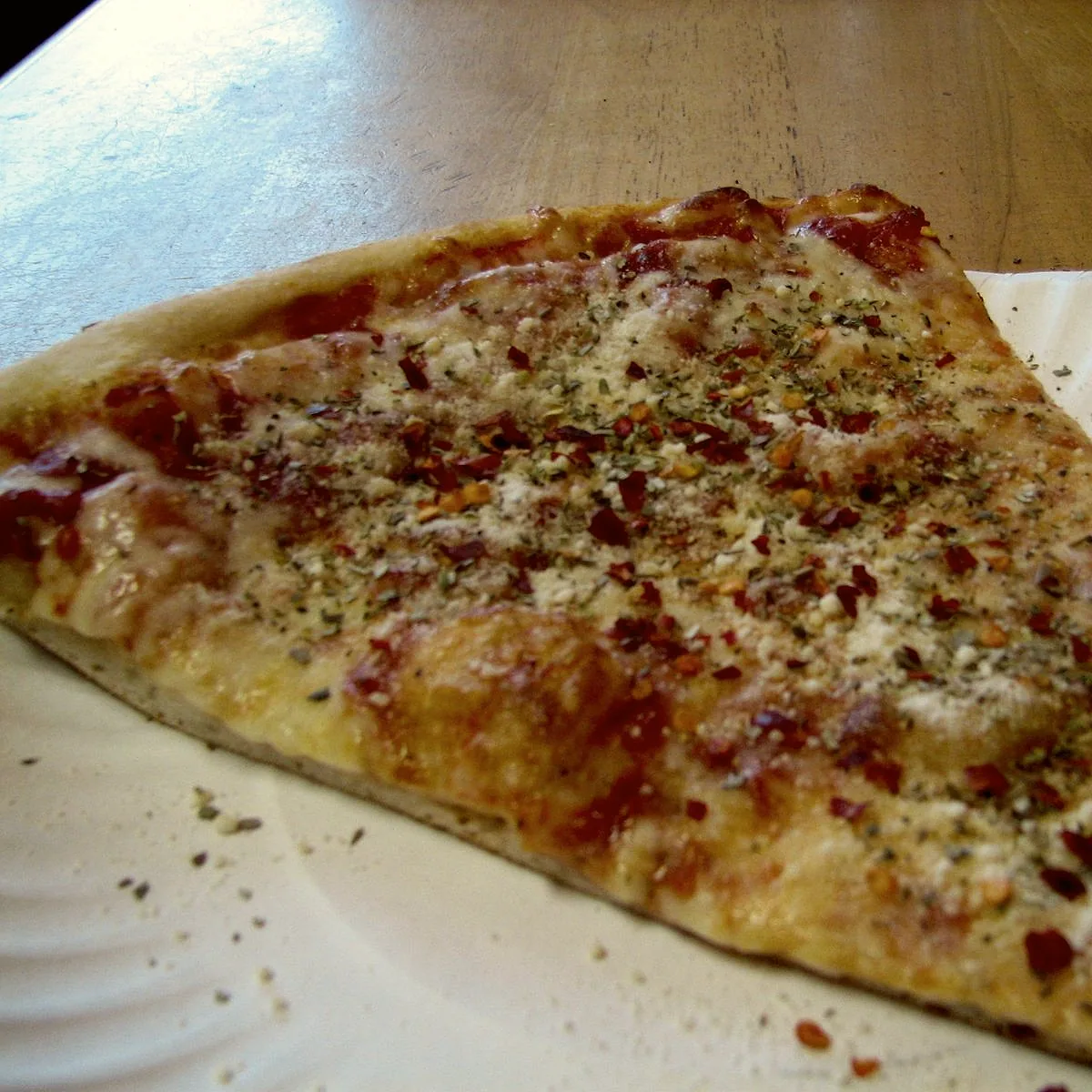

CC BY 3.0. Cropped and colour-adjusted for this site.
Method
Dissolve the 5 g dried yeast in the 350 ml water, then work in the 520 g bread flour and the 15 ml extra-virgin olive oil until a shaggy dough forms. Add the 14 g fine sea salt and mix until no dry flour remains.
Knead for 10m, until smooth and elastic.
Cover and refrigerate for 24h.
A long, slow rise in the refrigerator develops the sourness and depth of a proper New York crust in a way an hour or two at room temperature cannot; the yeast works too fast at room temperature to build the same flavour.
Turn the dough out and divide it into two equal pieces, shaping each into a tight ball.
Let the balls come back to room temperature over 1h, covered, until soft and relaxed.
Meanwhile heat the oven as high as it will go, with a stone or steel in place, for 45m to saturate fully.
Using the 30 g bread flour as needed, stretch each ball by hand from the centre outward into a wide, thin round, leaving a slightly thicker rim.
Common pitfallRolling the dough with a pin pushes out the gas built up over the long ferment and leaves a dense, cracker-like base. It is stretched by hand, working from the centre outward, to keep that structure.
Crush the 350 g tinned San Marzano tomatoes and spread a thin layer over each round, scatter with the 3 g oregano, cover with the 300 g fresh mozzarella and finish with the 10 ml extra-virgin olive oil.
Bake at 260 °C for 14m, until the crust is well browned with charred spots and the cheese is fully melted and beginning to colour.
New York pizza descends from the wave of Neapolitan immigration into the city around the turn of the twentieth century, brought by cooks who had grown up on the wood-fired pizza of Naples [1]. For decades the story credited one man with starting it here: Gennaro Lombardi, said to have taken out the country's first pizza-selling license at a grocery on Spring Street in 1905.
That license has never actually turned up. The researcher Peter Regas spent years working through immigration records, city directories and old advertisements and found that Lombardi did not arrive in New York until 1904, and that the Spring Street address had been run for years before him by other immigrant bakers. Regas argues the real pioneer was Filippo Milone, who quietly established several of the city's oldest pizzerias, including the shops that later became known as Lombardi's and John's of Bleecker Street, before selling them on to the men whose names they still carry [1]. Scott Wiener, a pizza historian who had repeated the 1905-license story on his own tours for years, has since dropped it, saying the claim "is now totally blown out of the water" [2].
None of this erases Lombardi's part in the story; he ran a real, influential pizzeria that his family reopened under his name decades later, and it is still there. It only means the tidy founding-father version of the story, the one printed on the wall of the shop itself, is far less certain than it looks. The dough below owes more to that whole generation of anonymous immigrant bakers, working from memory in a city that had none of Naples's ovens or ingredients, than to any single person's legend.
Sources
- The Father of American Pizza Is Not Who We Thought He Was, Smithsonian MagazineOn researcher Peter Regas's findings that Filippo Milone, not Gennaro Lombardi, first established the Spring Street pizzeria and others that became the city's oldest pizzerias.
- Everyone Says Gennaro Lombardi Brought Pizza To NYC. What This Blog Presupposes Is... Maybe He Didn't?, GothamistOn the missing 1905 mercantile-license record and pizza historian Scott Wiener's decision to drop the claim from his own tours.