American · Dessert
New York Cheesecake
A dense, tangy cream cheese filling on a buttered biscuit-crumb base, baked slowly in a water bath so it sets without cracking.
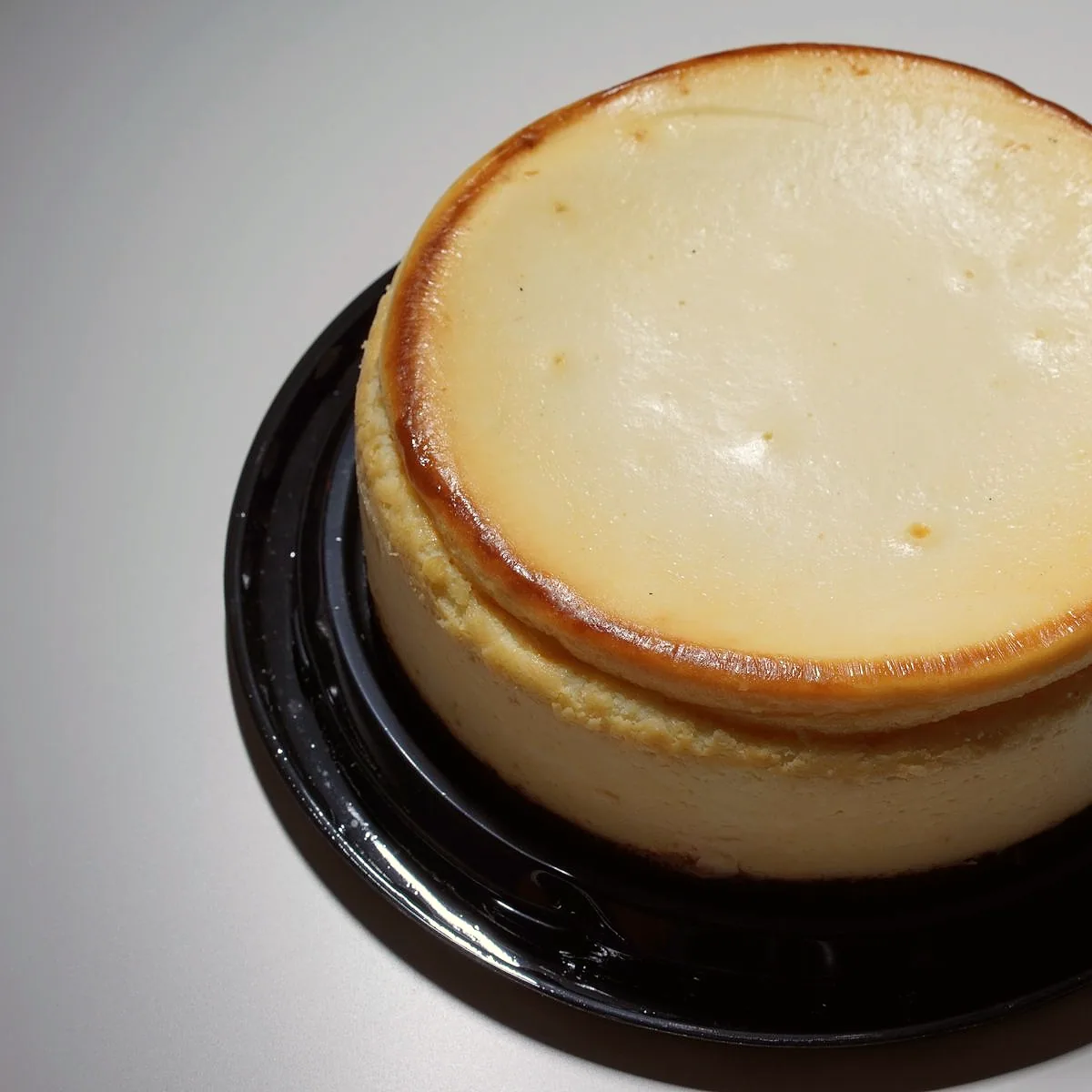

CC BY-SA 4.0. Cropped and colour-adjusted for this site.
Method
Stir the 200 g graham cracker crumbs into the 90 g unsalted butter and the 30 g caster sugar until every crumb is coated, then press the mixture firmly into the base of a springform tin. This takes 8m.
Meanwhile heat the oven to 170 °C, giving it 15m to settle, and wrap the outside of the tin in foil to keep water from the later bath seeping in.
Bake the crust for 10m, until just set, then leave it to cool while the filling is made. Lower the oven to 150 °C.
Beat the 900 g cream cheese until perfectly smooth, then beat in the 220 g caster sugar and the 20 g cornflour, over 4m, scraping down the bowl so no lumps of cheese are left at the base.
Beat in the 4 eggs (200 g) one at a time on the lowest speed, over 4m, mixing each just until it disappears before adding the next.
Common pitfallBeating air into the batter once the eggs go in is what causes a baked cheesecake to crack, since that trapped air expands in the oven and then collapses as it cools. Eggs are mixed in on the lowest speed, just until combined.
Stir in the 120 ml double cream, the 15 ml freshly squeezed lemon juice and the 8 ml vanilla extract by hand, using 2m, until just combined.
Pour the batter over the crust, set the tin in a larger roasting pan and pour boiling water into the pan to come partway up the sides of the foil. Bake for 1h 10m, until the edges are set and the centre still holds a slight wobble.
A water bath surrounds the tin with steady, moist heat well below the oven's own temperature, which is what lets the custard-like filling set slowly and evenly rather than puffing up at the edges before the centre is done.
Turn off the oven and leave the cheesecake inside with the door ajar for 1h, so it finishes setting gradually rather than meeting cold air all at once.
Lift the cheesecake out of the water bath, remove the foil and refrigerate it, uncovered at first, for 6h or overnight, before unmoulding and slicing.
What separates a "New York" cheesecake from cheesecake generally is a single ingredient switch, and it happened later than the dessert's reputation suggests. Cream cheese itself was invented in 1872, by William Lawrence in Chester, New York, but it took until stabilised, shelf-stable versions reached grocers in the late 1920s for bakers to build a cake around it rather than the curd cheeses American cheesecakes had used up to that point [1] [2].
The credit for making that switch is disputed between two Manhattan restaurateurs who did not particularly like each other, and the two independent accounts of the dispute do not entirely agree. Arnold Reuben said that after tasting a cheese pie at a dinner party in 1929, he got hold of the recipe and reworked it, substituting cream cheese for the curds, and served the result at his own restaurants through the 1930s. It is a story both accounts repeat [1] [2]. Lindy's, the Broadway delicatessen opened by Leo Lindemann in 1921 and later fictionalised as "Mindy's" in Damon Runyon's stories and in Guys and Dolls, became at least as associated with the dessert, but where the recipe came from is where the two accounts split: one holds that Lindemann had hired away Reuben's own baker, while the other traces Lindy's cheesecake instead to food journalist Clementine Paddleford and chef Paul Landry, as reported by the Los Angeles Times in 1948 [1] [2]. Neither version can be verified independently of the restaurant it favours, which is the usual condition of a rivalry conducted in gossip columns rather than patent filings, but a contested recipe origin is closer to the truth here than a tidy one would be.
Sources
- American Cakes: New York Cheesecake — History and Recipe, Tori AveyOn William Lawrence's 1872 invention of cream cheese, Arnold Reuben's 1929 account of acquiring a cheese-pie recipe, and the rival claim built around Lindy's restaurant.
- New York Cheesecake, Worldchefs (World Association of Chefs Societies)Independently corroborates William Lawrence's 1872 invention of cream cheese and Arnold Reuben's dinner-party cheese-pie story, but gives a different, contradicting account of Lindy's recipe (sourced to food journalist Clementine Paddleford and chef Paul Landry via a 1948 Los Angeles Times report) rather than a baker hired away from Reuben.