Indian · Dessert
Jalebi
A fermented batter piped into hot oil in coils, fried crisp, and steeped in warm saffron syrup until it turns glossy and juicy inside. Makes one batch of small jalebi; the nutrition panel is for one piece.
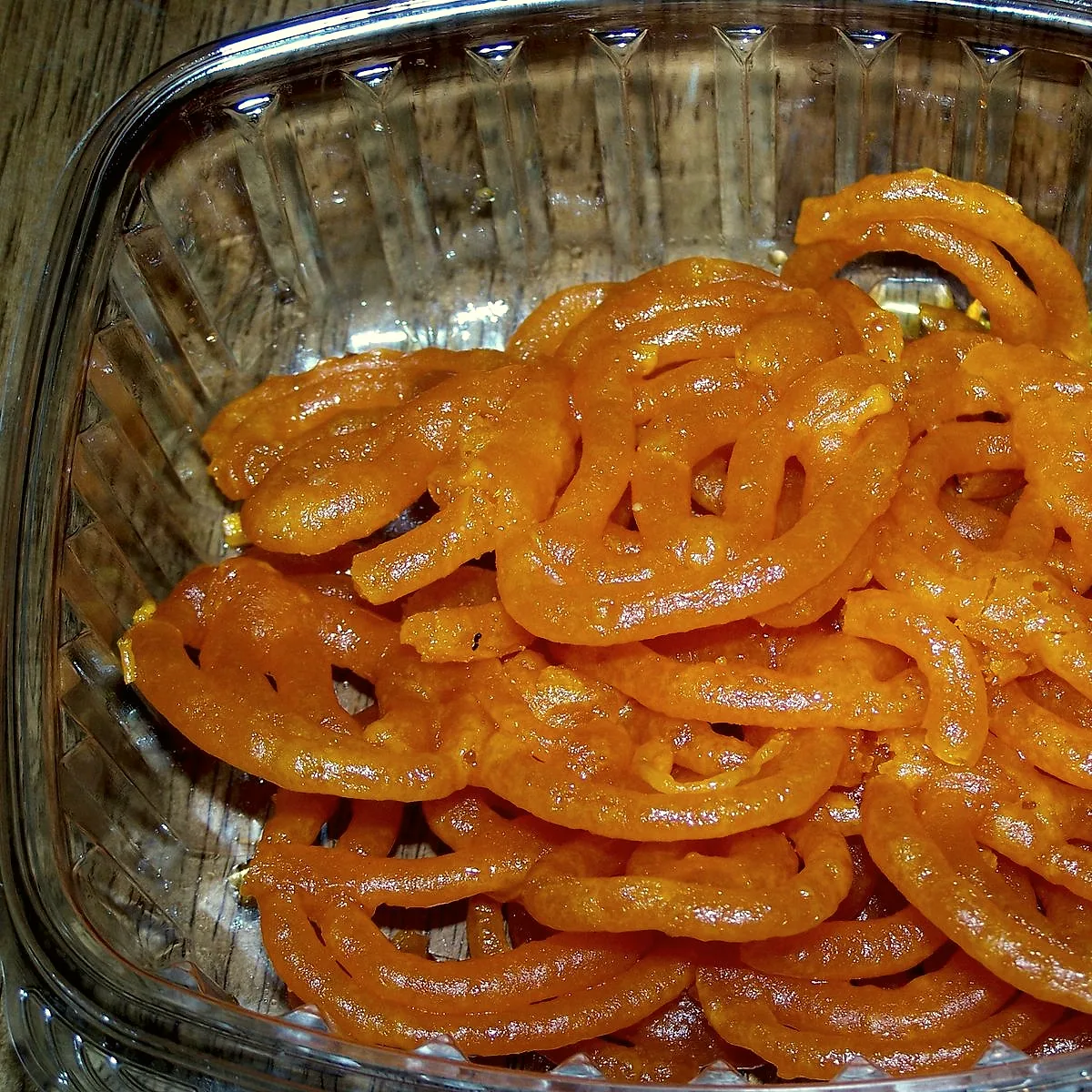

Public domain. Cropped and colour-adjusted for this site.
Method
Whisk the 150 g plain flour, 20 g cornflour and 3 g dried yeast together, then whisk in the 30 g yoghurt and the 160 ml water to a smooth, pourable batter, about the thickness of double cream. This takes 8m.
Cover the batter and leave it somewhere warm to ferment for 8h, until it has loosened further and turned lightly bubbly and faintly sour-smelling.
The long rest lets the yeast loosen the batter with a light, even sourness, which is what gives fried jalebi its characteristic tang against the sweetness of the syrup; a quick, unfermented batter fries flat-tasting by comparison.
Combine the 250 g caster sugar and the 150 ml water in a pan with the 7 ½ cardamom pods (3 g) and bring to a simmer, stirring until the sugar dissolves. Stir in the 0.15 g saffron and the 5 ml freshly squeezed lemon juice and simmer gently for 10m, until very slightly thickened. Keep warm.
Heat the 1 kg vegetable oil in a wide, shallow pan to a moderate heat. Transfer the fermented batter to a piping bag or a bottle with a narrow nozzle and pipe it into the oil in tight, overlapping coils, working in batches. Fry for 20m in total, turning once, until crisp and golden all over. Lift out with a slotted spoon, draining briefly.
Slide the hot, freshly fried jalebi straight into the warm syrup and turn them to coat for 3m, until they have soaked through and turned glossy. Lift out and serve warm.
Common pitfallThe syrup and the fritters both need to be warm at the same time. A cold syrup barely penetrates the crisp shell, leaving the jalebi dry at the centre rather than juicy.
Jalebi is a later stop on a much older sweet's journey. The earliest known recipe for the fried, syrup-soaked coil appears in a tenth-century Arabic cookbook, described there as latticed fritters dipped in syrup scented with rose water, musk or camphor [1][2]. The name itself is inherited rather than coined in India: the Hobson-Jobson dictionary of Anglo-Indian terms traces jalebi to the Arabic zulabiya or the Persian zolbiya [1][2].
The dish reached India along the same routes as much of the era's Persian and Central Asian cooking, carried by Turkish and Persian traders and artisans, and took on its Indian name once it arrived [2]. Its presence there is unusually well dated for a medieval sweet: a Jain text of around 1450 lists jalebi on a merchant's dinner menu, and a Sanskrit text from before 1600 sets out a recipe close enough to the modern one that food historians treat it as essentially the same dish [1][2].
What travelled was a technique and a name more than a fixed recipe. Once in India, jalebi diverged by region rather than staying uniform: thicker and chewier in some states, thinner and crisper in others, sold plain or stuffed elsewhere in the world under names as different as zlabia in North Africa and jerry in Nepal [1][2]. The fermented batter and the hot-oil coil are the constant; almost everything else about how a given region eats it was worked out locally, long after the sweet itself had arrived.
Sources
- Jalebi, WikipediaCovers the earliest known recipes in Arabic cookbooks, the Hobson-Jobson etymology, and the medieval Sanskrit and Jain textual references in India.
- The Journey of Jalebi Doesn't Begin in India. We Reveal Its Sweet Story!, The Better IndiaIndependent journalism corroborating the tenth-century Persian/Arabic origin, its transmission to India via Persian traders and artisans, and the Jain and Sanskrit textual record.