Levantine · Starter · Side
Hummus
Chickpeas cooked until they collapse, blended hot with tahini, lemon and garlic until the texture stops being a purée and becomes a cream.
Also known asḤummuṣ bi-ṭaḥīna · Levant
Not the same asMsabbaha (The same ingredients left coarse, with whole chickpeas folded through rather than blended smooth.)
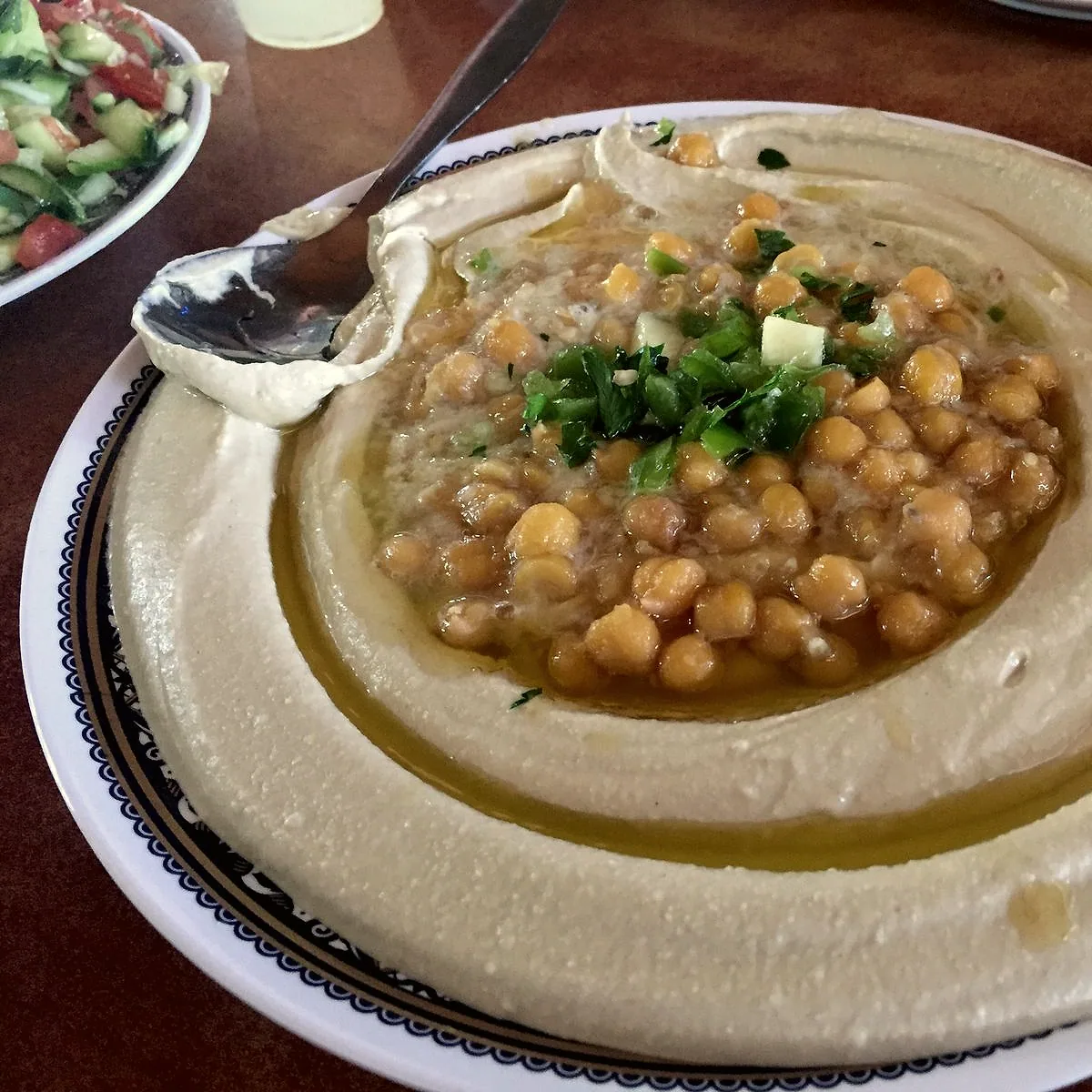

CC BY-SA 4.0. Cropped and colour-adjusted for this site.
Method
Drain the soaked 250 g dried chickpeas and put them in a pan with the 3 g bicarbonate of soda and the 1.5 L water. Bring to the boil, skim off the foam, then simmer for 55m, until a chickpea crushes to nothing between finger and thumb. They should be well past the point of merely cooked.
The bicarbonate of soda raises the pH of the water, which breaks down pectin in the skins and lets the chickpeas collapse. Without it they stay intact and the hummus stays grainy however long it is blended.
Meanwhile crush the 2 garlic cloves (10 g) and leave it in the 60 ml freshly squeezed lemon juice for 10m. The acid takes the raw heat out of the garlic, which would otherwise dominate everything.
Drain the chickpeas, keeping the water, and tip them straight into a blender while still steaming. Add the 130 g tahini, the strained lemon and garlic, the 2 g ground cumin and the 7 g fine sea salt, and blend for 6m, loosening with the cooking water until it turns pale and moves like whipped cream. It should be looser than you think; it sets as it cools.
Blending the chickpeas hot is what makes the difference between a purée and a cream. They break down while soft and the tahini emulsifies into them rather than sitting alongside.
Common pitfallAdding the tahini and lemon to a cold blender seizes the tahini into a stiff paste. Both go in while the chickpeas are still steaming.
Leave for 20m before serving, so the garlic and cumin settle into it. Spread into a shallow bowl, work a hollow into the middle with the back of a spoon, and pour the olive oil into it.
Hummus is Arabic for chickpea. The dish is properly ḥummuṣ bi-ṭaḥīna (chickpeas with tahini), and the shortening is an English convenience that quietly renames a sauce after one of its parts.
Its documented history runs back at least to the thirteenth century. Kitāb al-Wuṣla ilā l-ḥabīb, a Syrian collection of some 635 recipes sometimes ascribed to the Aleppan historian Ibn al-Adim, contains a chickpea preparation that any modern cook would recognise [2]. A roughly contemporary Cairo manuscript records a dish called ḥummuṣ kasa, built on puréed chickpeas and tahini, but soured with vinegar rather than lemon, heavily spiced, thick with herbs and nuts, and containing no garlic at all [1]. The ancestry is real; the continuity is looser than it is usually claimed to be.
The modern argument is about nationality rather than antiquity. Hummus has been the subject of a long public dispute between Lebanon and Israel (competing claims of ownership, competing record-breaking batches, an attempt at protected status), and the quarrel has been serious enough to acquire a name, the hummus wars [3]. It is not a question this page can settle, and the honest position is that a dish eaten across the Levant, Egypt and southern Turkey for centuries does not have a single national author.
What is not in dispute is what makes it good, and it is mostly texture. The difference between an ordinary hummus and a very good one is not the ratio of tahini to chickpea but how completely the chickpeas have been broken down, which is why the recipe here cooks them well past tender and blends them hot.
Sources
- The Oldest Hummus Recipe in the World, From a 13th-Century Syrian Manuscript, Eats HistoryOn the chickpea recipe in Kitāb al-Wuṣla ilā l-ḥabīb and how it differs from modern hummus.
- Kitab al-Wuslah ila l-habib, WikipediaOn the manuscript itself, a 13th-century Syrian collection of 635 recipes, sometimes attributed to the Aleppan historian Ibn al-Adim.
- 'Hummus Wars': a longstanding culinary and cultural battle, Public History Amsterdam, University of AmsterdamOn the modern national dispute over ownership of the dish.