American · Main Course
Hamburger
Beef mince, cooked hard and fast on a scorching griddle to build a deep crust while the inside stays barely done.
Not the same asSloppy joe (Loose spiced ground beef served open on a bun rather than a formed patty. It is a different dish built from the same mince.)
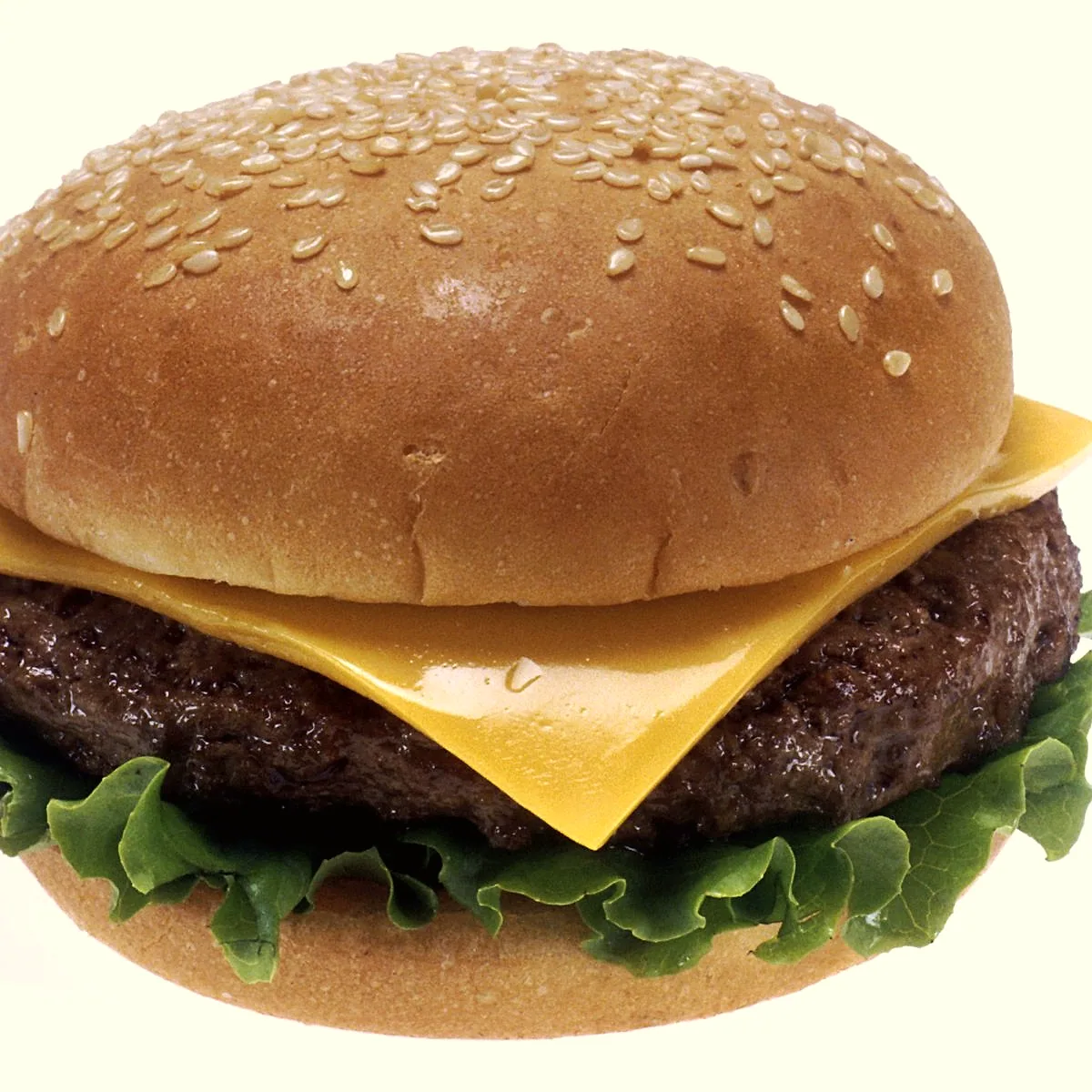

Public domain. Cropped and colour-adjusted for this site.
The same dish, adapted. Every quantity, time and figure below changes with the version.
Method
Heat a flat griddle or heavy pan over a high heat for 5m, until a drop of water skitters and evaporates on contact.
Meanwhile divide the 170 g beef mince into two loose, equal balls without compacting them.
Set the balls on the griddle and immediately press each flat with a heavy spatula, holding the pressure for a few seconds before letting go. Season with the 2 g fine sea salt, cook for 4m, then flip once, laying the 40 g American cheese over the patties as soon as they turn so it melts before the second side is done.
Flattening the ball the instant it hits the griddle maximises the surface touching hot metal, which is what builds the lacy, deeply browned crust a thicker patty cannot form in the same time.
Common pitfallPressing the patty more than once, or moving it before the crust has set, tears the meat away from the crust instead of releasing cleanly.
While the patties cook, toast the cut faces of the 1 bun (43 g) on the edge of the griddle for 2m, until golden.
Stack both patties on the toasted bun with the 15 g white onion, the 15 g dill pickles and the 15 g tomato ketchup.
Method
Shape the 170 g beef mince into a single patty a little wider than the 1 bun (43 g), pressing a shallow dimple into the centre so it cooks flat rather than doming.
Season with the 2 g fine sea salt and sear over a medium-high heat for 8m, turning once, laying the 20 g American cheese over the patty after the flip so it melts as the second side finishes.
Common pitfallPressing a thick patty flat with the spatula while it cooks only pushes the juice out into the pan. Once it is shaped, it is left alone until it is time to flip.
Rest the patty for 3m before building the burger.
Meanwhile toast the cut faces of the 1 bun (43 g) for 2m, until golden.
Build the burger on the toasted bun with the 20 g romaine, the 30 g ripe tomatoes, the 15 g white onion and the 15 g tomato ketchup.
No dish on this site has a more contested founding story than the hamburger, and none of the leading claims is properly settled. Louis' Lunch in New Haven, Connecticut credits Louis Lassen with assembling the first hamburger sandwich in 1900 for a customer in a hurry, a claim strong enough that the Library of Congress named the diner the sandwich's birthplace in 2000 [1]. Frank and Charles Menches are separately said to have substituted ground beef for pork sausage at a county fair in Hamburg, New York, in 1885 after running short of pork, and further claims point to Seymour, Wisconsin and Athens, Texas, all resting on oral tradition rather than surviving written record [2].
None of these accounts explains the two styles cooked today, which are a twentieth-century divergence in technique rather than a difference in age. A thick patty, seared and left alone so the juice stays inside, is the diner standard most of the disputed founding claims describe. The smash technique (a thin ball of mince flattened hard onto a scorching griddle the instant it lands) trades that juiciness for a heavily browned crust across the entire face of the patty, and has become the dominant style behind the modern wave of American smash-burger restaurants. Both are correctly "the" hamburger; they simply optimise for different things.
Sources
- Louis' Lunch and the Birth of the Hamburger, Connecticut History (a CTHumanities project)On Louis Lassen's 1900 claim and its recognition by the Library of Congress.
- The Birthplace Of The Hamburger Is A Heated Debate, Tasting TableOn the competing claims from Hamburg NY, Seymour WI, and Athens TX, and their reliance on oral history.