Chinese · Dessert
Hong Kong Egg Tart
A wobbling, faintly sweet egg custard baked in a small pastry shell until the top sets smooth and pale rather than browned.
Also known asDan tatEgg custard tart · Hong Kong
Not the same asPortuguese egg tart (A different, later Macau pastry with a caramelised, blistered custard top and an all-butter puff pastry shell, created by an English pharmacist in Macau in 1989 rather than descending from the Cantonese dan tat.)
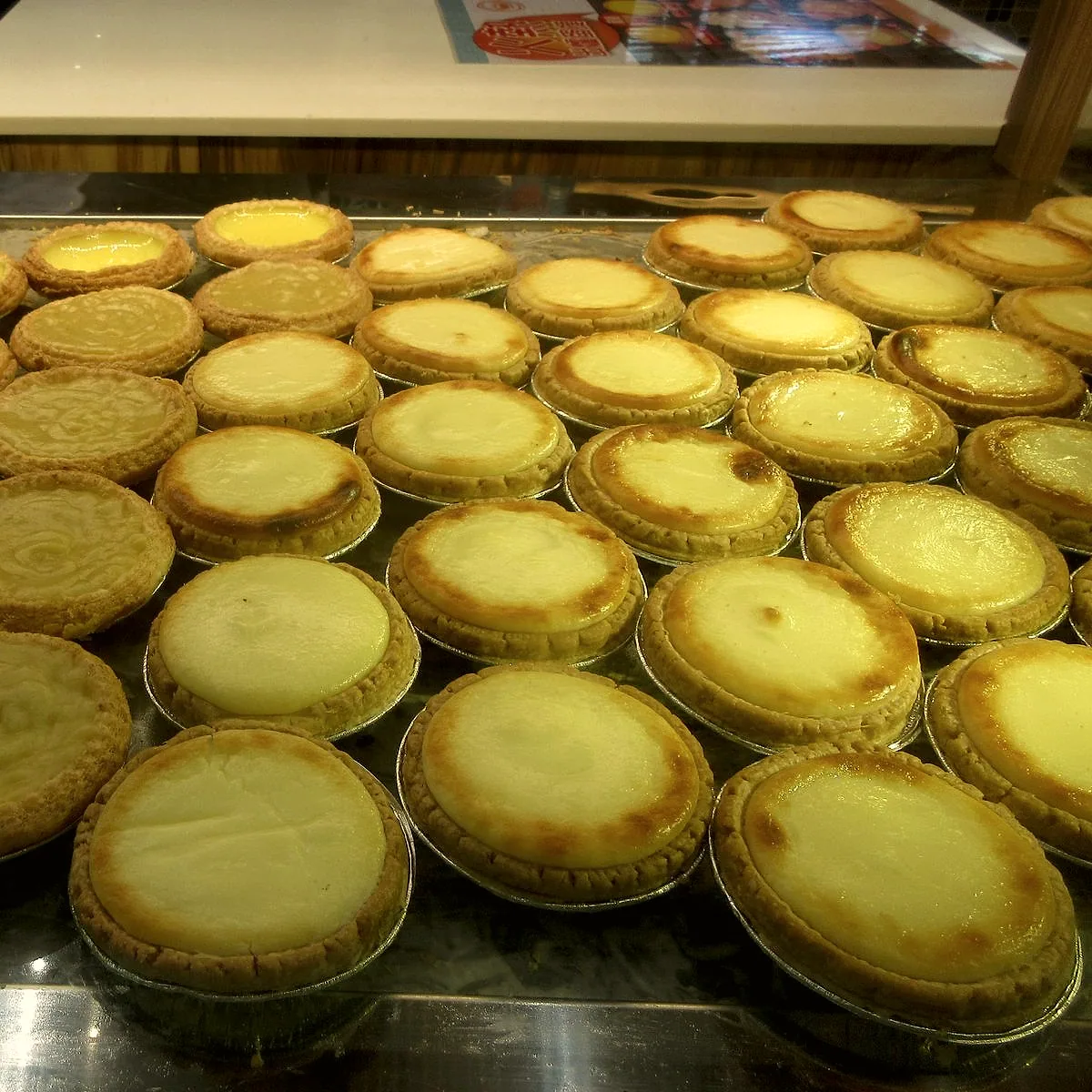

CC BY-SA 4.0. Cropped and colour-adjusted for this site.
The same dish, adapted. Every quantity, time and figure below changes with the version.
Method
Combine the 200 g plain flour, 20 g icing sugar, ½ eggs (25 g), 90 ml water and 20 g lard into a smooth dough, taking 10m.
Wrap and rest the dough in the refrigerator for 30m.
Beat the 50 g plain flour into the 100 g lard to make a soft paste. Roll the rested dough into a rectangle, spread the lard paste over two-thirds of it, and fold as if folding a letter. Roll and fold again several times, taking 20m in total, until the layers are even.
Wrap and rest the laminated dough in the refrigerator for 30m.
Roll the dough out and cut rounds to line a tart tin, pressing each round up the sides so the pastry stands slightly proud of the rim, taking 20m.
Meanwhile, dissolve the 80 g caster sugar in the 150 ml water and leave to cool. Whisk in the 4 eggs (200 g), 60 ml evaporated milk and 4 ml vanilla extract, then strain through a fine sieve, taking 10m.
Dissolving the sugar in hot water and letting it cool before it meets the egg, rather than beating sugar directly into the egg, keeps the mixture from trapping air; a frothy custard bakes with a pitted, bubbled surface instead of the smooth, glassy top this tart is judged on.
Pour the custard into the lined tart cases, filling almost to the rim. Bake at 220 °C for the first part of 22m, then lower the heat to 160 °C for the remainder, until the pastry is golden and the custard is just set with a faint wobble at the centre.
Common pitfallAn oven left too hot throughout puffs and cracks the custard's surface. Baking hot to set the pastry and then dropping the temperature is what keeps the custard smooth rather than curdled.
Method
Rub the 110 g unsalted butter into the 220 g plain flour and 60 g icing sugar until the mixture looks like coarse crumbs, taking 10m.
Common pitfallButter worked until fully smooth rather than left in small flecks gives a dense, biscuit-like shell instead of the short, sandy crumb this pastry is meant to have.
Add the ½ eggs (25 g) and bring together into a smooth dough without overworking it, taking 5m.
Wrap and rest the dough in the refrigerator for 30m.
Press the dough into a tart tin in a thin, even layer, taking 15m.
Meanwhile, dissolve the 80 g caster sugar in the 150 ml water and leave to cool. Whisk in the 4 eggs (200 g), 60 ml evaporated milk and 4 ml vanilla extract, then strain through a fine sieve, taking 10m.
Pour the custard into the lined tart cases, filling almost to the rim. Bake at 220 °C for the first part of 22m, then lower the heat to 160 °C for the remainder, until the pastry is golden and the custard is just set with a faint wobble at the centre.
The Cantonese egg tart is a hybrid from the start. It developed in Guangzhou in the early twentieth century, when the city's status as China's one treaty port open to European traders put its bakers in direct contact with British custard tarts and, by way of neighbouring Macau, Portuguese egg pastries; department-store pastry chefs are credited with combining the two into a Cantonese version by the 1920s [1] [3]. The tart reached Hong Kong after the Second World War, carried by Cantonese families who settled there, at first as a treat served in Western-style restaurants before spreading into dim sum service and, later, into cafés serving ordinary diners [3] [1].
That older, shortcrust or laminated-pastry dan tat is regularly confused with a second, unrelated tart: the caramelised, blistered-top "Portuguese egg tart" now sold across Macau and much of Asia. That version is not, in fact, an older import that Hong Kong's tart derived from; it was invented in Macau in 1989, more than sixty years after the Cantonese original, by Andrew Stow, an English pharmacist who built his own recipe around a family custard rather than any historical Portuguese formula, and Macau's community coined a separate name, "Portuguese egg tart," specifically to mark it as different from the dan tat already established there [2]. The two tarts now sit side by side in Cantonese bakeries, similar enough in shape to be mistaken for variations on one dish and different enough in origin, pastry and filling to really be two.
Sources
- Egg tart, WikipediaOn the Guangzhou department-store origin in the early twentieth century, the 1927 Zhen Guang Restaurant reference, its spread to Hong Kong in the 1940s, and 2014 recognition on Hong Kong's Intangible Cultural Heritage Inventory.
- The Surprising Origin of Macau's Portuguese Egg Tarts, Taipei TimesOn Andrew Stow, the English pharmacist who created the separate Macau "Portuguese egg tart" in 1989, and how it differs from the older Cantonese dan tat.
- The Globetrotting History of the Legendary Egg Tart, MONTECRISTO MagazineOn British businessmen bringing the custard tart to 1920s Guangzhou, its adaptation into the Cantonese daan tat, and its postwar move to Hong Kong.