American · Breakfast · Dessert
Cinnamon Rolls
A yeasted dough rolled around butter, brown sugar and cinnamon, cut into spirals and finished with cream cheese frosting. One serving is one roll.
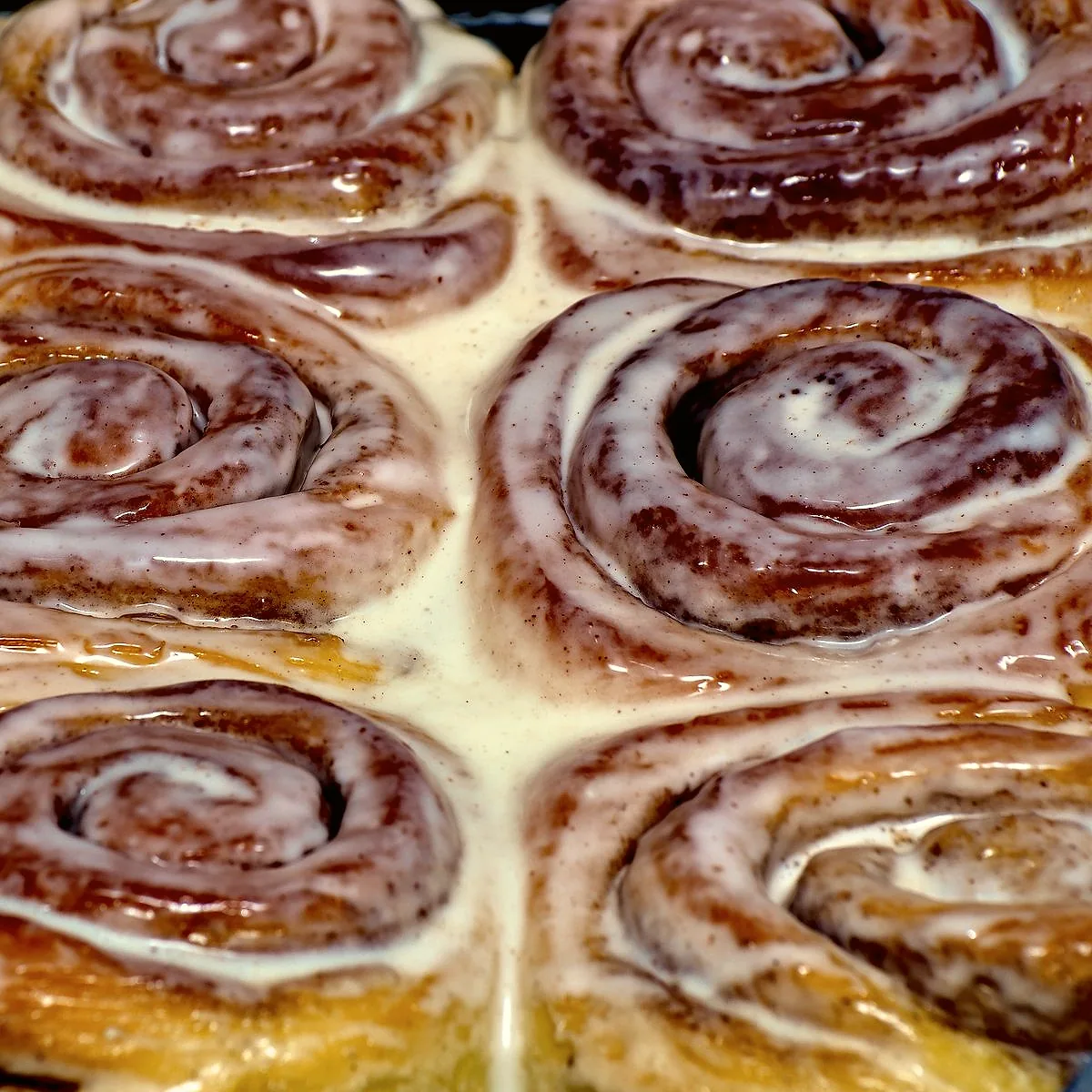

CC BY 4.0. Cropped and colour-adjusted for this site.
Method
Stir the 7 g dried yeast and the 50 g caster sugar into the warm 250 ml milk and leave until foamy. Beat in the 2 eggs (100 g) and the 60 g unsalted butter, then add the 500 g plain flour and the 6 g fine sea salt and bring together into a shaggy dough over 8m.
Knead the dough on a lightly floured surface for 8m, until smooth and elastic.
Put the dough in an oiled bowl, cover, and leave it to rise somewhere warm for 1h 15m, until doubled in size.
While the dough proves, beat the 60 g unsalted butter with the 150 g light brown sugar and the 10 g ground cinnamon into a spreadable paste, which takes 3m.
Turn the risen dough out and roll it into a large rectangle. Spread the filling evenly over it, leaving one long edge bare, spending 10m on an even layer right to the other three edges. Roll the dough up tightly toward the bare edge, finishing with the seam underneath.
Spreading the filling to the very edges except for one bare strip is what lets the final seam seal; a border left dry everywhere else would leave the roll unable to hold its spiral shut in the oven.
Slide a length of thread under the log, cross the ends over the top and pull to slice through cleanly, working along the log to cut even rolls over 8m. Arrange the rolls cut-side up in a buttered baking dish, leaving a little space between them to expand.
Common pitfallSawing through the rolled log squashes the spiral flat. A length of unflavoured thread or floss, pulled through and crossed over itself, cuts a clean disc where a knife would not.
Cover the dish and leave the rolls to prove again for 40m, until visibly puffed and touching one another.
Bake at 180 °C for 22m, until golden on top and cooked through in the centre.
While the rolls bake, beat the 100 g cream cheese with the 30 g unsalted butter, the 150 g icing sugar and the 5 ml vanilla extract until smooth, over 5m. Spread it over the rolls while they are still warm, so it melts slightly into the top.
The rolled, spiced sweet bun eaten across the United States today did not start there. The earliest recorded recipes resembling a cinnamon roll come from Germany in the sixteenth century, from where the idea spread north into Scandinavia [1]. The specific form now most closely associated with the dish in Sweden (a soft yeasted dough, rolled around cinnamon and sugar, cut into spirals) took shape only after the First World War: wartime restrictions on imported sugar, eggs and butter had kept it off Swedish tables, and cinnamon buns began appearing in cafés and bakeries once those restrictions lifted in the 1920s, where the bun became known as the kanelbulle [2].
German immigrants carried their own version of the rolled cinnamon bun to the United States well before the Swedish kanelbulle had taken its now-familiar shape, so the American cinnamon roll's ancestry runs through Germany rather than through Sweden directly [1]. Sweden still marks the bun's place in its food culture directly, though more recently than the bun itself: Sweden's Home Baking Council created a dedicated Cinnamon Bun Day, held each October, in 1999 [2].
The American chain Cinnabon, founded in 1985, is often assumed to have invented the cinnamon roll outright. It did not: the roll it sells is a late, heavily sweetened descendant of a bun with several centuries and at least two countries behind it already [1].
Sources
- Cinnamon roll, WikipediaOn the earliest recorded cinnamon-roll recipes in sixteenth-century Germany and their spread to Scandinavia.
- Cinnamon Bun Day: Six sticky facts about Sweden's beloved bun, The Local SwedenOn the kanelbulle's emergence in Swedish cafés in the 1920s after wartime import restrictions lifted, and the 1999 origin of Cinnamon Bun Day.