Filipino · Main Course
Chicken Inasal
Chicken marinated in vinegar, calamansi and lemongrass, grilled over coals and basted orange-red with annatto oil.
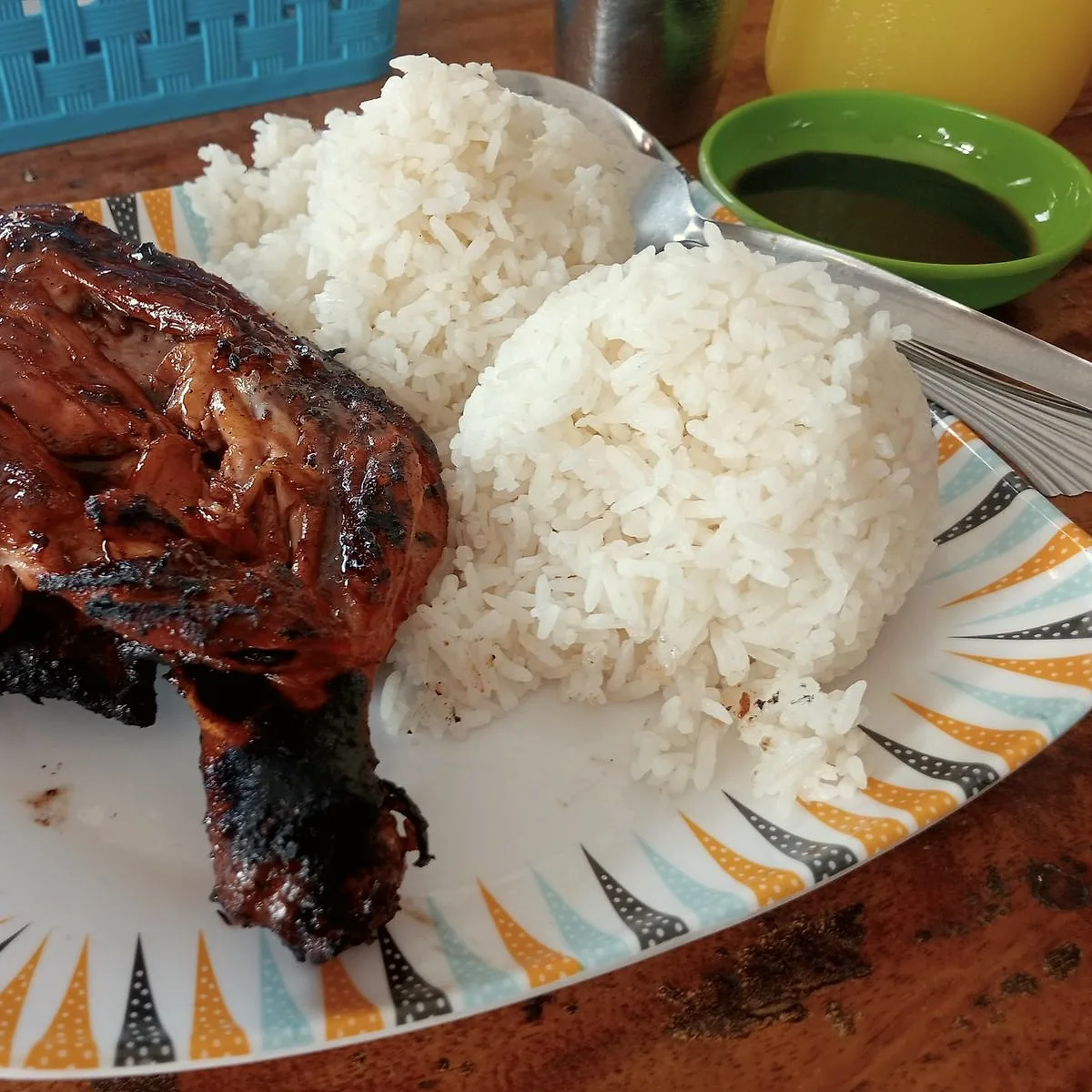

CC BY-SA 4.0. Cropped and colour-adjusted for this site.
Method
Combine the 4 calamansi (60 g), 45 ml cane vinegar, 30 g lemongrass, 4 garlic cloves (20 g), 3 g ground black pepper and 5 g fine sea salt in a bowl and turn the 900 g bone-in, skin-on chicken through it, coating every piece, for 10m.
Cover and marinate in the refrigerator for 2h.
Meanwhile, warm the 60 ml vegetable oil with the 6 g achiote over a low heat for 5m, until the oil turns deep orange, then strain out the seeds.
The annatto is warmed gently in oil rather than added raw, which draws its colour out into the oil so basting tints the chicken's skin as it grills instead of leaving the seeds' colour behind on the surface.
Lift the chicken from the marinade and grill over hot coals for 25m, turning and basting repeatedly with the annatto oil, until the skin is deeply coloured and the chicken is cooked through.
Common pitfallBasting only once leaves pale patches where the marinade never reaches. Repeated basting through the whole grilling time is what gives the skin its even, deep colour.
The name is a Hiligaynon word for a method rather than a dish: inasal means to grill or roast over live coals [2]. Grilling over coals in Iloilo predates the dish's modern Bacolod branding by decades: the Filipino photographer Félix Laureano's 1895 album of Iloilo and Panay daily life, Recuerdos de Filipinas, is the earliest surviving photographic record of the region's markets and daily customs [3].
Which of the two Western Visayas cities the dish properly belongs to is still argued rather than settled. Wikipedia's own account credits Bacolod's version to Banoy Velez, who is said to have brought it to the city from Oton, near Iloilo, in 1946. Bacolod's inasal reads as a touch more sour, Iloilo's as sweeter, and Iloilo has its own claim to having originated the dish first [1] [2]. Bacolod's version became a citywide fixture along Cuadra Street, later renamed Manokan Country, or "Chicken Alley," a strip of open-air grills built entirely around the dish [2].
That regional identity was made official only recently: in 2022, Bacolod City passed a local ordinance recognising chicken inasal as an important cultural property of the city, formalising an association that had built up over decades of Manokan Country grills rather than resolving the older dispute with Iloilo [2].
What both cities agree on is the method: chicken marinated in vinegar, calamansi juice and garlic, then grilled over coals while repeatedly basted with oil coloured deep orange by annatto, which is what gives the finished chicken its distinctive colour rather than any chilli or paprika [1] [2].
Sources
- Chicken inasal, WikipediaGives an 1895 photographic record from Iloilo, the Bacolod-Iloilo history (including Banoy Velez bringing the dish from Oton, Iloilo to Bacolod in 1946), and the standard marinade and basting method.
- Chicken inasal: A culinary journey from Bacolod, SunStarRegional Philippine newspaper coverage of the Hiligaynon etymology, the Bacolod claim, Manokan Country, and the 2022 cultural-heritage ordinance.
- Recuerdos de Filipinas — Memories of the Philippines, Villanova University, Falvey LibraryDescribes Félix Laureano's 1895 photograph album of Iloilo and Panay life, the earliest surviving photographic record of the region's daily customs and markets.