Balkan · Main Course
Ćevapi
Small, hand-rolled skinless sausages of seasoned beef and lamb mince, grilled hot and fast and stuffed into warm flatbread with raw onion.
Also known asĆevapčići · Bosnia and Herzegovina
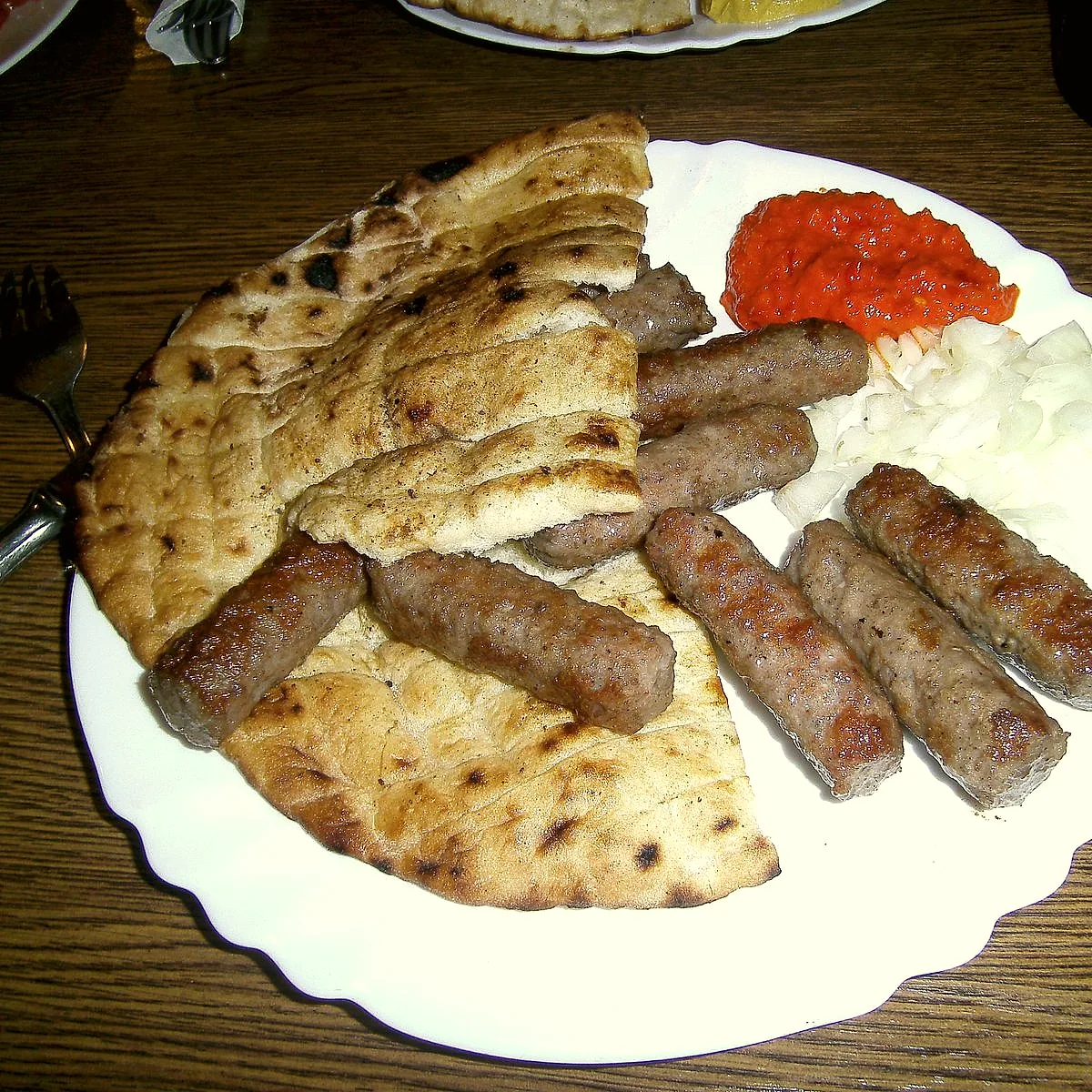
.jpg)
CC BY 2.0. Cropped and colour-adjusted for this site.
Method
Combine the 400 g beef mince, 200 g lamb mince, 2 garlic cloves (10 g), 9 g fine sea salt, 2 g ground black pepper, 3 g bicarbonate of soda and the 30 ml water in a large bowl. Mix by hand for 10m, until sticky and well combined.
Cover and refrigerate the mixture for 4h, so it firms up and the bicarbonate of soda has time to work.
The rest lets the bicarbonate of soda raise the mixture's pH and work into the proteins, which is what gives ćevapi their characteristic springy, slightly bouncy bite rather than a dense, crumbly one.
With cold, wet hands, roll the mixture into short, finger-thick lengths, working for 15m and keeping the mixture cold throughout.
Common pitfallHandled too warm or too long, the fat in the mince starts to smear rather than stay distinct, and the ćevapi lose their light, open texture on the grill. Keep the mixture and your hands cold while shaping.
Grill the ćevapi over high, direct heat, turning regularly, for 10m, until well charred outside and cooked through.
Split open the warm 320 g pita bread and tuck the grilled ćevapi inside, scattering over the diced 100 g white onion and spooning over the 60 g clotted cream. This takes 5m.
Ćevapi are told, often, as an Ottoman-era survival: small skewers or logs of seasoned minced meat said to descend directly from Turkish köfte, carried into the Balkans by the Ottomans and adapted along the way; ćevapčići is itself a diminutive of the Turkish kebap, in turn from Arabic kabāb [1][2]. A more specific and more romantic version of that story credits hajduks, the outlaw rebels of Ottoman-ruled Bosnia, with a precursor dish grilled over an open fire. It is a claim the documentary record does not support.
Researching the dish's history in the Dubrovnik archives, Bosnian Franciscan chronicles and other period sources, the historians Slavojka Beštić-Bronza and Boro Bronza were able to reconstruct Bosnian eating habits up through the end of the nineteenth century, and found no trace of ćevapi in any of it. No mention of a ćevapi vendor in Bosnia appears before 1900, and the dish is missing from Belgrade's record too until well into the second half of the nineteenth century [2][1]. The historians point instead to 1878, when the southern Serbian town of Leskovac, already known for grilling minced meat, was annexed into the Principality of Serbia, as the pivotal year for the dish's spread; in the 1880s and 1890s, migrants from the newly annexed south filled Belgrade and opened grill taverns there, the moment at which the minced-meat grill became attached to Serbian cooking [2]. The hajduk story, in other words, looks like exactly the kind of folk backdating that turns a nineteenth-century urban food into something that sounds older and more defiant than the evidence allows.
What is well documented is what happened afterward. The writer Branislav Nušić was already describing ćevapi as a Yugoslav national dish by the 1920s, and the dish spread west with the creation of Yugoslavia, taking firm root in Bosnia and reaching as far as Maribor, where the first recorded ćevapi grill-house opened in 1933 [2]. It became, and remains, the everyday food of Bosnian cities in particular, sold from dedicated grill-houses each guarding its own recipe.
Sources
- Ćevapi, WikipediaSummarises Beštić-Bronza and Bronza's research, the absence of ćevapi from medieval and early Ottoman sources, the hajduk legend resting on no contemporary evidence, and the term's appearance in records from the 1850s onward.
- Ćevapi nemaju veze s Bosnom i još nekoliko razotkrivajućih istina o socijalističkoj gastronomiji, Jutarnji list, 2019Croatian daily's report on Beštić-Bronza and Bronza's chapter, describing their search of Dubrovnik archives and Franciscan chronicles, the absence of any ćevabdžija in Bosnia before 1900, the 1878 Leskovac dissemination, and the dish's spread to Belgrade, Bosnia and Maribor.