Canadian · Dessert
Butter Tarts
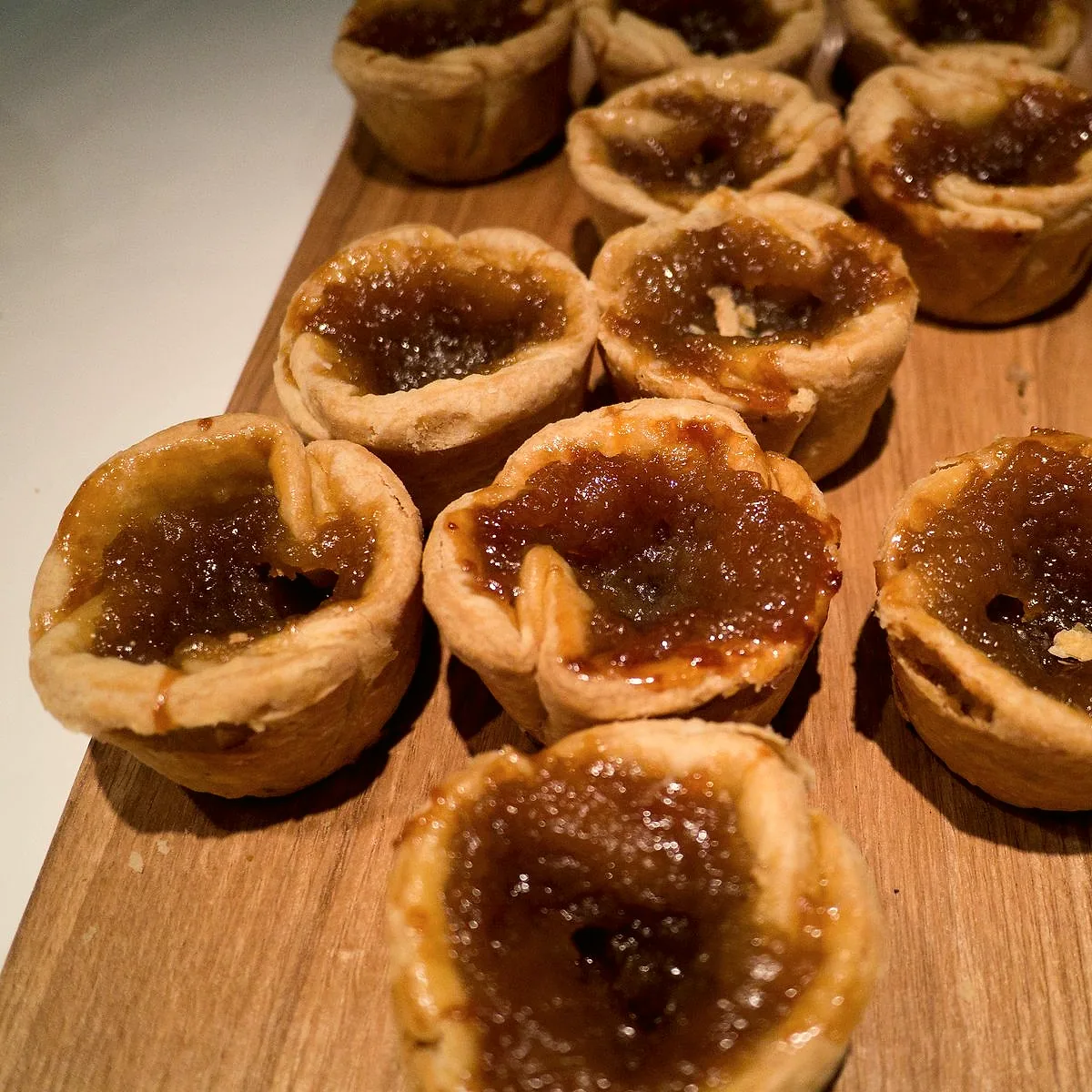
Small lard pastry shells filled with a runny brown sugar and butter custard, baked until the edges are set and the centre still wobbles.
Not the same asPecan pie (A related American dessert with a similar sugar-and-egg filling, baked as one large pie and packed with pecans; butter tarts are individual tarts with a runnier filling, often with raisins.)
.jpg)
CC BY 2.0. Cropped and colour-adjusted for this site.
Method
Rub the 80 g lard and the 40 g unsalted butter into the 250 g plain flour and the 3 g fine sea salt until the mixture looks like coarse crumbs, then mix in the 60 g water just until the dough comes together.
Chill the pastry for 30m.
Roll the pastry thin and cut rounds to line the cups of a muffin tin, pressing them in gently.
Whisk the 60 g unsalted butter, the 150 g light brown sugar, the 120 g light corn syrup, the 2 eggs (100 g) and the 5 g vanilla extract together until smooth.
Scatter a few 100 g raisins into each pastry shell and pour over the filling, leaving a small gap below the rim.
Common pitfallFilling the shells too close to the rim lets the filling boil over and glue the tarts into the tin as they bake. Leaving a visible gap below the rim keeps the bubbling filling inside the shell.
Bake at 200 °C for 18m, until the pastry is golden and the filling has puffed at the edges but still wobbles gently in the centre.
Pulling the tarts while the centre still wobbles is what keeps the filling runny rather than set solid; carryover heat firms the edges further as they cool, and a fully set centre in the oven means an overbaked, candy-hard tart once cold.
Cool in the tin for 20m before lifting out.
The oldest butter tart recipe anyone has produced is dated and precise: it appears in The Women's Auxiliary of the Royal Victoria Hospital Cookbook, published in Barrie, Ontario, in 1900, submitted by a Mrs Malcolm MacLeod and calling for nothing more than a cup of sugar, half a cup of butter, two eggs and a cup of currants [1][2]. What came before that recipe is genuinely unresolved. One theory traces the tart to "border tarts," a dried-fruit pastry carried to Ontario by Scottish and English settlers from the Anglo-Scottish border region; a second traces it to tarte au sucre, a sugar pie possibly introduced generations earlier by French women who settled in Quebec in the 1600s, and adapted over time with local maple syrup, butter and dried fruit [1][2]. Neither theory has documentary proof strong enough to settle the question, and a museum account of the dish puts it about as plainly as the evidence allows: butter tarts "seem to have been invented in Canada, although the exact origin is unknown" [2].
What is not in dispute is how quickly the tart spread once it reached print. Further recipes appeared through the following decades (a pie cookbook in 1915, wider newspaper and farm-cookbook circulation soon after), and the tart had become genuinely popular across the country by the 1920s and 1930s [1][2]. It has since been claimed as a specifically Canadian pastry rather than a borrowed one, formal enough in that status to have been one of five desserts on a Canada Post commemorative stamp set released in April 2019 [1][3], a symbolic honour that rather overstates how settled its own history actually is.
Sources
- Butter tart, WikipediaOn the 1900 Barrie, Ontario cookbook recipe, the competing "border tart" and filles du roi sugar-pie theories, and the tart's later status as a symbol of Canadian identity.
- Butter Tarts, Sidney Museum and ArchivesOn the two rival origin theories and the exact wording of the 1900 Mrs Malcolm MacLeod recipe.
- 'Sweet Canada' Stamps Serve Up Traditional Canadian Desserts, Canadian Stamp NewsOn the Canada Post "Sweet Canada" stamp set of April 2019, which included the butter tart alongside four other Canadian desserts.