American · Breakfast · Snack
Banana Bread
A butter-creamed quick bread leavened with bicarbonate rather than yeast, built around bananas ripened well past eating.
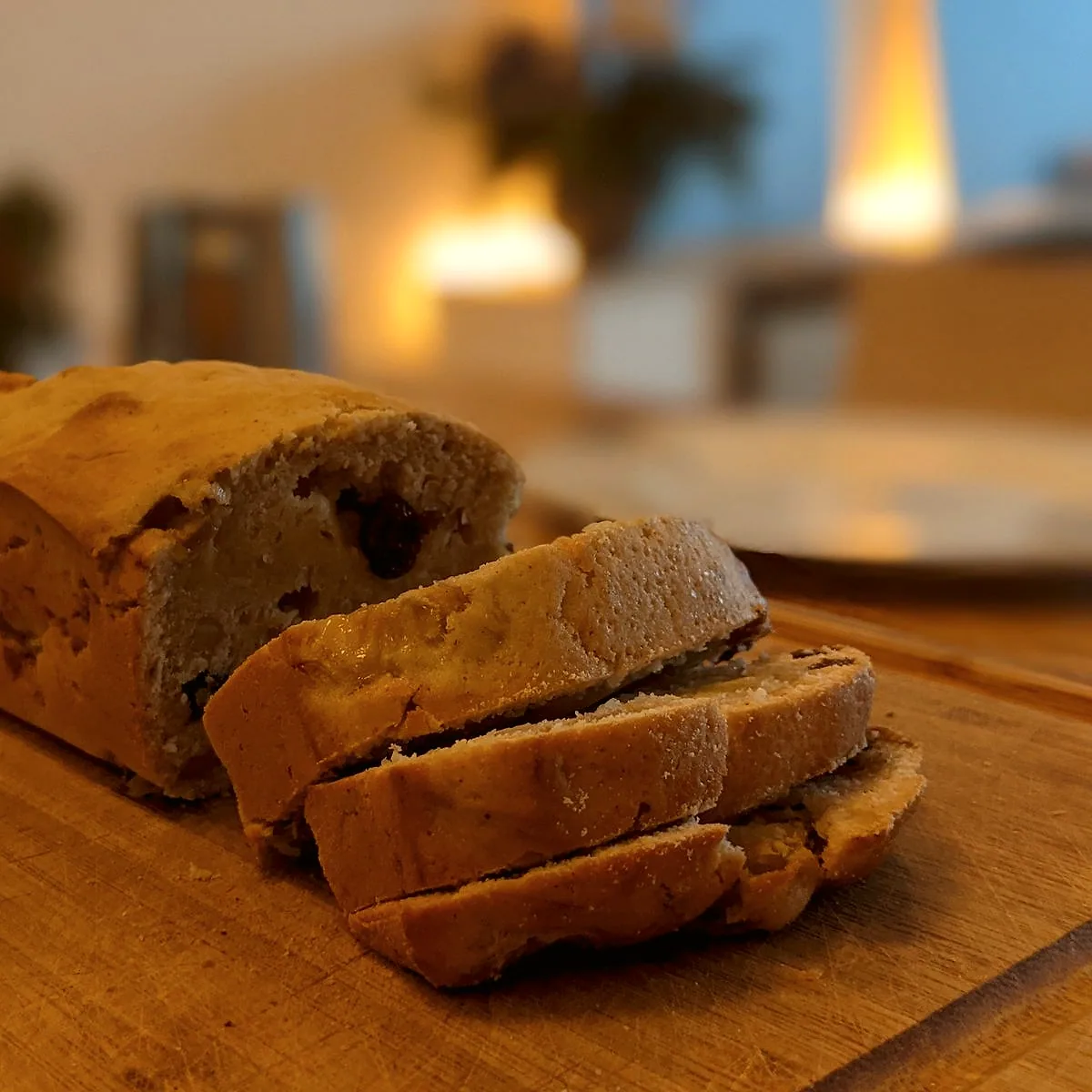

CC BY 4.0. Cropped and colour-adjusted for this site.
Method
Beat the 115 g unsalted butter with the 200 g light brown sugar for 4m, until pale and fluffy.
Creaming butter and sugar is the only aeration this batter gets before the bicarbonate takes over; there is no whisked egg foam or separately beaten white to lean on.
Beat in the 2 eggs (100 g) and the 8 ml vanilla extract, taking 2m and stopping as soon as the mixture looks smooth again.
Stir the 350 g banana through, using 2m. A few small lumps left in the mash are no fault; they turn to soft pockets in the baked loaf.
Sift the 280 g plain flour together with the 4 g baking powder, the 5 g bicarbonate of soda and the 4 g fine sea salt, and fold them into the banana mixture with the 100 g chopped walnuts over 3m, stopping the moment no dry flour is visible.
Common pitfallOverworking the batter once the flour goes in develops gluten that a quick bread has no use for, giving a tough, tunnelled crumb instead of a tender one.
Meanwhile heat the oven to 170 °C, allowing 15m for it to settle, and butter and line a loaf tin.
Turn the batter into the tin and bake for 1h, until a skewer pushed into the centre comes out clean and the top has split along its length.
Leave the loaf in its tin for 15m before turning it out onto a rack, where the crumb finishes setting as it cools the rest of the way.
Banana bread belongs to a category of baking, the quick breads, that did not exist in its modern form until chemical leavening did. Baking powder reached American grocery shelves in quantity only in the early 1930s, and it was that availability, rather than any single inventor, that let bakers raise a batter with bicarbonate and acid instead of waiting on yeast [1][2]. Recipes for banana bread proper follow closely behind: it "began to gain popularity in the early 1930s" once the technique was available to home cooks [2].
Why bananas specifically is less settled than the loaf's now-fixed place in home baking suggests. One account ties the recipe to the Great Depression, when households facing real scarcity found a use for bananas already too ripe to eat out of hand, whose sugar stood in for some of the sugar a recipe would otherwise need [1][2]. A competing explanation credits the flour and baking-soda producers of the period with promoting the recipe as a way to move their own products, which would make the bread's association with thrift a matter of marketing rather than necessity [1]. The two accounts are not easily reconciled from the record that survives, and the bread's popularity was in any case not new: a banana bread was already being sold in Lawrence, Kansas, as early as January 1881, decades before baking powder made the quick-bread version possible [1].
The recipe kept changing well after its first popularity. Loaves grown plainer after the Second World War, with fewer additions, before brown sugar and whole-wheat flour became common again from the 1960s [2], a reminder that "banana bread" has named a moving target for most of its history rather than one fixed recipe.
Sources
- Banana bread, WikipediaOn the 1930s spread of baking powder into grocery stores, the debate over Depression-era thrift versus corporate promotion as the recipe's driver, and the earliest documented sale of banana bread in 1881.
- The Quest for the Perfect Loaf: An Investigation into the Creation of Banana Bread, Food-Fueled, American UniversityOn baking powder reaching grocery stores in the early 1930s, the Depression-era case for using up overripe bananas, and later changes to the recipe after the Second World War.