Central American · Snack · Breakfast
Baleadas
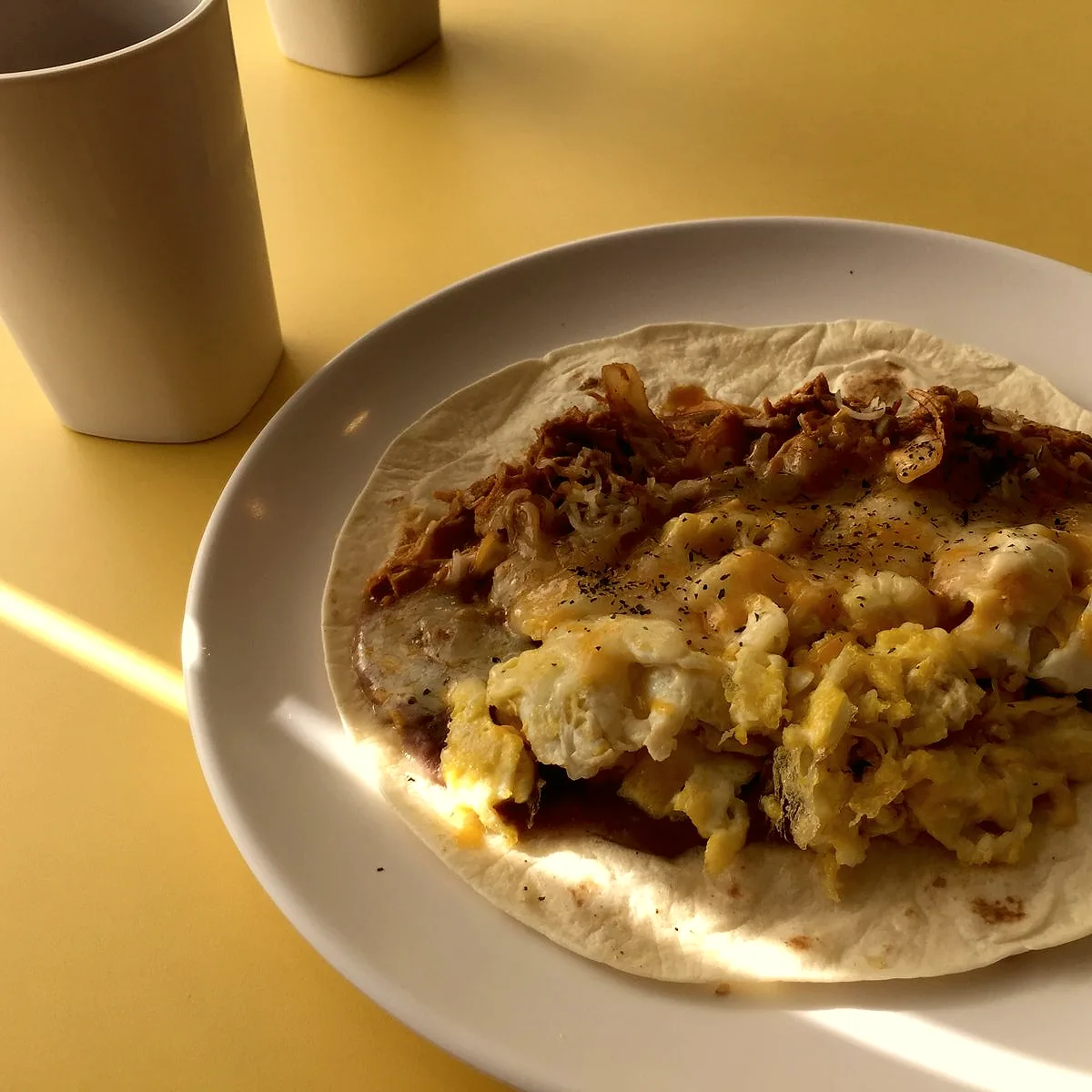
A thick flour tortilla folded around mashed red beans, crumbled queso fresco and crema. Honduras's everyday street food, one tortilla to a serving.
.jpg)
CC BY-SA 2.0. Cropped and colour-adjusted for this site.
Method
Soak the 150 g dried kidney beans in plenty of cold water for 8h, then drain.
Simmer the soaked beans in the 600 ml water for 50m, until completely soft.
Drain the beans, reserving a little of the cooking liquid, and mash them with the 20 ml vegetable oil and 4 g fine sea salt in a pan over a medium heat, adding a splash of the reserved liquid as needed, until they form a thick, smooth paste. This takes about 10m.
Common pitfallMashing the beans while they are still wet from cooking, rather than letting most of the liquid cook away first, leaves the filling too loose to hold inside a folded tortilla.
Warm the 8 flour tortillas (320 g) on a dry, hot griddle or pan for 5m, until soft and lightly speckled.
Spread the mashed beans over half of each warm tortilla, scatter with the 120 g queso fresco and spoon over the 80 g cultured soured cream, then fold in half. This takes about 5m.
Unlike most dishes on this site, the baleada has a founding story with a name, a place and a date attached to it, rather than one lost to generations of home cooks. It is credited to Doña Tere, a single mother running a food stand near the railway that carried workers to the Standard Fruit Company's banana plantations in La Ceiba, on Honduras's northern coast, around 1964 [1] [2]. She is said to have folded flour tortillas around mashed beans and cheese to feed plantation and railway workers passing her stand.
Even a dish this recently invented has more than one story attached to its name. "Baleada" plays on bala, Spanish for bullet, and Doña Tere's own account frames it as a joke: the beans are the bullets, the cheese is the gunpowder, and the tortilla is the cartridge that holds them [1] [2]. A second story circulating in La Ceiba instead holds that a vendor selling the dish survived a shooting and kept working, and that the dish took her name from the incident. This is a grimmer account that both sources treat as unconfirmed local legend rather than established fact [1] [2].
The flour tortilla itself marks the dish as a product of the Caribbean coast rather than Honduras's interior, where maize tortillas are the norm; wheat flour reached La Ceiba through the same banana-trade infrastructure that built the railway Doña Tere's stand stood beside.
Sources
- Cooking Heritage: The cryptic origin of Honduran baleadas, WSAV-TVStates Doña Tere's 1964 food stand near the Standard Fruit Company railway in La Ceiba, her own bullets-gunpowder-cartridge naming account, and a second, unverified story of a vendor who survived a shooting.
- Conoce la historia de las baleadas, una comida hondureña que lleva municiones en su nombre, Nuestro StoriesIndependently corroborates Doña Tere as a young single mother in La Ceiba credited with inventing the baleada, her beans-bullets/cheese-gunpowder/tortilla-cartridge naming account, and presents the rival shooting-incident story explicitly as unconfirmed urban culinary legend.