Decoding Nature's Legacy (1833-1902)
Ebonite (Vulcanite)
The Black Gold
In May 1851, six million people (a third of the population of Britain) filed through Joseph Paxton’s Crystal Palace in Hyde Park to see the Great Exhibition of the Works of Industry of All Nations, a glass-and-iron building large enough to enclose the mature elm trees already standing on the site. Among the thousands of exhibitors competing for attention with steam hammers and hydraulic presses, one American had borrowed heavily to build something stranger: a complete suite of rooms (walls, furniture, musical instruments, six-foot balloons) fashioned entirely out of hardened rubber. Charles Goodyear called it his Vulcanite Court, and by the time it closed he had won six medals and very little of his money back.
Plates I & II
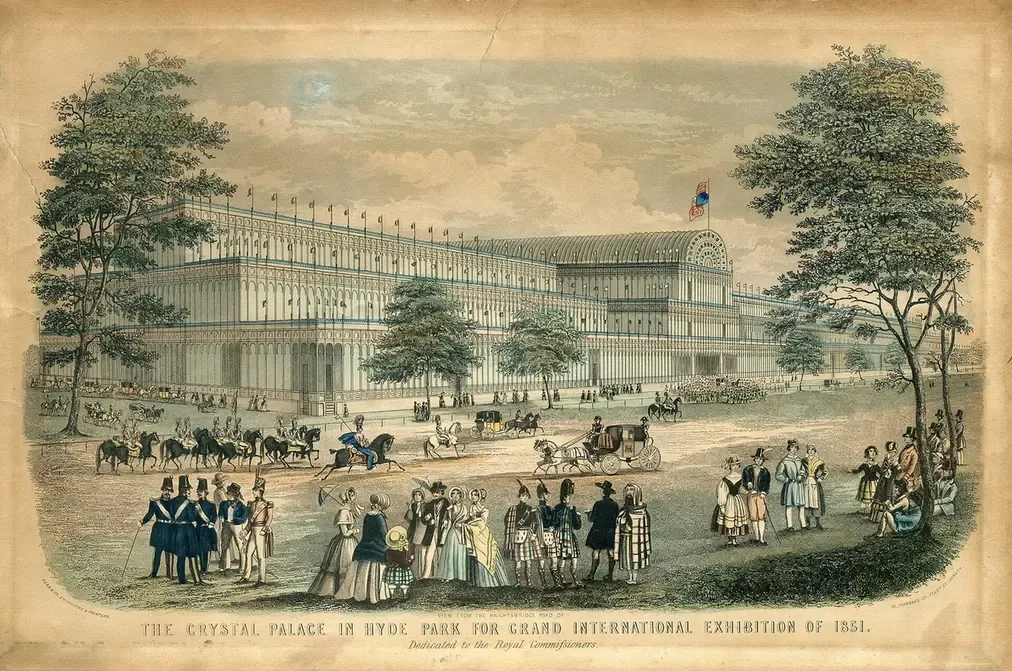

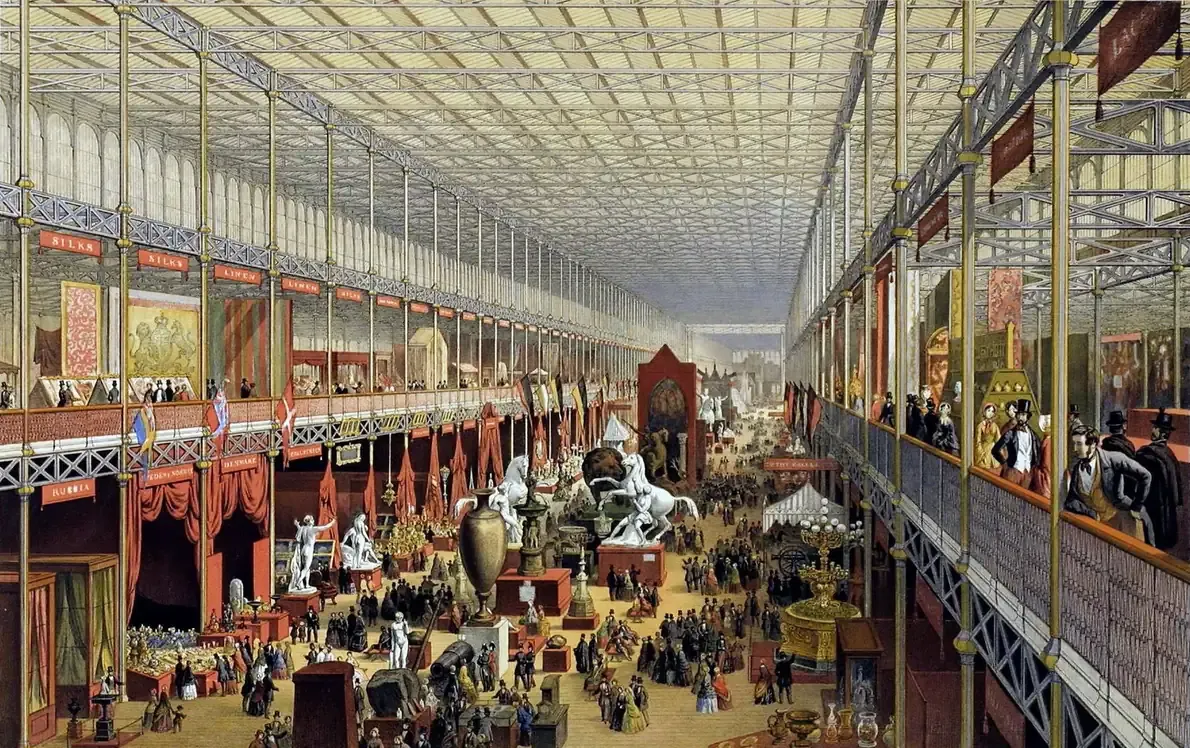

The timing was not entirely a coincidence. Days after the Exhibition opened, on 6 May 1851, Charles’s younger brother Nelson Goodyear was granted a United States patent of his own: not for the flexible, sulfur-cured rubber Charles had stumbled onto in 1839, but for something closer to its opposite.
When Too Much of a Good Thing Became Great
Charles’s process added a small amount of sulfur (a few percent) to keep rubber elastic across a wider range of temperatures. Nelson pushed the same reaction hard past that point: somewhere between roughly a quarter and half of the mixture’s weight in sulfur, cured under heat for hours rather than minutes. The result was not a better rubber but a different material altogether: hard, dense, and capable of taking a polish, closer in feel to ebony or horn than to anything that had come out of a rubber vat before. Contemporaries called it hard rubber, or vulcanite; the name ebonite, evoking the ebony wood it was bought to imitate, did not arrive until 1864, coined by the English rubber manufacturer Hugh Silver.
A Network, Not a Chain
Ordinary vulcanized rubber keeps the long-range elasticity of natural rubber because its occasional sulfur bridges are sparse: roughly one for every hundred isoprene units, just enough to stop permanent creep without stopping the chains from stretching. Push the sulfur content up toward a third or more of the total weight, as Nelson Goodyear’s recipe did, and that arithmetic changes completely: there are now enough crosslinks that very little of any given chain is more than a few units from a bridge to its neighbour. The material stops behaving like a rubber at all, because there is no longer enough uncrosslinked chain left between junctions to do the stretching an elastomer depends on. What remains is a single, densely interlocked three-dimensional network of carbon and sulfur; it is conceptually much closer to a rigid thermoset resin than to the rubber it was made from, which is why, unlike its softer sibling, its structure resists being drawn as a simple repeating chain at all.
What the Material Actually Does
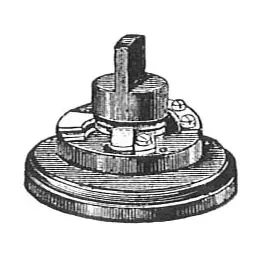
Ebonite is noticeably heavier than the rubber it is cured from and dense enough to sink rather than float, a simple consequence of packing that much sulfur into the network. It stays rigid at ordinary room temperature; unlike a soft vulcanizate, which stays rubbery well below freezing, ebonite only softens once warmed to somewhere close to the temperature of a hot drink, and it does not have a melting point so much as a scorching one: pushed hot enough, it chars and decomposes rather than flowing. That same rigidity is a double-edged trait: ebonite can be turned on a lathe, cut, drilled and polished to a shine the way ivory or horn can, which is exactly why the Victorians reached for it in place of both, but it takes a sharp blow badly, cracking rather than denting where a softer rubber would simply absorb the impact. Its resistance to carrying an electric current, well short of anything quantified here but obvious enough from a century of use, is why it turns up throughout the early electrical trade wherever a live conductor needed to be kept away from a hand.
Plate III
.jpg)
Manufacturing: The Art of Hard Rubber
The process starts from the same raw natural rubber as any other vulcanizate, milled together with sulfur (typically a quarter to half the batch by weight, sometimes with zinc oxide or linseed oil worked in as filler), then cured under heat for hours rather than the minutes a soft vulcanizate needs. Too little time leaves the interior under-cured and soft; too much invites scorching. What comes out the other end can be sliced, turned and buffed like a solid block of dense, dark stock, which is precisely how most ebonite objects were actually made: not molded to shape, but machined from bar and sheet the way a woodworker or ivory turner would work.
Plate IV
Applications, and a Murder Over the Patent
Ebonite’s single most consequential application had nothing to do with electricity or jewellery. Dentures had traditionally been carved from ivory, hippopotamus tusk or salvaged human teeth; these materials were expensive enough that a full set was a luxury. A denture base molded from ebonite could be fitted to an individual patient’s mouth cheaply and precisely, and within a few years of Nelson Goodyear’s patent it had become the standard material for false teeth on both sides of the Atlantic.
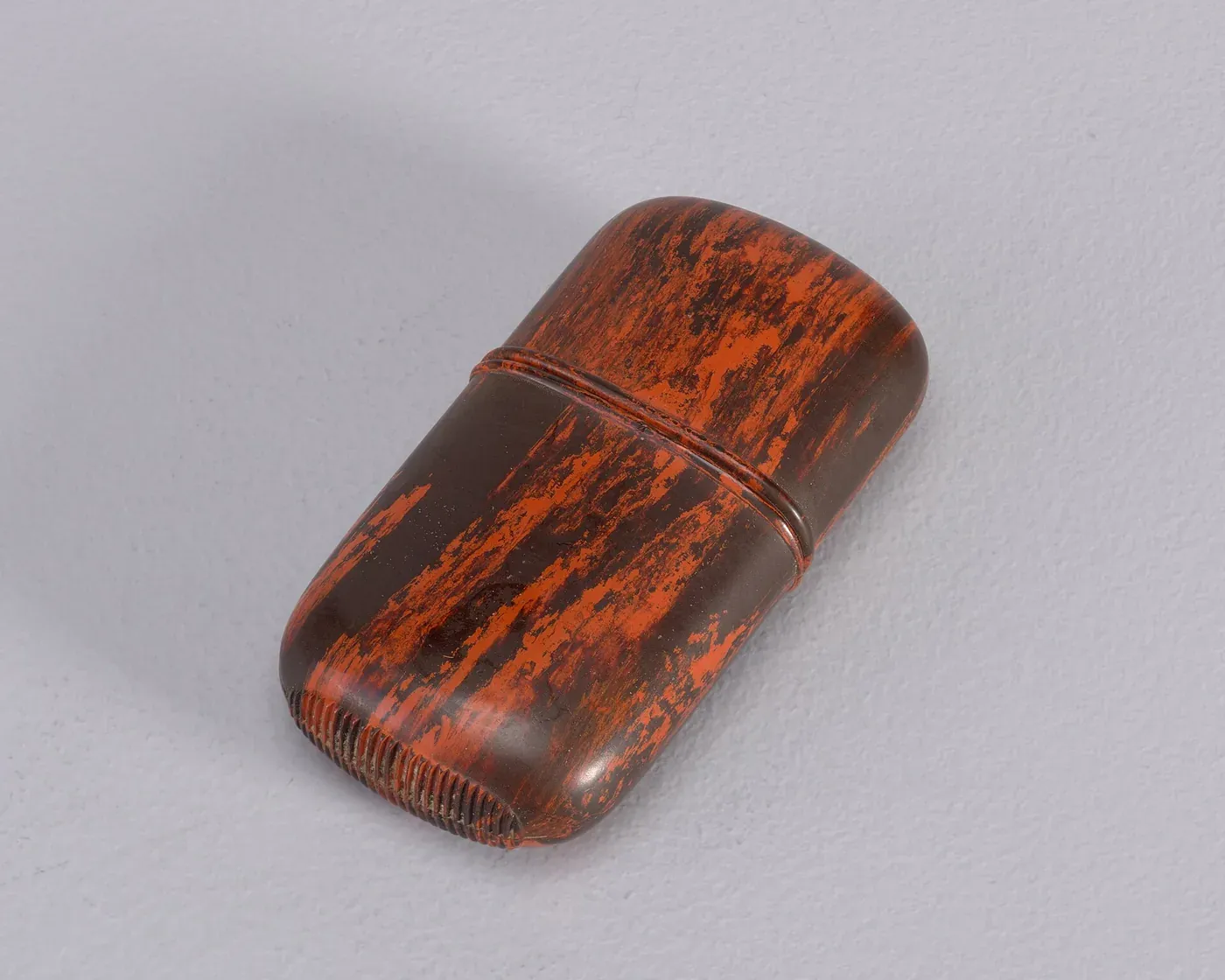
That success curdled into one of the ugliest patent disputes of the nineteenth century. The Goodyear Dental Vulcanite Company licensed the process and pursued unlicensed dentists relentlessly for over a decade, led by its treasurer, Josiah Bacon. One of the dentists Bacon had repeatedly pursued and shut down, Samuel P. Chalfant, confronted him at a San Francisco hotel in April 1879, the morning after yet another infringement conviction, and shot him dead. The patents themselves expired two years later, in 1881, ending the licensing fees at the root of the killing. Beyond dentistry, the same combination of hardness, workability and resistance to current carried ebonite into fountain pens, pipe stems, combs, battery cases and laboratory fittings, ordinary Victorian objects, made from a material invented to solve a much more specific problem.
Plate V
.jpg)
A Legacy That Lives On
Modern plastics have replaced ebonite in almost every one of those roles, but its brief run as the material of choice for hard, precise, mass-producible objects, dentures especially, previewed exactly what the twentieth century’s synthetic polymers would go on to do at far greater scale. It survives today mostly at the edges: in saxophone and clarinet mouthpieces, in a handful of fountain pens still turned from the solid rod the old way, and in physics classrooms, where a rubbed ebonite rod is still one of the standard ways to demonstrate static electricity.
values with [n] cite the numbered references·estimates are flagged·“not yet available” and “N/A” are honest states, not gaps
fetching the model…
Ebonite repeat unit
- Abbreviation
- Vulcanite
- Type
- variantpart of the vulcanized-natural-rubber family
- CAS number
- None (heterogeneous class or not assigned)
- Resin ID code
- none assigned
- Formula
- (C5H8)nThe same cis-1,4 isoprene repeat as natural rubber. Ebonite is what happens when vulcanization is pushed to its limit: 30 to 50% sulfur by weight, crosslinking so dense that the material stops being a rubber and becomes a hard, brittle solid.
- Repeat unit (BigSMILES)
{[][$]C/C(C)=C\C[$][]}- IUPAC name
- —
- Synonyms
- vulcanite; hard rubber
- Also known as
- vulcanitehard rubber
- Chemical family
- natural-rubberdiene-rubber
- Backbone class
- carbon-chain
- Polymerization mechanism
- natural-biosynthesis
- Constitutional monomer
- Isoprene
- Polymer class
- thermoset
- Year of origin
- 1851
- Era
- Decoding Nature's Legacy (1833-1902)
- Key figures
- Nelson Goodyear · Charles Goodyear
- Events referenced
- The Great Exhibition and the Crystal Palace, London (1851) · Charles Goodyear's Vulcanite Court exhibit at the Great Exhibition (1851) · Nelson Goodyear's hard-rubber patent, granted 6 May 1851 · Murder of Josiah Bacon in the vulcanite dental patent dispute (1879)
- Polymerization type
- not yet available
- Common monomers (feedstocks)
- not yet available
- Catalysts
- sulfur (25-80% by mass)
Extended, heavy sulfur vulcanization of natural rubber (25–80% sulfur, often with zinc oxide and/or linseed oil filler), pioneered by Nelson Goodyear (brother of Charles Goodyear) starting 1851. Optimal mechanical properties are reported around ~35% sulfur content, with maximum impact strength near ~30%.
- Tacticity
- cis-1,4 backbone (inherited from natural rubber), densely crosslinked via sulfur bridges.
- Crystal structure
- not yet available
- Typical crystallinity
- Not applicable
Molecular weight
- Number average (Mn)
- not yet available
- Mass average (Mw)
- not yet available
- Dispersity (Mw/Mn)
- not yet available
Mark-Houwink constants
not yet available
Rigid at room temperature due to dense sulfur crosslinking; exhibits shape-memory behavior when reheated.
- Density
- 1.15 (1.1–1.2) g/cm³[1]Varies with sulfur/filler composition.
- Melt flow index
- Not applicable
- Refractive index
- not yet available
- Transmittance
- not yet available
- Haze
- not yet available
- Gloss
- not yet available
- Water absorption
- not yet available
- Dielectric constant
- not yet available
- Dielectric strength
- not yet available
- Electrical conductivity
- not yet available
- Glass transition (Tg)
- 75 (70–80) °C[1]Reported as the softening/glass-transition range.
- Melting temperature (Tm)
- Not applicableCrosslinked thermoset; does not melt.
- Crystallization (Tc)
- Not applicable
- Heat deflection (HDT)
- not yet available
- Decomposition onset
- not yet available
- Thermal conductivity
- not yet available
- Tensile modulus
- not yet available
- Yield strength
- not yet available
- Tensile strength at break
- not yet available
- Elongation at break
- not yet available
- Impact strength (Izod)
- not yet available
- Impact strength (Charpy)
- not yet available
- Hardness
- not yet availableQualitatively rigid/brittle; no single sourced Shore number.
- Flexural modulus
- not yet available
- Poisson's ratio
- not yet available
- Coefficient of friction
- not yet available
- Weathering / UV
- not yet available
- Hydrolysis resistance
- Not applicable
- Flammability (UL94)
- not yet available
- Limiting oxygen index
- not yet available
- Solubility parameter (δ)
- not yet available
Gas permeability
not yet available
Polymer-solvent interaction parameter (χ)
not yet available
- Processing methods
- compression molding with heavy sulfur curemachining/turning (fountain pen and mouthpiece manufacture)
- Drying required
- not yet determined
- Processing temperature
- not yet available
- Shrinkage rate
- not yet available
- Writing instrumentsfountain pen bodies and components
- Musical instrumentssaxophone and clarinet mouthpieces
- Electricalhistorical battery casings · electrical insulation and plugs
- Sporting goods & educationhockey pucks · static-electricity demonstration rods
- Recyclable
- No
- Biodegradable
- No
- Degradation pathway
- not yet available
Brittleness led to replacement by modern plastics (e.g. polypropylene) in applications like battery cases.
- LD50 (oral, rat)
- not yet available
- NFPA health
- not yet available
- NFPA flammability
- not yet available
- NFPA reactivity
- not yet available
- Carcinogenic classification
- not yet available
- [1]EboniteWikipediaAccessed 2026-07-14https://en.wikipedia.org/wiki/Ebonite[wiki-ebonite]
Illustrations
- Plate IThe Crystal Palace in Hyde Park, built to house the Great Exhibition of 1851.Wikimedia Commons
- Plate IIThe exhibition floor from the inside: the scale of spectacle Goodyear's own rubber pavilion was built to compete with.Wikimedia Commons
- Plate IIIAn ebonite switch from 1888: the material's hardness and resistance to current made it a natural fit for the earliest domestic electrical fittings.Wikimedia Commons
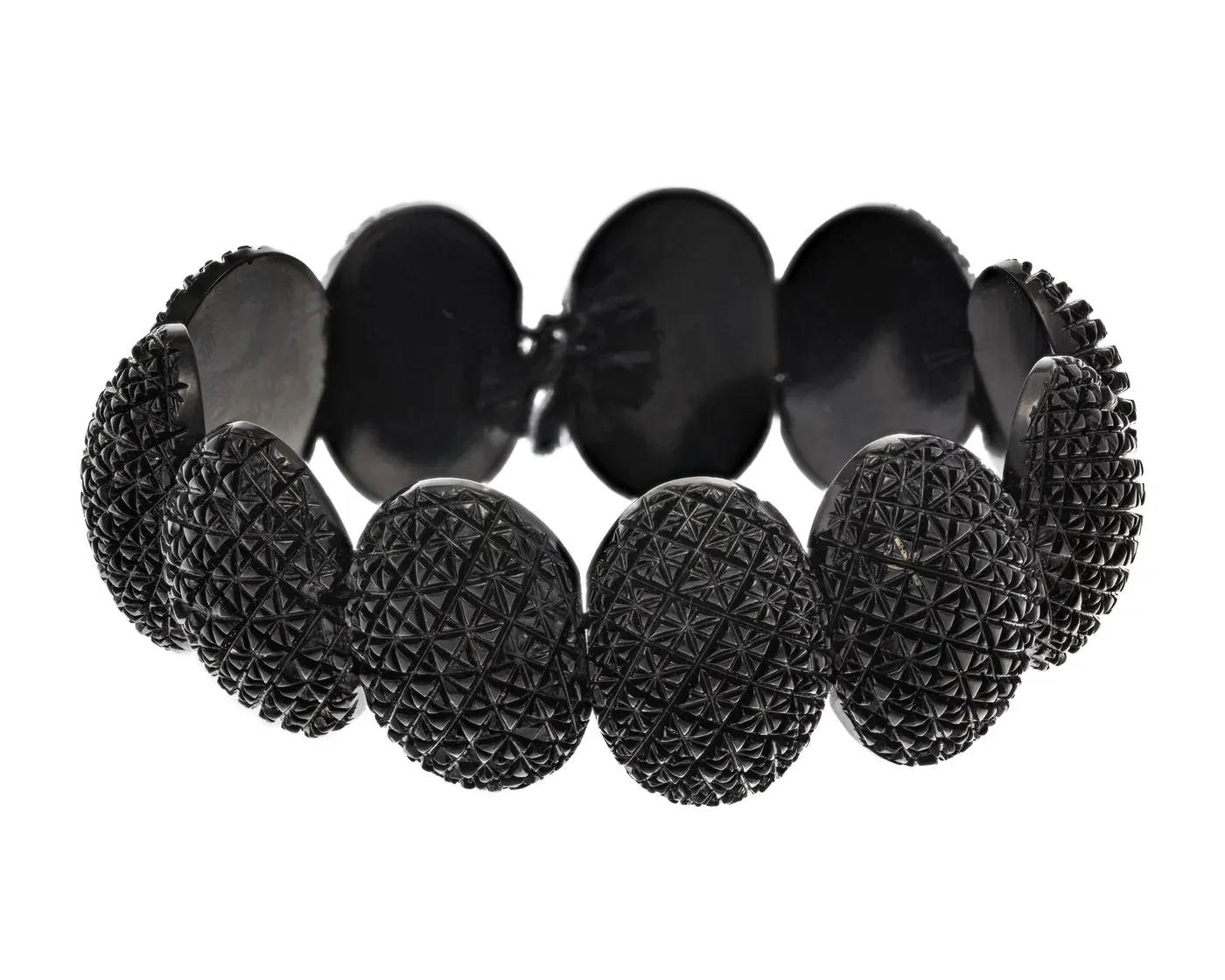
- Plate IVAn ebonite bracelet from the second half of the 1800s: light enough to wear as jewellery, black enough to serve as an inexpensive substitute for jet in Victorian mourning dress.Wikimedia Commons
- Plate VA vulcanite matchsafe from the early twentieth century: the mottled finish left by the sulfur cure became a decorative feature in its own right, on objects far removed from dentistry or electricity.Wikimedia Commons