The Smart Materials Era (2000-2015)
Self-Healing Polymers
The Materials That Mend Themselves
Two enormous repair manuals went public in 2001, though only one of them was read as such. In February, the International Human Genome Sequencing Consortium published its draft of the human genome: three billion base pairs, printed out for exhibition as more than a hundred fat volumes, each too small in type to read comfortably. Buried in that draft, alongside the genes for eye colour and enzymes and everything else, was the machinery every cell already carries to patrol its own DNA for breaks and mend them, mostly without the organism ever noticing. Biologists had not built that capability. They had only just finished reading it.
Plate I


A stranger, smaller kind of self-repair went online that January, when a handful of volunteers launched a free encyclopedia that anyone could edit. Wikipedia had no editorial board and no way to stop a page being defaced: its only defence was that any other volunteer could see the damage and undo it, usually within minutes. The finished article was never permanent. It just kept getting fixed faster than it broke.
Plate II


Neither of those was a materials science story, but both were rehearsals for one, and the coincidence runs closer than it looks. The 15 February 2001 issue of Nature that carried the human genome draft also carried, sixty-odd pages earlier, a paper called “Autonomic healing of polymer composites,” from a team at the University of Illinois at Urbana-Champaign led by Scott White, an aerospace engineer, and Nancy Sottos, a materials scientist. They had built a structural plastic that, when it cracked, did not just sit there damaged. It fixed the crack itself, with no person and no repair crew involved. The same issue of the same journal was quietly carrying both the read-out of a repair system life had run since its earliest cells and the debut of a synthetic one built to do something like the same job.
A Crack That Meets Its Own Repair Kit
White and Sottos’s material carried its fix hidden inside itself, waiting. Scattered through their epoxy were millions of tiny capsules, each one a shell of poly(urea-formaldehyde) around a droplet of liquid dicyclopentadiene, an unremarkable, cheap monomer more commonly cracked out of petroleum feedstock than prized for chemistry. Mixed into the same epoxy, in trace amounts, sat a ruthenium catalyst related to the ones Robert Grubbs’ lab had spent the 1990s developing for ring-opening metathesis. Separately, the two ingredients did nothing.
Plate III

A crack, moving through the material, tore capsules open along its path and let the dicyclopentadiene bleed into the wound. Where that liquid found the catalyst, it polymerised on the spot, into a solid that welded the two crack faces back together. That was a repair the material carried out before anyone even knew the damage had happened. It was not a full recovery: capsules near a given crack are used up the first time they rupture, and a second crack through the same spot finds nothing left to bleed. But it was a real one, and it was automatic, which nothing in structural plastics had been before.
Plate IV


Plate V

Two Ways to Hide a Repair
Every self-healing polymer since has followed one of two logics, and both amount to giving a material something it can spend when it is hurt. The first, extrinsic healing, is White and Sottos’s own approach: reservoirs of a healing agent (microcapsules, or in later work a branching network of hollow microchannels modelled loosely on blood vessels) sit dormant in the matrix until damage releases them. The reservoir gives a strong, one-time fix; a vascular network, refillable from outside, can in principle keep supplying agent to the same site again and again.
The second logic, intrinsic healing, asks nothing of a reservoir because the network itself is built to come apart and reconnect. Instead of permanent crosslinks, the polymer is held together by bonds designed to be reversible (commonly a Diels-Alder linkage, a set of hydrogen bonds, or a metal-ligand pairing) that will let go and re-form when the material is warmed, lit, or simply pressed back together. Nothing is consumed in the process, so an intrinsically healing material can, in principle, repair the same spot indefinitely. What it usually trades away is the outright mechanical performance of a densely and permanently crosslinked network, since some of that network’s bonds have to stay breakable on purpose.
What the Data Actually Says
Self-healing is a design principle bolted onto dozens of different host chemistries (epoxies, polyurethanes, elastomers, even concrete additives), so there is no single density, stiffness or strength that belongs to “a self-healing polymer” any more than there is one for “a car with airbags.” Whatever numbers matter belong to the underlying epoxy or elastomer, not to the healing chemistry layered onto it, which is why this page’s data carries no property block of its own. The one property genuinely specific to the class (how much of the original strength a repair actually recovers, and how many times it can happen at the same spot) is reported by researchers case by case rather than as a fixed material constant, because it depends on capsule size, network chemistry and how badly the material was damaged in the first place.
Where the Idea Went Next
Corrosion-prevention coatings are among the most developed applications: a self-healing layer that closes its own scratches keeps water and salt away from the metal underneath for years longer than a coating that just sits there and slowly fails. Fibre-reinforced composites for aircraft follow the same logic at a larger scale: a wing spar with an undetected internal crack is a far more serious problem than a scratched coating, and a material that can arrest that crack before it grows buys real margin. Researchers are also testing the idea in soft robotics, where a limb that can reseal a puncture keeps working instead of leaking hydraulic fluid, and in biomedical implants, which have to survive years inside a body without a maintenance visit. Much of this is still lab and pilot-scale work rather than something on a shelf: self-healing coatings for foldable phone screens, in particular, are a research direction chasing a commercial product, not yet a thing you can buy.
A Second Trick Borrowed From Biology
What White and Sottos actually proved in 2001 was narrower than “materials that heal themselves”; it was that a crack could trigger its own chemistry, with no sensor, no controller and no human in the loop. Every self-healing system since, extrinsic or intrinsic, is a variation on that same wager: hide the fix inside the material, and let the damage itself pull the trigger. It is the same bet biology made with clotting factors and DNA repair enzymes long before anyone was reading genomes or editing encyclopedias, and in the same year both of those systems were, by coincidence, being examined in public for the first time.
values with [n] cite the numbered references·estimates are flagged·“not yet available” and “N/A” are honest states, not gaps
- Abbreviation
- —
- Type
- polymer family (hub)
- CAS number
- None (heterogeneous class or not assigned)
- Resin ID code
- none assigned
- Formula
- A structural/functional class (any polymer engineered to autonomously or triggerably repair damage) rather than one chemistry; mechanisms include microcapsule-based, vascular, and intrinsic/reversible-bonding systems, each built on a different host polymer.
- Repeat unit (BigSMILES)
- A structural/functional class (any polymer engineered to autonomously or triggerably repair damage) rather than one chemistry; mechanisms include microcapsule-based, vascular, and intrinsic/reversible-bonding systems, each built on a different host polymer.
- IUPAC name
- —
- Synonyms
- —
- Also known as
- —
- Chemical family
- —
- Backbone class
- —
- Polymerization mechanism
- —
- Constitutional monomer
- None (no single constitutional monomer)
- Polymer class
- —
- Year of origin
- 2001
- Era
- The Smart Materials Era (2000-2015)
- Key figures
- Scott White · Nancy Sottos
- Events referenced
- Publication of the draft human genome sequence, International Human Genome Sequencing Consortium, Nature (15 February 2001) · Launch of Wikipedia (January 2001)
- Polymerization type
- not yet available
- Common monomers (feedstocks)
- not yet available
- Catalysts
- not yet available
Three main mechanism families: (1) microcapsule-based, in which microscopic vessels containing a healing agent (e.g. dicyclopentadiene monomer) and a catalyst (e.g. Grubbs' catalyst) embedded in a host resin (e.g. epoxy) rupture when a crack reaches them, releasing monomer that polymerizes in the crack, achieving ~67% strength recovery; (2) vascular, in which hollow channels analogous to blood vessels deliver healing agent continuously and can support repeated healing cycles; (3) intrinsic/reversible bonding, in which the polymer network itself uses reversible chemistry (commonly Diels-Alder) to break down and reform under an external stimulus (heat, light). Scott White and Nancy Sottos published the foundational microcapsule-based approach in Nature in 2001; the field's first international conference was held in 2007.
- Tacticity
- not yet available
- Crystal structure
- not yet available
- Typical crystallinity
- Not applicable
Molecular weight
- Number average (Mn)
- not yet available
- Mass average (Mw)
- not yet available
- Dispersity (Mw/Mn)
- not yet available
Mark-Houwink constants
not yet available
Structural principle varies entirely by mechanism family (embedded microcapsules vs. vascular channels vs. reversible covalent chemistry throughout the network). See industrial_process_notes.
- Density
- Not applicableDepends entirely on the host polymer matrix; not a single value for the class.
- Melt flow index
- Not applicable
- Refractive index
- Not applicable
- Transmittance
- not yet available
- Haze
- not yet available
- Gloss
- not yet available
- Water absorption
- not yet available
- Dielectric constant
- Not applicable
- Dielectric strength
- not yet available
- Electrical conductivity
- Not applicable
- Glass transition (Tg)
- Not applicable
- Melting temperature (Tm)
- Not applicable
- Crystallization (Tc)
- Not applicable
- Heat deflection (HDT)
- Not applicable
- Decomposition onset
- Not applicable
- Thermal conductivity
- Not applicable
- Tensile modulus
- Not applicable
- Yield strength
- Not applicable
- Tensile strength at break
- Not applicable
- Elongation at break
- Not applicable
- Impact strength (Izod)
- Not applicable
- Impact strength (Charpy)
- Not applicable
- Hardness
- Not applicable
- Flexural modulus
- Not applicable
- Poisson's ratio
- not yet available
- Coefficient of friction
- not yet available
- Weathering / UV
- Not applicable
- Hydrolysis resistance
- Not applicable
- Flammability (UL94)
- Not applicable
- Limiting oxygen index
- not yet available
- Solubility parameter (δ)
- not yet available
Gas permeability
not yet available
Polymer-solvent interaction parameter (χ)
not yet available
- Processing methods
- microencapsulation (extrinsic)microvascular network fabrication (extrinsic)reversible-bond network design (intrinsic)
- Drying required
- not yet determined
- Processing temperature
- Not applicable
- Shrinkage rate
- Not applicable
- Aerospacefiber-reinforced composite fuselages and T-joints
- Coatingscorrosion-prevention coatings on metals and microelectronics
- Electronicsself-healing screens · electrical conductivity restoration in damaged circuits
- Recyclable
- not yet determined
- Biodegradable
- not yet determined
- Degradation pathway
- not yet available
Extending service life via self-repair is itself an environmental/sustainability argument, independent of any single polymer's own recyclability/biodegradability.
- LD50 (oral, rat)
- not yet available
- NFPA health
- not yet available
- NFPA flammability
- not yet available
- NFPA reactivity
- not yet available
- Carcinogenic classification
- not yet available
- [1]Self-healing materialWikipediaAccessed 2026-07-14https://en.wikipedia.org/wiki/Self-healing_material[wiki-self-healing]
Illustrations
- Plate IThe human genome, printed out as a shelf of a hundred-odd books for a London exhibition: three billion letters of code that include the cell's own instructions for repairing itself.Wikimedia Commons
- Plate IIWikipedia's homepage a few weeks after its January 2001 launch: a project with no way to prevent damage, only a fast way to reverse it.Wikimedia Commons
- Plate IIIDicyclopentadiene, the ordinary petrochemical monomer that White and Sottos loaded into microcapsules as the healing agent.Wikimedia Commons
- Plate IVRobert Grubbs, whose ruthenium catalysts (developed for a different purpose, and later recognised with a share of the 2005 Nobel Prize in Chemistry) turned out to be exactly what a rupturing microcapsule needed to trigger repair.Wikimedia Commons
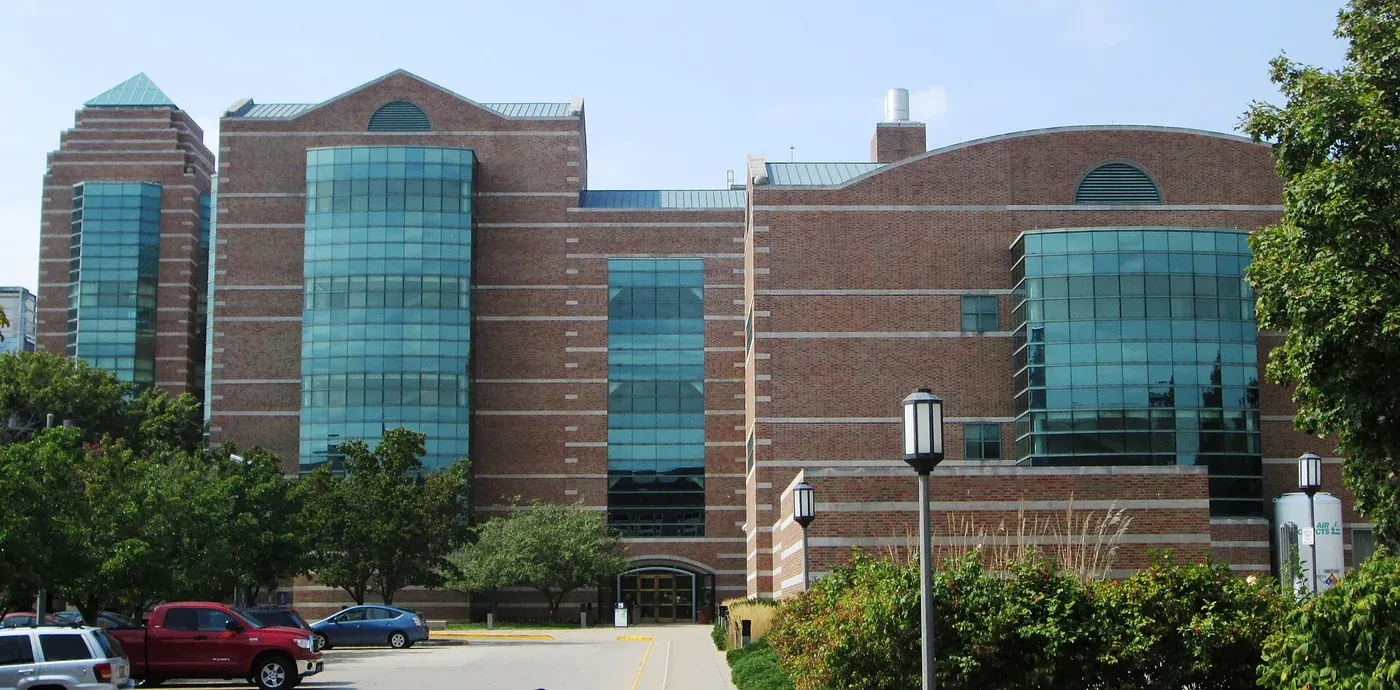
- Plate VThe Beckman Institute at the University of Illinois, home to the research group White and Sottos went on to build around the discovery.Wikimedia Commons