The Smart Materials Era (2000-2015)
Conjugated Microporous Polymers (CMPs)
Swiss Cheese
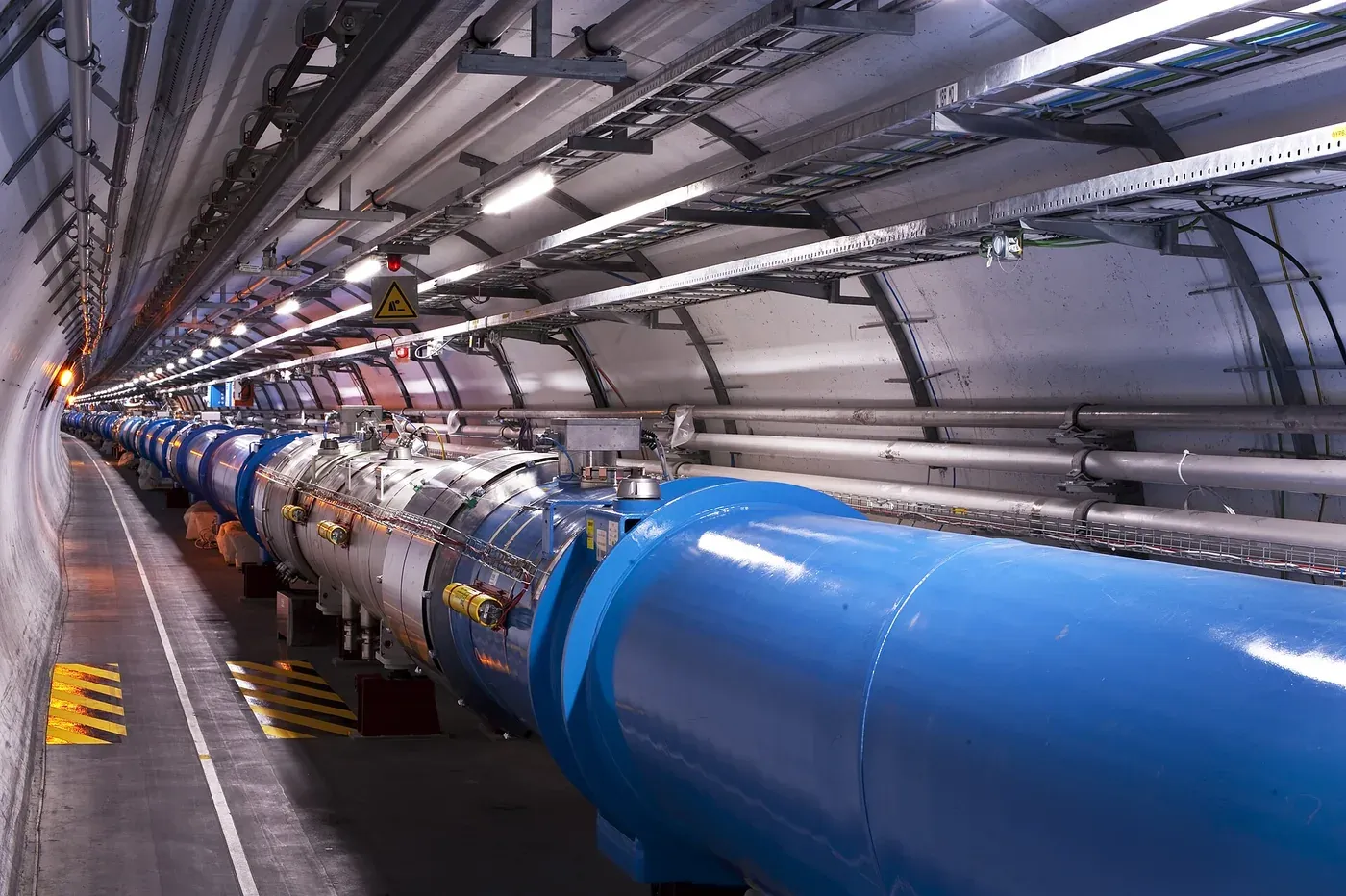
On the evening of 15 September 2008, the electronic ticker running across the front of Lehman Brothers’ Times Square building was still showing its own name in lights when the firm filed for the largest bankruptcy in American history. The world spent the following year absorbing what that meant: credit tightened, research budgets everywhere came under pressure, and the case for materials that could do more than one job with the same atoms got a great deal more persuasive. Fourteen months later, a different kind of long-delayed machine finally worked as designed: on 23 November 2009, more than a year after a faulty electrical joint had shut it down nine days into its first run, the Large Hadron Collider produced its first proton collisions. Two enormous, expensive systems (one financial, one physical) had spent 2008 and 2009 teaching the same lesson in different languages: a structure that looks sound on paper can still fail at the joint nobody was watching.
Plate I


Conjugated microporous polymers belong to 2009 for a similar reason of timing rather than of birth. Andrew Cooper’s group at the University of Liverpool had actually built the first one two years earlier, in 2007, coupling small aromatic building blocks together through rigid triple bonds to make a network that stayed permanently porous rather than collapsing in on itself. What happened in 2009 was that Cooper wrote the paper that gave the class its name and made the case, in print, that it deserved to be treated as a category of its own: “Conjugated Microporous Polymers,” published in Advanced Materials that year. This page follows the Atlas’s own convention: the year is the year of recognition, not first synthesis, and 2009 is when CMPs stopped being one interesting result and became a field.
Plate II

One Structure, Two Jobs
The idea Cooper’s paper crystallised is simple to state and unusually hard to engineer. A conjugated polymer (the same family that gave the world electrically active plastics, and a share of the 2000 Nobel Prize in Chemistry to Alan Heeger, Alan MacDiarmid and Hideki Shirakawa for showing a plastic could conduct electricity at all) gets its electrical behaviour from alternating single and double (or triple) bonds running along its backbone, which let electrons move with comparative ease from one end of a conjugated segment to the other. A microporous material, separately, gets its usefulness from permanent internal cavities too small to close up, the same principle behind activated carbon and zeolites. Before CMPs, these were two different design problems solved with two different materials: a conjugated polymer was usually a dense film, good at conducting but offering no internal surface at all; a porous material was usually an electrical insulator, good at holding gas molecules but doing nothing with the electrons in them.
Plate III


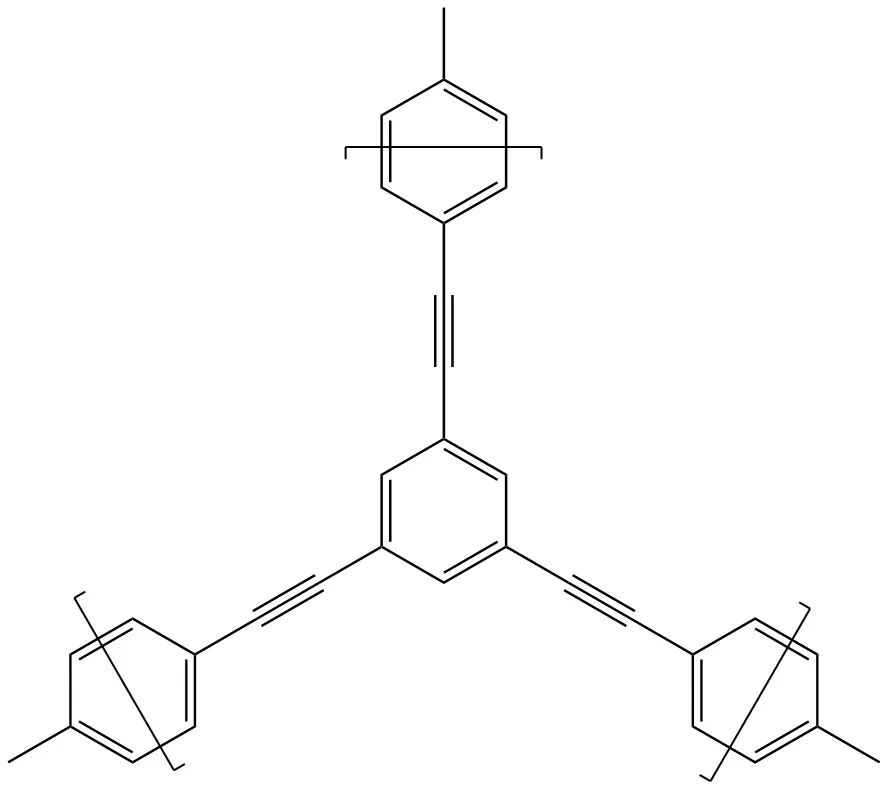
Cooper’s networks did both at once, because they are built from exactly the same rigid, conjugated aromatic units either way: link them with enough three-dimensional stiffness (usually through Sonogashira-Hagihara, Suzuki or Yamamoto cross-coupling reactions joining small aromatic monomers into a rigid three-dimensional web) and the network cannot collapse into a dense solid the way a flexible conjugated polymer normally would. The rigidity that keeps the pores open is supplied by the very same bonds that carry the electrons. There is no separate scaffold holding a conjugated wire in place; the wire is the scaffold. That single fact is why this page carries no chemical formula and no repeat unit of its own: which aromatic building blocks go in, and which coupling chemistry joins them, varies by synthesis route, and a CMP is defined by that design principle rather than by one fixed monomer.
Plate IV

What the Combination Is Good For
Because the same architecture carries both properties, CMPs turn up in applications that ask a material to sense, store, or react to something using light or electricity, rather than just hold it. In gas storage and capture, a CMP’s internal surface adsorbs carbon dioxide or hydrogen much the way any microporous material does, but a conjugated backbone can also be tuned to signal that capture optically or electrically rather than requiring a separate sensor. In photocatalysis, the same conjugated network that carries charge can absorb visible light and use the resulting excited electrons to drive a chemical reaction, including, in some CMPs, splitting water into hydrogen and oxygen, an active research goal for solar fuel production rather than a solved industrial process. In supercapacitor electrodes, a high internal surface area and intrinsic electrical conductivity are both exactly what the application wants, in a material that does not need a separate conductive additive mixed in.
Cousins in the Porous-Materials Family
CMPs did not appear in an empty field. Metal-organic frameworks, this Atlas’s other porous-network entry, solve a related problem with a different chemistry: rigid metal-ion joints and organic linker rods instead of an all-organic conjugated backbone. That difference matters more than it might look. A MOF’s coordination bonds are directional but comparatively easy to break and reform, which is part of what lets some frameworks flex or “breathe”, and also what makes many of them vulnerable to water. A CMP’s covalent, conjugated bonds are harder to break, generally more chemically and thermally robust, and carry the added property no MOF has built into its structure by default: intrinsic electronic conductivity along the backbone itself. Traditional zeolites and activated carbons remain cheaper and more established for straightforward adsorption, but neither offers a backbone with anything to say electronically. Covalent organic frameworks sit closer to CMPs (rigid, all-covalent, often highly ordered) but usually trade some of that order for the CMP’s comparatively forgiving, less crystallinity-dependent synthesis.
Where the Field Actually Stands
CMPs remain, more than fifteen years after Cooper’s paper, a research material rather than a commodity one: real, published, and useful for exactly the dual-function jobs described above, but not yet manufactured or sold at the scale of an activated carbon or a zeolite. That is worth stating plainly, because coverage of the field has sometimes described applications (quantum computing, self-healing electronics) that remain speculative directions rather than demonstrated results. The genuine achievement of 2009 was narrower and more solid than that: proof that a material’s pore and a material’s wire did not have to be two different pieces of chemistry.
values with [n] cite the numbered references·estimates are flagged·“not yet available” and “N/A” are honest states, not gaps
- Abbreviation
- CMPs
- Type
- polymer family (hub)
- CAS number
- None (heterogeneous class or not assigned)
- Resin ID code
- none assigned
- Formula
- A structural class (pi-conjugated aromatic building blocks linked into a permanently microporous 3-D network) rather than one chemistry. Building blocks and linking chemistry vary by synthesis route (Suzuki, Sonogashira, Yamamoto, Schiff base, cyclotrimerization), so no single repeat unit represents the class.
- Repeat unit (BigSMILES)
- A structural class (pi-conjugated aromatic building blocks linked into a permanently microporous 3-D network) rather than one chemistry. Building blocks and linking chemistry vary by synthesis route (Suzuki, Sonogashira, Yamamoto, Schiff base, cyclotrimerization), so no single repeat unit represents the class.
- IUPAC name
- —
- Synonyms
- —
- Also known as
- —
- Chemical family
- porous-polymer-networkconducting-polymer
- Backbone class
- carbon-chain
- Polymerization mechanism
- —
- Constitutional monomer
- None (no single constitutional monomer)
- Polymer class
- thermoset
- Year of origin
- 2009
- Era
- The Smart Materials Era (2000-2015)
- Key figures
- Andrew Cooper
- Events referenced
- Lehman Brothers files for bankruptcy (15 September 2008) · The Large Hadron Collider produces its first proton collisions after over a year of repairs (23 November 2009) · Andrew Cooper publishes "Conjugated Microporous Polymers" in Advanced Materials, naming and establishing the field (2009)
- Polymerization type
- not yet available
- Common monomers (feedstocks)
- not yet available
- Catalysts
- palladium (Suzuki, Sonogashira); nickel (Yamamoto)
Andrew Cooper published foundational CMP work in the mid-2000s. Five primary synthesis routes: Suzuki coupling (palladium-catalyzed aryl-aryl bonding), Sonogashira coupling (alkyne cross-coupling), Yamamoto coupling (nickel-mediated C-C bond formation), Schiff base condensation (metal-free, amine-aldehyde), and cyano cyclotrimerization (ionothermal synthesis).
- Tacticity
- not yet available
- Crystal structure
- Rigid aromatic building blocks (often alkyne-containing) linked through pi-conjugated pathways into a 3-D network with permanent, tunable microporosity. Surface areas typically 500–1000 m²/g, with related conjugated porous materials exceeding 5500 m²/g.
- Typical crystallinity
- Not applicable
Molecular weight
- Number average (Mn)
- not yet available
- Mass average (Mw)
- not yet available
- Dispersity (Mw/Mn)
- not yet available
Mark-Houwink constants
not yet available
Extended pi-conjugation (unlike a typical porous polymer network) enables light absorption/energy transfer, giving CMPs optoelectronic function beyond pure gas adsorption.
- Density
- Not applicableHighly porous, low apparent density by design; varies by monomer/synthesis route, not a single value for the class.
- Melt flow index
- Not applicable
- Refractive index
- Not applicable
- Transmittance
- not yet available
- Haze
- not yet available
- Gloss
- not yet available
- Water absorption
- not yet available
- Dielectric constant
- Not applicable
- Dielectric strength
- not yet available
- Electrical conductivity
- not yet availableThe pi-conjugated backbone suggests some conductivity, but no specific value sourced.
- Glass transition (Tg)
- Not applicable
- Melting temperature (Tm)
- Not applicable
- Crystallization (Tc)
- Not applicable
- Heat deflection (HDT)
- Not applicable
- Decomposition onset
- not yet available
- Thermal conductivity
- Not applicable
- Tensile modulus
- Not applicable
- Yield strength
- Not applicable
- Tensile strength at break
- Not applicable
- Elongation at break
- Not applicable
- Impact strength (Izod)
- Not applicable
- Impact strength (Charpy)
- Not applicable
- Hardness
- Not applicable
- Flexural modulus
- Not applicable
- Poisson's ratio
- not yet available
- Coefficient of friction
- not yet available
- Weathering / UV
- not yet available
- Hydrolysis resistance
- not yet available
- Flammability (UL94)
- Not applicable
- Limiting oxygen index
- not yet available
- Solubility parameter (δ)
- not yet available
Gas permeability
not yet available
Polymer-solvent interaction parameter (χ)
not yet available
- Processing methods
- Suzuki couplingSonogashira couplingYamamoto couplingSchiff base condensationionothermal cyclotrimerization
- Drying required
- not yet determined
- Processing temperature
- Not applicable
- Shrinkage rate
- Not applicable
- Gas storage & captureCO2 capture · hydrogen storage
- Photocatalysislight-driven chemical transformations
- Sensingmolecular detection via porous structure
- Energylight harvesting · supercapacitor electrodes
- Recyclable
- No
- Biodegradable
- No
- Degradation pathway
- not yet available
- LD50 (oral, rat)
- not yet available
- NFPA health
- not yet available
- NFPA flammability
- not yet available
- NFPA reactivity
- not yet available
- Carcinogenic classification
- not yet available
- [1]Conjugated microporous polymerWikipediaAccessed 2026-07-14https://en.wikipedia.org/wiki/Conjugated_microporous_polymer[wiki-cmp]
Illustrations
- Plate ILehman Brothers' Times Square building on the night of 15 September 2008, still lit with its own name as the firm entered bankruptcy, the opening of a downturn that sharpened the case for materials able to do two jobs with one structure.Wikimedia Commons
- Plate IIA section of the Large Hadron Collider tunnel, photographed in October 2009, weeks before it produced its first proton collisions after more than a year of repairs.Wikimedia Commons
- Plate IIIThe Victoria Building at the University of Liverpool, where Andrew Cooper's group built and named the first conjugated microporous polymers.Wikimedia Commons
- Plate IVA representative CMP monomer: a rigid, star-shaped aromatic unit whose triple-bonded arms will not fold, so a network built from it holds its pores open rather than collapsing into a dense film.Wikimedia Commons